


Fact: Smaller is Better and Safer
By María H. Berrocal, MD
The year 1972 was an eventful one for vitreoretinal surgery: Conor O’Malley described the 3-port all-20-gauge pars plana vitrectomy with the Ocutome (Berkley Bioengineering), a de facto recognition that many small incisions were better than 1 or 2 larger ones.1 Use of 20-gauge vitrectomy was the norm for the subsequent 30 year period, until the next novel evolution: the introduction of 3-port transconjunctival vitrectomy by Eugene de Juan.2 Since then, the technology for vitrectomy has improved with a vast armamentarium of vitrectomy instruments in 23-, 25-, and now 27-gauge (Figure 1).
At present, worldwide, 23- and 25-gauge vitrectomy platforms are the most often utilized.

Figure 1. The availability of a wide range of small gauge instruments lets surgeons choose the most appropriate instrument for each case.
ADVANTAGES OF SMALLER SYSTEMS
The advantages of smaller gauge vitrectomy are many. The current trocar-cannula entry systems reduce sclerotomy complications common in the past—namely, retinal and vitreous incarceration, neovascularization at sclerotomy sites, and iatrogenic breaks and dialyses at the vitreous base. Smaller vitrectomy probes with smaller openings and higher cutting speeds reduce traction on the retina and allow more controlled and efficient removal of tissue. Shaving of the vitreous base and fibrovascular membranes on the surface of the retina is possible with reduced traction, and the result is increased precision and safety.
The increased surgical efficiency with these smaller instruments reduces surgical times, particular in cases involving complex pathologies. The advantages of expediency include reduced phototoxicity, bleeding, and hypothermia time and optimized control of intraocular pressure. This is particularly important in diabetic traction detachments to minimize bleeding, as well as in eyes with glaucomatous damage to reduce pressure and fluidic damage to the optic nerve (Video 1).
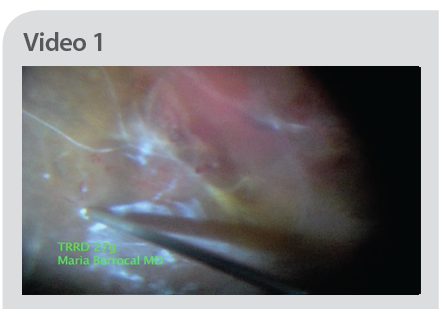

Figure 2. Smaller gauge instruments have given rise to new techniques, such as using the probe for blunt dissection between the retina and abnormal tissue.

Figure 3. Smaller probe size combined with higher cutting rates affords surgeons greater control during maneuvers while minimzing potential for complications during delicate operations such as peeling the hyaloid and epiretinal (A) and internal limiting membranes (B).
The most salient feature of smaller gauge probes with high cutting rates and increased flow is that they can be used as multifunctional instruments. With 20-gauge vitrectomy, it is not possible to shave tissue near the retina because the large probe opening can cause iatrogenic breaks to the underlying retina. The large opening of the 20-gauge probe increases the mobility of the underlying retina so that it can be inadvertently aspirated into the probe opening. In order to remove fibrovascular tissue safely with 20-gauge instruments, particularly in diabetic eyes, it is imperative to utilize bimanual techniques and/or illuminated instruments, tissue manipulators, chandeliers, etc.
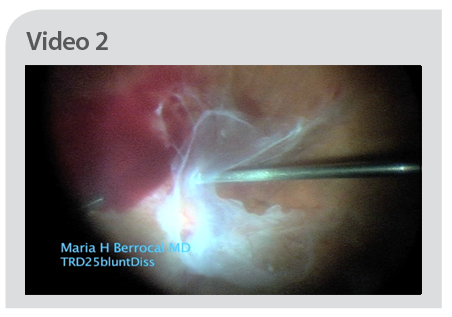
With 25- and 27-gauge vitrectomy probes, on the other hand, it is possible to blunt-dissect under membranes with the small vitrectomy probe and shave tissue on the surface of the retina with exquisite finesse and control (Video 2).
NEW TECHNIQUES
Segmentation, delamination, and en-block dissection techniques were commonly used in the era of 20-gauge vitrectomy. New techniques of tissue removal are possible with 25- and 27-gauge vitrectomy probes. These include lift-and-shave, blunt dissection, and back-shaving techniques.

Figure 4. Greater precision with smaller instruments means it is possible to aspirate subretinal fluid with the probe through existing breaks or retinotomies.
It is possible to lift membranes with the probe by applying aspiration and subsequently shave the lifted tissue using high-speed cut rates. Blunt dissection can be performed with the probe in tissue planes created between the retina and abnormal tissue (Figure 2). This is similar to the viscodissection technique, except that the separation of tissues is performed with the vitrectomy probe only. Once blunt dissection is performed, back-shaving can be performed to safely remove tissue with the probe opening facing anteriorly.
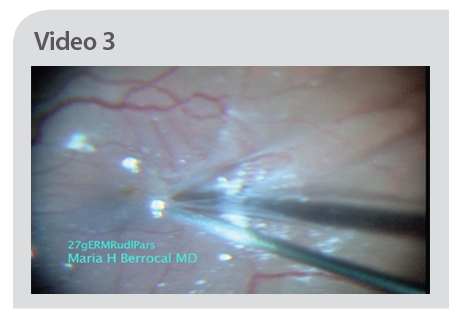
The precision and efficiency of the smaller probes is such that it is possible to remove the posterior hyaloid and peel epiretinal and internal limiting membranes with the vitrectomy probe alone (Figure 3 and Video 3). It is also possible to aspirate subretinal fluid with the vitrectomy probe through existing breaks or retinotomies (Figure 4).
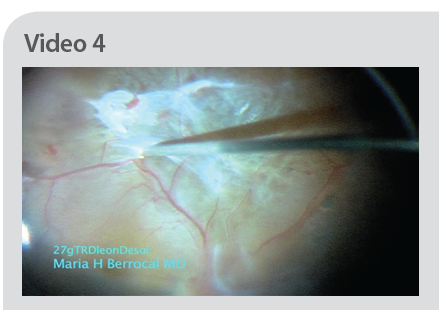
The diverse use of the vitrectomy probe for multiple maneuvers has distinct advantages. It minimizes the need for ancillary instruments and the associated exchange of instruments during the case (Video 4). This allows improved efficiency, reduced sclerotomy complications, and optimized intraocular pressure control during surgery with concomitant reduction of intraoperative bleeding.
CONCLUSION
Three-port 20-gauge vitrectomy was an important innovation, but the technology is 43 years old. Surgeons must evolve constantly, taking full advantage of technological advances and not being beholden to technology that is almost a half century old. Progress and innovation can only occur if we embrace change, start thinking outside the box, and resist complacency. It is always possible to improve on techniques, and we should constantly think of ways to optimize surgical outcomes. Small-gauge vitrectomy has been the most important vitreoretinal evolution since 1972, and, yes, smaller is much better. n
María H. Berrocal, MD, is an assistant professor at the University of Puerto Rico School of Medicine in San Juan. She is a member of the Retina Today Editorial Board. She is a consultant to Alcon. Dr. Berrocal may be reached at +1-787-725-9315 or mariahberrocal@hotmail.com.
1. O’Malley P, Heintz RM. Vitrectomy via the pars plana—a new instrument system. Trans Pac Coast Otoophthalmol Soc Ann Meet. 1972;53:121-137.
2. Fujii GY, De Juan E Jr, Humayun MS, et al. A new 25-gauge instrument system for transconjunctival sutureless vitrectomy surgery. Ophthalmology. 2002;109(10):1807-1812; discussion 1813. Erratum in: Ophthalmology. 2003;110(1):9.
Fiction: A Modified 20-Gauge Technique Delivers Similar Results
By David F. Williams, MD, MBA
The development of sub–20-gauge vitrectomy instrumentation and techniques has been heralded as a major advance in the armamentarium of the vitreoretinal surgeon. Proponents of small-gauge vitrectomy cite many advantages relative to traditional 20-gauge surgery. These purported advantages will be listed and analyzed sequentially below.
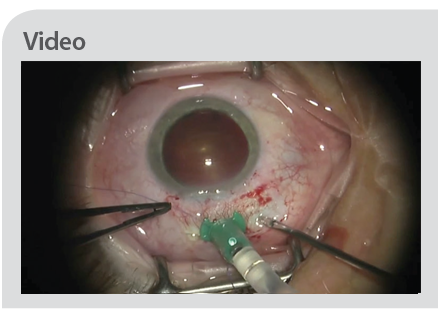
This analysis is presented in light of the author’s modified 20-gauge vitrectomy technique. Modified 20-gauge vitrectomy is characterized by a single superior limbal conjunctival incision from the 10:30- to 1:30-o’clock meridians with a 3 mm radial relaxing incision at the 10:30-o’clock meridian. Sclerotomies are created at the 11-, 12-, and 1-o’clock meridians, and the infusion cannula is placed through the 12-o’clock sclerotomy and secured with a preplaced figure-of-8 suture. At the completion of the vitrectomy, the working sclerotomies at 11- and 1-o’clock are closed with a single suture pass, and the 12-o’clock sclerotomy is closed with the preplaced suture simultaneous with removal of the infusion cannula. The conjunctiva is closed with a single buried suture at the site of the 10:30-o’clock conjunctival relaxing incision. This technique places all of the surgical incisions inconspicuously under the upper eyelid, minimizes conjunctival incisions and visible postoperative ocular redness, and eliminates postoperative suture irritation.
ANALYSIS OF SMALL-GAUGE SURGERY
With the above modified 20-gauge technique as a precursor, following is an analysis of the pros and cons of small-gauge surgery.
Less Conjunctival Disruption and Scarring
In most cases, small-gauge surgery does not require large conjunctival incisions and associated sutures. This benefit is offset in cases in which a wound leak requires opening of the conjunctiva for placement of a scleral suture to prevent postoperative hypotony. Scleral depression for peripheral retina examination may also cause conjunctival tears, particularly in older patients with delicate conjunctiva, thus requiring conjunctival sutures. Relatively minor modifications in 20-gauge technique, as described above and seen in the accompanying surgical Video, offset this purported advantage.
Faster Healing of the External Eye
When small-gauge surgery can be accomplished without the need for a conjunctival suture, healing of the external ocular tissues can indeed occur faster than with modified 20-gauge surgery. However, the occurrence of subconjunctival hemorrhages and the occasional need for conjunctival sutures in small-gauge surgery offset this minor advantage.
Less Postoperative Discomfort
Postvitrectomy discomfort is due almost exclusively to the presence of exposed conjunctival sutures. A single buried conjunctival suture in my modified 20-gauge technique eliminates this small-gauge advantage.
Faster Visual Recovery
This purported advantage of small-gauge surgery is due exclusively to the absence of scleral suture-induced postoperative astigmatism. However, the majority of vitrectomies are done in individuals with macular pathology, for which macular function and associated visual recovery occur slowly over several months. In these cases, the transient presence of suture-induced astigmatism is immaterial with regard to visual recovery.
Fewer Intraoperative Complications
There is no consistent evidence for the occurrence of fewer intraoperative complications in small-gauge versus 20-gauge vitrectomy.1 The smaller port of a small-gauge vitrectomy instrument, in association with high-speed cutting, may theoretically allow shaving of the vitreous close to mobile retina with less potential for retinal incarceration in the port and iatrogenic retinal breaks. However, retinal breaks can still easily occur with small-gauge vitrectomy, and a careful surgeon can minimize iatrogenic breaks irrespective of instrumentation. Small-gauge surgery does have an advantage in selected eyes with diabetic vitrectomy, in which the small port close to the instrument tip can allow shaving of fibrotic and proliferative membranes from the retinal surface with fewer instrument exchanges compared with 20-gauge surgery. However, small-gauge surgery may be associated with higher risks of certain complications such as intra- and postoperative choroidal detachment and unwanted anterior chamber air infusion during fluid-air exchange.2 Careful attention to cannula placement and management and further improvements in instrumentation may mitigate these increased risks of small-gauge surgery.
Fewer Postoperative Complications
In early experience with small-gauge vitrectomy, there were reports of an increased risk of postoperative complications such as hypotony and endophthalmitis.3 Improvements in surgical technique and instrumentation appear to have mitigated much of this increased risk.1,4 However, the weight of evidence suggests that, at best, the incidence of postoperative complications is similar for small-gauge and 20-gauge surgery.5,6 The incidence of postoperative retinal tears and detachments appears to be similar between gauge techniques.7
Faster Surgery
The claim of faster surgery is predicated on the lack of need for scleral and conjunctival sutures, and, in certain cases, the need for fewer instrument exchanges in small-gauge surgery. The need to carefully assess cannula wounds and the occasional need for conjunctival and scleral sutures partially offsets this possible advantage. The modified 20-gauge technique completely offsets any potential speed advantage for small-gauge surgery. (In 2013 my procedure time average was 24 minutes in 270 consecutive 20-gauge vitrectomies for indications exclusive of retinal detachment. The average time for 12 other retinal surgeons was 36 minutes and 29 minutes for 23- and 25-gauge surgery, respectively [personal data].) Surgical speed and efficiency are highly surgeon-dependent, and it is possible that surgeon variation in these factors outweighs gauge variation.
COST
The cost of surgery often receives less attention than other metrics. However, 20-gauge vitrectomy is less expensive than small-gauge surgery. In our open-access, non–surgeon-owned, specialty surgical hospital ophthalmology facility, the cost of a 20-gauge surgery pack is $225 compared with $344 and $379 for 23- and 25-gauge packs. Packs for 23- and 25-gauge surgery are 53% and 68% more expensive than 20-gauge packs, respectively.
CONCLUSION
Traditional 20-gauge vitrectomy has a long track record of effectiveness and safety in the treatment of a wide variety of vitreoretinal pathologies. Although small-gauge vitrectomy may offer marginal advantages in selected cases, surgeon experience and minor adjustments to 20-gauge technique can offset most of its purported advantages. n
David F. Williams, MD, MBA, is in private practice at VitreoRetinal Surgery PA in the Twin Cities of Minnesota, and is an assistant clinical professor of ophthalmology at the University of Minnesota.
1. Recchia FM, Scott IU, Brown GC, et al. Small-gauge pars plana vitrectomy: a report by the American Academy of Ophthalmology. Ophthalmology. 2010;117(9): 1851-1857.
2. Tarantola RM, Folk JC, Shah SS, et al. Intraoperative choroidal detachment during 23-gauge vitrectomy. Retina. 2011;10:1-9.
3. Kunimoto DY, Kaiser RS. Incidence of endophthalmitis after 20- and 25-gauge vitrectomy. Ophthalmology. 2007;114(12):2133-2137.
4. Bahrani HM, Fazelat AA, Thomas M, et al. Endophthalmitis in the era of small gauge transconjunctival sutureless vitrectomy—meta analysis and review of literature. Semin Ophthalmol. 2010;25(5-6):275-282.
5. Shah RE, Gupta O. The microsurgical safety task force: guidelines for minimizing endophthalmitis with vitrectomy surgery. Curr Opin Ophthalmol. 2012;23(3):189-194.
6. Wu L, Berrocal MH, Arévalo JF .Endophthalmitis after pars plana vitrectomy: results of the Pan American Collaborative Retina Study Group. Retina. 2011;31(4): 673-678.
7. Rizzo S, Belting C, Genovesi-Ebert F, di Bartolo E. Incidence of retinal detachment after small-incision, sutureless pars plana vitrectomy compared with conventional 20-gauge vitrectomy in macular hole and epiretinal membrane surgery. Retina. 2010; 30(7):1065-1071.


_1784132761.jpg?auto=compress,format&w=75)





