


Pars plana vitrectomy (PPV) is an established and successful treatment for the complications of proliferative diabetic retinopathy (PDR).1,2 It is required within 1 year in up to 10% of patients presenting with PDR.3 The most common indication for surgery is nonclearing vitreous hemorrhage.1,2 Unfortunately, postoperative vitreous cavity hemorrhage is a significant complication occurring in approximately 20% to 30% of cases.4-10
Some advances in surgical techniques and instrumentation such as en bloc dissection, delamination, segmentation, bimanual surgical techniques, and viscodissection have led to improved results in the treatment of severe PDR.11-14 We have previously described a new surgical dissection technique, en bloc perfluorodissection (EBPD), which facilitates removal of epiretinal membranes and the posterior hyaloid by the injection of perfluorocarbon liquid (PCL) between the retina and the posterior hyaloid to separate the epiretinal tissues from the subjacent retina.15,16 In addition, identification and removal of all posterior vitreoretinal traction is very important. Vitreoschisis is also known to occur in patients with PDR. Identification of this feature and dissection in the true vitreoretinal plane are important to avoid recurrent traction and postoperative bleeding from neovascular tissue.17
The use of preoperative anti-VEGF therapy has been proposed as an intervention to reduce the incidence of nonclearing vitreous hemorrhage.18 It has been reported that use of intravitreal bevacizumab (Avastin, Genentech) in patients with vitreous hemorrhage and PDR resulted in marked regression of neovascularization and rapid resolution of vitreous hemorrhage.19 Chen and Park20 and Avery et al21 have suggested that preoperative intravitreal bevacizumab reduces the risk of intraoperative bleeding, facilitating the removal of fibrovascular membranes, particularly when preoperative panretinal photocoagulation (PRP) cannot be performed.
The objective of this article is to describe the technique and demonstrate the applicability of using EBPD and preoperative intravitreal bevacizumab injection for membrane dissection in diabetic tractional retinal detachment (TRD) with small-gauge vitreoretinal surgery.
SURGICAL TECHNIQUE
A 0.18-mL aliquot of commercially available bevacizumab was prepared for each patient and placed in a tuberculin syringe using aseptic techniques. Four days before vitrectomy, after the eye had been prepared in a standard fashion using 5% povidone-iodine, an eyelid speculum was used to stabilize the eyelids, and 1.25-mg (0.05-mL) injection of the bevacizumab was performed 3.5 to 4.0 mm posterior to the limbus and through the inferotemporal pars plana with a 30-gauge needle under topical or subconjunctival lidocaine anesthesia. After the injection, retinal artery perfusion was checked with indirect ophthalmoscopy (no anterior chamber paracenthesis was necessary), and patients were instructed to administer topical antibiotics for 4 days preoperatively.

Figure 1. Artist's representation of the surgical technique. A hole is made in the midperipheral posterior hyaloid (A). PCL is injected to mechanically and slowly separate the posterior hyaloid from the retina. A dual bore cannula (for 23- and 25-gauge cases) attached to a 5-cc syringe filled with PCL is used to separate membranes from the underlying retina (B, C). Once all the epiretinal tissues have been separated from the retina, vitrectomy is completed (D). Endolaser is applied under PCL (E). Air-fluid and air-gas (C3F8) exchanges are performed to finish the case (F).
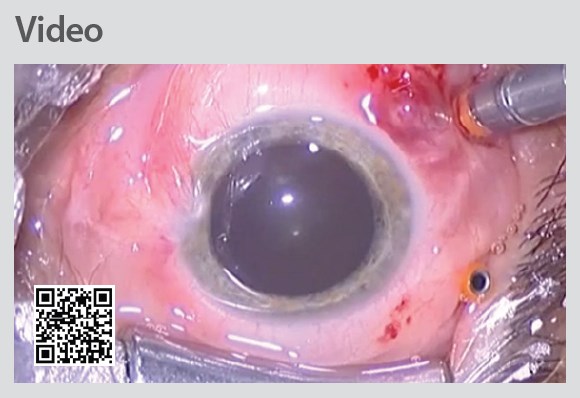
On the day of surgery, a 23- or 25-gauge three-port pars plana transconjunctival sutureless vitrectomy (TSV) was performed to clear any vitreous hemorrhage (video; eyetube.net/?v=ufemu). The microcannulas were inserted through the conjunctiva by means of a trocar. Insertion was accomplished by first displacing the conjunctiva laterally by approximately 2.0 mm. An initially oblique and then perpendicular tunnel was made parallel to the limbus through the conjunctiva and sclera, thus creating a self-sealing wound. After insertion of the first microcannula, the intraocular portion of the infusion cannula was inserted into the external opening of the microcannula. The other two microcannulas were inserted in the superotemporal and superonasal quadrants.
A hole was then made in the midperipheral posterior hyaloid (Figure 1A) to inject the PCL (perfluorooctane [C8F18]) and to slowly separate the posterior hyaloid from the retina (Figures 1B and 1C). We used a 23- or 25-gauge dual bore cannula attached to a 5-cc syringe filled with PCL to separate the posterior hyaloid and membranes as a single unit from the underlying retina. Once all the epiretinal tissues were separated from the retina, vitrectomy was completed (Figure 1D), endolaser was applied (Figure 1E), and air-fluid and air-gas (perfluoropropane [C3F8]) exchanges were performed to finish the procedure (Figure 1F).
At the completion of surgery, the microcannulas were removed by grasping the collars and withdrawing, followed by assessment of intraocular pressure (IOP) and inspection of wound sites for leaks. An illuminated cannula was utilized (25-gauge Awh chandelier, Synergetics; or 25-gauge chandelier, Alcon) for bimanual surgery combined with a noncontact wide-angle viewing system (BIOM, Oculus).
SURGICAL RESULTS
Patients were prospectively enrolled from January 2006 to January 2010 at Clinica Oftalmologica Centro Caracas in Caracas, Venezuela. Inclusion criteria included TRD in severe PDR and macular involvement or impending macular involvement with or without vitreous hemorrhage. We performed EBPD in 114 eyes (consecutive patients) during vitrectomy for TRD in severe PDR. Mean age was 42 years (23-84 years). Surgical time was a mean 50 minutes (range, 40-75 minutes). We have followed our group of patients for a mean 24 months (range, 12-32 months).
Each patient underwent BCVA measurement using ETDRS criteria. Patients were examined on day 1 postoperatively, again at 1, 3, and 7 weeks, and every 3 months thereafter. Each visit consisted of a complete eye examination, including BCVA assessment, slit-lamp examination, IOP measurement, and stereoscopic biomicroscopy of the retina. Patients were included in this consecutive series only if there was a minimum of 12 months of follow-up. An increase or decrease in BCVA was considered to have occurred if there was a change of 2 or more ETDRS lines. Main outcome measures included changes in BCVA and retinal reattachment.
EBPD was performed using a mean volume of 4 mL (3-8 mL) of PCL. None of our patients have developed ocular hypertension or undue inflammation. Anatomic success was achieved in 100% of eyes, and an improvement of 2 or more ETDRS lines occurred in 70.1% (80/114). In 28 eyes (24.5%), BCVA remained stable, and in 6 eyes (5.2%) BCVA decreased by 2 ETDRS lines or more. Final BCVA was 20/50 or better in 25% of eyes, between 20/60 and 20/400 in 47% of eyes, and worse than 20/400 in 28% of eyes. Complications included phthisis bulbi in 1 eye (0.9%), iatrogenic retinal breaks in 8 eyes (7%), vitreous hemorrhage requiring another procedure in 8 eyes (7%), subretinal PCL in 2 eyes (1.7%), and cataract in 30 eyes (26.3%).
COMMENTS
Performing EBPD with preoperative use of intravitreal bevacizumab may result in anatomic and functional improvement in eyes with TRD in PDR in selected cases. Benefits of this technique over other approaches include retinal stability at the time of vitreous removal, less blood in the vitreous cavity, rapid retinal reattachment, better visualization of vitreous and intraocular structures, blood confinement, and easier dissection of epiretinal membranes.
In our study, we have not seen any difficulties with the technique. However, in one case, PCL was injected within a vitreous schisis, which became apparent after a short amount of instillation (1 mL); PCL was aspirated, and a new hole in the posterior hyaloid was made at another location, making sure that the proper plane was found between the posterior hyaloid and the retina. No complications resulted from this event. In addition, there were 2 eyes (1.7%) with subretinal PCL that required peripheral retinotomy, aspiration with an extrusion cannula, and injection of additional PCL. In our study, the prevalence of postoperative vitreous hemorrhage was lower than has been reported in other studies (7% vs 20% to 30%),4-10 which can be explained by the use of intravitreal bevacizumab 4 days preoperatively.
Experienced surgeons can manage complex retinal detachments in patients with TRD using viscodissection, conventional pick-and-scissors dissection, or small-gauge techniques with the vitreous cutter. Surgeons should approach cases selectively according to their level of experience. An ideal case for EBPD might be one in which there is a TRD with no tears, limited posterior vitreous detachment, and relatively loose attachment of the posterior hyaloid face to the retina. We use a combination of several techniques in our cases, including EBPD and the use of picks and forceps with bimanual surgery. Currently, the use of minimally invasive vitreoretinal surgery (23- and 25-gauge TSV) and preoperative intravitreal bevacizumab in diabetic TRD have improved our surgical time and results.
What does the future hold? Minimally invasive vitreoretinal surgery with small-gauge TSV techniques may gain greater utilization due to the increasing incidence of diabetes and its complications. In the coming years, we will likely use techniques that are less invasive in vitreoretinal surgery (we have already started that experience with 27-gauge surgery). We will have available other anti-VEGF agents capable of blocking all types of VEGF isoforms before and after surgery, thereby reducing intraoperative bleeding and postoperative inflammation. It is likely that the use of preoperative agents that promote the detachment of the posterior hyaloid and facilitate the removal of membranes will become routine. They will facilitate surgery in complex cases, such as in PDR. Use of optical coherence tomography in the OR will facilitate intraoperative tissue differentiation, thus helping surgeons achieve better functional results. The advent of new lasers will permit faster retinal photocoagulation and will minimize collateral damage to the retina.
EBPD and preoperative intravitreal bevacizumab injection for vitrectomy in eyes with TRD in PDR is a useful technique because it appears to facilitate retinal stability at the time of vitreous removal, better visualization of vitreous and intraocular structures, rapid retinal reattachment, less blood in the vitreous cavity, subretinal fluid resolution, blood confinement, and easier dissection of epiretinal membranes. n
This article was created with the assistance of the Arevalo-Coutinho Foundation for Research in Ophthalmology in Caracas, Venezuela.
J. Fernando Arevalo, MD, FACS, is a professor of ophthalmology in the retina division at the Wilmer Eye Institute, Johns Hopkins University School of Medicine, in Baltimore, Maryland, and chief of the vitreoretinal division at King Khaled Eye Specialist Hospital, Riyadh, Kingdom of Saudi Arabia. He is a member of the Retina Today editorial board. He has no proprietary or financial interest in any products or techniques described in this article. Dr. Arevalo may be reached at arevalojf@jhmi.edu.
1. Ho T, Smiddy WE, Flynn HW Jr. Vitrectomy in the management of diabetic eye disease. Surv Ophthalmol. 1992;37(3):190-202.
2. McLeod D. Microsurgical management of neovascularisation secondary to posterior segment ischaemia. Eye (Lond). 1991;5(Pt 2):252-259.
3. Kaiser RS, Maguire MG, Grunwald JE, et al. One-year outcomes of panretinal photocoagulation in proliferative diabetic retinopathy. Am J Ophthalmol. 2000;129(2):178-185.
4. Benson WE, Brown GC, Tasman W, McNamara JA. Complications of vitrectomy for non-clearing vitreous hemorrhage in diabetic patients. Ophthalmic Surg. 1988;19(12):862-864.
5. Blankenship GW. Management of vitreous cavity hemorrhage following pars plana vitrectomy for diabetic retinopathy. Ophthalmology. 1986;93(1):39-44.
6. Liggett PE, Lean JS, Barlow WE, Ryan SJ. Intraoperative argon endophotocoagulation for recurrent vitreous hemorrhage after vitrectomy for diabetic retinopathy. Am J Ophthalmol. 1987;103(2):146-149.
7. Novak MA, Rice TA, Michels RG, Auer C. Vitreous hemorrhage after vitrectomy for diabetic retinopathy. Ophthalmology. 1984;91(12):1485-1459.
8. Tolentino FI, Cajita VN, Gancayco T, Skates S. Vitreous hemorrhage after closed vitrectomy for proliferative diabetic retinopathy. Ophthalmology. 1989;96(10):1495-1500.
9. Virata SR, Kylstra JA. Postoperative complications following vitrectomy for proliferative diabetic retinopathy with sew-on and noncontact wide-angle viewing lenses. Ophthalmic Surg Lasers. 2001;32(3):193-197.
10. Yorston D, Wickham L, Benson S, et al. Predictive clinical features and outcomes of vitrectomy for proliferative diabetic retinopathy. Br J Ophthalmol. 2008;92(3):365-368 (2008).
11. Abrams GW, Williams GA. “En bloc” excision of diabetic membranes. Am J Ophthalmol. 1987;103(3 Pt 1):302-308.
12. Stenkula S, Tornquist R. Healon: a guide to its use in ophthalmic surgery. In: Miller D, Stegman R. Use of healon in vitrectomy and difficult retinal detachments. New York: Wiley; 1983:207-221.
13. Grigorian RA, Castellarin A, Bhagat N, et al. Use of viscodissection and silicone oil in vitrectomy for severe diabetic retinopathy. Semin Ophthalmol. 2003;18(3):121-126.
14. Chang S, Zimmerman NJ, Iwamoto T, et al. Experimental vitreous replacement with perfluorotributylamine. Am J Ophthalmol. 1987;103(1):29-37.
15. Arevalo JF. En bloc perfluorodissection for tractional retinal detachment in proliferative diabetic retinopathy. Ophthalmology. 2008;115(6):e21-25.
16. Arevalo JF. En bloc perfluorodissection in vitreoretinal surgery: a new surgical technique. Retina. 2008;28(4):653-656.
17. Schwatz SD, Alexander R, Hiscott P, Gregor ZJ. Recognition of vitreoschisis in proliferative diabetic retinopathy. A useful landmark in vitrectomy for diabetic traction retinal detachment. Ophthalmology. 1996:103(2):323-328.
18. Yeoh J, Williams C, Allen P, et al. Avastin as an adjunct to vitrectomy in the management of severe proliferative diabetic retinopathy: a prospective case series. Clin Experiment Ophthalmol. 2008;36(5):449-454.
19. Spaide RF, Fisher YL. Intravitreal bevacizumab (Avastin) treatment of proliferative diabetic retinopathy complicated by vitreous hemorrhage. Retina. 2006;26(3):275-278.
20. Chen E, Park CH. Use of intravitreal bevacizumab as a preoperative adjunct for tractional retinal detachment repair in severe proliferative diabetic retinopathy. Retina. 2006;26(6):699-700.
21. Avery RL, Pearlman J, Pieramici DJ, et al. Intravitreal bevacizumab (Avastin) in the treatment of proliferative diabetic retinopathy. Ophthalmology. 2006;113(10):1695.e1-15.


_1784132761.jpg?auto=compress,format&w=75)




