


An implanted retinal microchip capable of restoring vision to the blind was considered a medical impossibility a short two decades ago. Today, however, such a device is now in regular use in clinics across Europe, where it received the CE Mark in July 2013—the first subretinal implant of its kind to be approved in the European Union.
To date, the Alpha IMS subretinal implant from Germany-based Retina Implant AG has been implanted in 38 patients with late-stage retinitis pigmentosa (RP), and most patients have demonstrated a marked improvement in visual capabilities.
For the estimated 1.5 million people worldwide living with RP, this innovation offers a safe, new option for restoring some visual function, along with independence and quality of life.
HOW RETINAL IMPLANTS WORK
There have been two approaches to designing and developing retinal implants: subretinal and epiretinal. The primary differences between the existing technologies are in where the implants are placed, the number of electrodes they have, and the mechanics of operating the devices.
The Alpha IMS is designed for subretinal implantation. A sophisticated 3 x 3 mm microchip is surgically implanted via a transchoroidal approach under the foveal region (Figure 1). Clinical research has indicated that this is the best position to ensure retinotopically correct excitation.
The Alpha IMS subretinal implant is composed of 1500 electrodes (Figure 2). This is substantially more (and the electrodes are substantially smaller) than the 60 electrodes in the epiretinal implant that is also commercially available in the European Union, the Argus II (Second Sight). The greater number of electrodes may allow light and dark images to appear more vibrant, thereby enhancing visual resolution.

Figure 1. The Alpha IMS is the most advanced and studied subretinal implant. It consists of a 3 x 3 mm microelectronic chip containing 1500 electrodes, and it is implanted directly under the retina to generate artificial vision.

Figure 2. The subretinal implant microchip from Retina Implant AG has 1500 electrodes, more than any other implantable microchip.
The subretinal implant supports the natural movement of the eye and does not require a camera or other external equipment to capture and interpret images, which may enable eye-hand coordination to be restored more easily (Figure 3). The only other element required is an energy source, and the Alpha IMS receives power inductively via transmitter coils placed subdermally (Figure 4).
This is in contrast to the epiretinal chip of the Argus II, which is placed directly on the retina, requires a camera and transmitter mounted on the patient's eyeglasses, an implanted receiver, electrodes secured to the retina with a tack to keep the device in place, and a battery pack worn on the patient's belt to power the entire system. The camera captures images that are processed by the transmitter and receiver, then turned into electrical pulses which the retina sees as patterns of light and dark spots.
With the Alpha IMS subretinal implant, patients initially see lines and gray scale. Scientists are finding, however, that over time the human brain can retrain itself to interpret these lines and grayscale into meaningful images—an outcome affirmed by the results of the Alpha IMS clinical trials, which were published in peer-reviewed literature (described below).
The ultimate goal of both approaches is the same: to generate artificial vision in patients blinded by RP—similar to the way in which cochlear implants restore hearing in deaf people—enabling once-blind patients to independently perform their normal daily activities.
CLINICAL EXPERIENCE
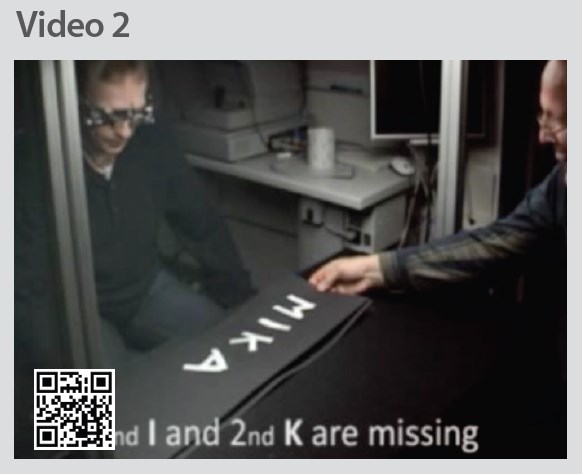
In 2005, 11 patients with RP were implanted with the Alpha IMS as part of a clinical trial. Notably, some patients implanted with the Alpha IMS were able to see objects and shapes so clearly that they could read letters and words as well as visualize objects that were previously unknown to them (Video 1 [eyetube.net/?v=otogi] and Video 2 [eyetube.net/?v=arunu]).1

The positive pilot study results encouraged a second clinical trial which began in the spring of 2010 in Tuebingen, Germany. It subsequently expanded into a multicenter trial, with 25 additional patients receiving the subretinal implant at study sites in Germany, the United Kingdom, China and Hungary.
The multicenter trial was led by Professor Eberhart Zrenner, founding director of the Institute of Ophthalmic Research, University of Tuebingen, Germany, in partnership with professor Robert MacLaren, professor of ophthalmology at the University of Oxford and a consultant retinal surgeon at the Oxford Eye Hospital; Mr. Tim Jackson, PhD, consultant retinal surgeon at King's College Hospital, London; Dr. Caroline Chee, senior consultant and head of Surgical Retina, National University Hospital, and clinical associate professor, National University of Singapore; professor David Wong, chair professor in ophthalmology and director of the Eye Institute, University of Hong Kong; Professor Katarina Stingl, Centre for Ophthalmology, University of Tuebingen, Germany; Dr. Janos Nemeth, director of the department of ophthalmology at Semmelweis University in Budapest, Hungary; and me.

Figure 3. Retina Implant AG's microchip is implanted below the retina, specifically in the foveal region (A). Research has shown the macular region is the ideal location because this is the location of light-sensitive photoreceptor cells, which are responsible for producing clear images in normal-sighted individuals (B).
The multicenter trial demonstrated that implanted patients were able to recognize faces and read street and door signs during a 3- to 9-month observation period both within and outside the laboratory setting. Functional vision was restored in five of nine German patients implanted with the subretinal microchip as part of the first module of this second clinical trial. In addition, visual acuity for two of the nine patients surpassed the visual resolution of patients from the company's first clinical trial.2
The successful outcomes of these clinical trials led to receipt of the CE Mark for the Alpha IMS subretinal microchip in July 2013. Patient outcomes at 1 year after implantation of the Alpha IMS microchip were presented at last year's American Academy of Ophthalmology Annual Meeting, affirming the safety and efficacy of the device.3 Key findings included improved ability to detect light and grating acuity in 85% and 54% of patients, respectively.
In addition, one-quarter of patients achieved the ability to read newspaper headlines. Another quarter of patients could see light, doors, and windows when they entered a room. A quarter of patients could detect whether a light was on or off and locate the light source. One quarter of patients did not respond to implantation. The rate of patient satisfaction with the subretinal implant has been consistently high, and there have been no reported serious adverse events or issues with the device. Easily managed dry eye was the most frequently reported safety issue.

Figure 4. The external power supply for the 3 x 3 mm microchip is self-contained and is connected to the implant by a cable placed under the patient's skin. Patients can adjust the level of stimulation.
Another important finding has been that the Alpha IMS microchip can be explanted and reimplanted, giving patients the option to change the device as the technology—and the benefit it confers—continues to be refined. Notably, patients in whom the device was explanted as part of the pilot study protocol were so satisfied with its performance that they unequivocally wanted to be reimplanted.
A TRAJECTORY OF INNOVATION
Although it is never fast enough for most scientists or the patients we seek to help, the speed at which the Alpha IMS subretinal implant has moved from concept to clinical reality has been impressive.
The most challenging step was the first, from research to human implantation. The clinical trials yielded clear proof of principle: The technology worked. Now, 10 years since the launch of the first trial, the device is commercialized, and investigators can gain even more information as it is implanted in more patients.
The focus now is on improving the technical performance of the Alpha IMS, including its longevity. As with the development of cardiac pacemakers decades ago, this is the beginning of a careful, iterative process. But we remain confident that subretinal implant technology holds tremendous promise for the global population of patients with RP. And as we are able to implant a growing number of patients, our knowledge and capabilities will grow as well.
Perhaps the most frequently asked question, from both physicians and patients, is whether there is potential for retinal implants to treat other conditions that cause blindness. The Alpha IMS subretinal implant investigator team believes that, in the future, patients with conditions such as age-related macular degeneration may be candidates for retinal implants.
It is important to note, however, that patients with conditions such as diabetes and glaucoma are not appropriate candidates. The subretinal implant requires a healthy infrastructure to the brain so that it can stimulate the retina, and these conditions preclude that ability.
THE MOMENTUM CONTINUES
Currently, the institutions involved in the Alpha IMS clinical trials that led to the CE Mark in Germany as well as the trial sites in the United Kingdom and Asia, are able to offer Alpha IMS implantation. Other leading clinics will begin to offer the treatment in 2015 and beyond.
Subretinal microchip implantation is a safe procedure; however, it is still complex, so comprehensive training in the technique and technology and in appropriate patient selection is essential before other sites come online.
Reimbursement also is an issue being addressed in the European Union now that the device is commercially available. In Germany, the Alpha IMS microchip was granted NUB (New Diagnostic and Therapeutic Methods) status and is now reimbursed by the country's statutory health insurance system, which insures 90% of its citizens. The value of the implant and surgery is estimated to be approximately €100 000 (US$113 000).
One of the most exciting developments on the horizon is the possibility of a US clinical trial of the Alpha IMS. Wills Eye Institute in Philadelphia, Pennsylvania, has signed on to serve as the primary investigation site, led by Jay L. Federman, MD. Retina Implant AG and Wills Eye Institute are currently in discussions with the US Food and Drug Administration to obtain approval to launch this study.
With the Alpha IMS subretinal implant's base of successful patient outcomes and proven effective technology, a future is in sight in which patients with RP and, potentially, other degenerative conditions, can regain their vision. n
Helmut Sachs, MD, is senior consultant and head of the department of ophthalmology, Clinic Dresden-Friedrichstadt, Germany. He is a shareholder of and a paid consultant to Retina Implant AG. Dr. Sachs may be reached at sachs-he@khdf.de.
1. Zrenner E, Bartz-Schmidt KU, Benav H, et al. Subretinal electronic chips allow blind patients to read letters and combine them to words. Proc Biol Sci. 2011 22;278(1711):1489-1497
2. Stingl K, Bartz-Schmidt KU, Besch D, et al. Artificial vision with wirelessly powered subretinal electronic implant alpha-IMS. Proc Biol Sci. 2013 20;280(1757):20130077
3. Sachs H, Bartz-Schmidt K-U, Chee CKL, et al. Subretinal implantation and functional results of the Alpha IMS chip to restore vision in 26 blind retinitis pigmentosa patients. Paper presented at: American Academy of Ophthalmology Annual Meeting; October 21, 2014; Chicago.


_1784132761.jpg?auto=compress,format&w=75)





