


At a Glance
• Heads-up surgery with 3-D digital imaging promotes career longevity and comfort.
• Retina surgeons benefit from an increased depth of field with 3-D digital viewing.
Photography in the field of ophthalmology has gone from conventional optical imaging on film to modern digital imaging. The availability of digital manipulation opens up vast opportunities for image enhancement, brightness adjustment, image sharing, graphics, and other functions commonly used in today’s practices.
Now, new developments in ophthalmic imaging and surgical microscopes are on the cusp of revolutionizing visualization of the surgical field. This article makes the case for the adoption of 3-D visualization technologies in retina surgery.
3-D DIGITAL IMAGING THROUGH THE YEARS
Live 3-D digital imaging has been used during corneal and cataract procedures since the introduction of the TrueVision 3D Surgical system (TrueVision Systems) in 2008.1 Its application in the retina world has only recently begun to take place, and it is slowly being adopted by retina surgeons.
Originally introduced in ophthalmology and neurosurgery as a rear projection system using dual stacked projectors and a retractable screen, the design progressed to a high-definition (HD) video monitor viewed with passive polarization 3-D glasses. Over time, the image quality, computational processing speed, and 3-D monitor resolution have improved significantly, leading to the current ultra-HD 4K 3-D monitor configuration now in use. This technology converts an optical microscope into a powerful digital imaging system. In 2014, the Leica M844 and Leica M822 ophthalmology microscopes (Leica Microsystems) were made globally available with TrueVision 3D visualization, recording, and editing technology. Combined with TrueVision’s fifth-generation ICM5 camera platform, the 4K display provides a new level of image quality and utility.
The improvement in image resolution and color quality has been a key factor in the adoption of 3-D digital imaging for heads-up live retina surgery.2 Additionally, 3-D camera improvements have provided a greater sense of depth, and faster computer processing has reduced latency between image capture and video output so that retinal procedures can now be routinely performed in a heads-up fashion working off the 3-D screen.3 In an experimental study, Eckardt and Paulo found the method to be well suited for heads-up surgery in vitreoretinal procedures.4 In their survey of 20 surgeons and a retrospective analysis of more than 400 vitrectomy cases, the authors noted that nearly 92% of the volunteers preferred the ergonomics of the heads-up technique. They deemed the heads-up technique and the traditional method to be similar as far as speed, ease of microscopic manipulations, and image sharpness. However, they noted that surgeons made significantly fewer mistakes with the heads-up method.4
The next opportunity for enhancing 3-D retinal surgery lies in digital image manipulation capabilities, which may allow surgeons to significantly reduce microscope illumination levels. In early use, the TrueVision 3D ICM5 camera’s high dynamic range function has allowed retinal surgeons to reduce microscope illumination by 80% or more while still producing excellent image quality for live surgery. This could be key in reducing retinal phototoxicity risk for patients.
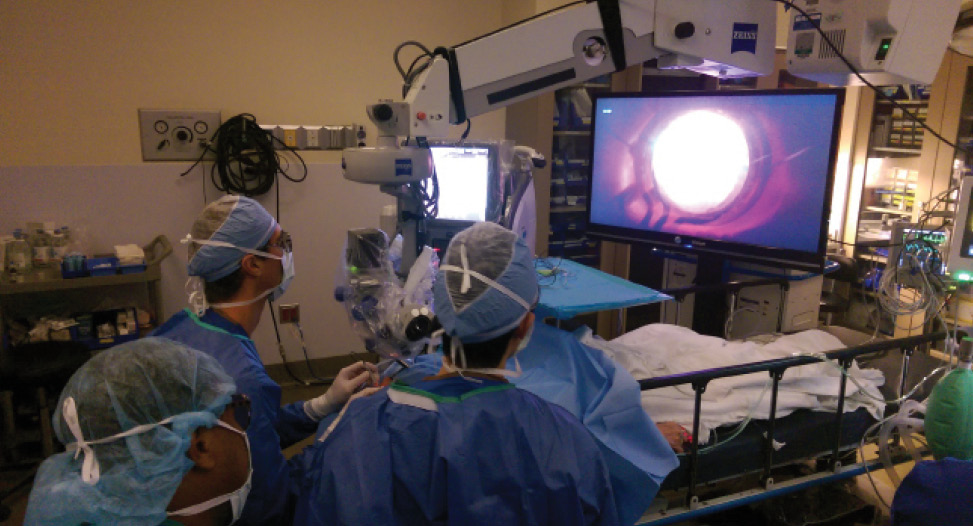
Figure. One of the benefits of 3-D visualization for retina surgery is that everyone sees what the surgeon sees, as shown in this photo taken in the OR with Allen C. Ho, MD; S.K. Steven Houston III, MD; and Allen Chiang, MD.
ADVANTAGES OF 3-D DIGITAL IMAGING
The most obvious benefits of 3-D digital imaging are ergonomic, visual, and educational in nature.
Ergonomic
Retina surgeons have physically demanding jobs, and they are all too familiar with repetitive work, fine motor tasks, and awkward body positioning. Over time, these factors lead to the development of musculoskeletal disorders (MSDs) and associated symptoms such as neck and back pain.5,6 If not addressed, MSDs can have severe consequences, leading to disability or other health problems. Three-dimensional digital imaging is one way of reducing surgeon fatigue and neck strain by allowing greater freedom of movement during surgery via the heads-up viewing rather than requiring the surgeon to be tied to the microscope oculars. Additionally, split-screen viewing functions can allow surgeons to view preoperative images or other video imaging inputs on one screen, which can also provide ergonomic advantages for surgeons during extended cases because they do not have printed diagnostic images to read or additional monitors in the OR to position.
Visual
Three-dimensional digital imaging offers increased depth of field as well as a greater panoramic view, providing a big screen immersive experience that allows everyone in the OR to see exactly what the surgeon is seeing (Figure). Anecdotally, in our experience, the viewing system was sufficient for the gamut of cases that a vitreoretinal surgeon routinely encounters. Rhegmatogenous and tractional retinal detachments, macular puckers, macular holes, diabetic vitreous hemorrhages, and submacular hemorrhages with tissue plasminogen activator injections and pneumatic displacements were all performed without difficulty using the TrueVision platform. While image latency during intraocular procedures was not troublesome, the faster gross movements of extraocular procedures such as suturing can make some image latency more noticeable to the operating surgeon. Technical improvements are continually being made to the camera, data cable, processing speed, and 3-D monitor to further address this issue.
Educational
>The large 3-D view allows the full surgical team to see the same field of view as the operating surgeon with full stereo depth, which is particularly helpful in teaching environments such as residency or fellowship training programs, as well as meeting courses. Communication with medical device clinical training personnel can also be enhanced, for example when a new instrument is being used during surgery.7
THE FUTURE OF 3-D RETINA SURGERY
Digital imaging in retina surgery is poised to enter a new phase of development with the integration of imaging and data into the live surgical field of view using 3-D visualization. In anterior segment surgery, for example, software applications now allow the system to incorporate preoperative images and graphical guidance overlays onto the live 3-D view for incision alignment and intraocular lens positioning.8 Integration of other technologies, such as intraoperative optical coherence tomography, into the flexible high-resolution viewing format should allow greater efficiency during complex cases. n

David W. Friess, OD, is president of Optimus Clinical Partners LLC in Glen Mills, Pa., and consultant/director of clinical affairs at TrueVision 3D Surgical. He is a clinical consultant to TrueVision, Alcon/WaveLight, and i-Optics. Dr. Friess may be reached at dwfriess@gmail.com.

Allen C. Ho, MD, is the director of retina research at Wills Eye Hospital, a surgeon at Mid Atlantic Retina, and a professor of ophthalmology at Thomas Jefferson University, all located in Philadelphia, Pa. He has no relevant disclosures related to the content of this article. Dr. Ho is the chief medical editor of Retina Today.
He may be reached at achomd@gmail.com.

Jason Hsu, MD, is a faculty member of the Retina Service of Wills Eye Hospital, a managing partner of Mid Atlantic Retina, and an assistant professor of ophthalmology at Thomas Jefferson University, all located in Philadelphia, Pa. He has no relevant disclosures. Dr. Hsu may be reached at jhsu@midatlanticretina.com.

Ehsan Rahimy, MD, is with Palo Alto Medical Foundation in Palo Alto, Calif. He has no relevant disclosures related to the content of this article. Dr. Rahimy may be reached at erahimy@gmail.com.
1. Weinstock RJ. Heads up cataract surgery using high-definition 3-D microscopic viewing system. Paper presented at: American Society of Cataract and Refractive Surgery Annual Meeting; April 3-8, 2009; San Francisco, CA.
2. Eckardt C. Live surgery presentation in 3-D. Frankfurt Retina Meeting; March 15, 2014; Mainz, Germany.
3. Eckardt C. Heads up: no microscope vitreoretinal surgery. Paper presented at: American Academy of Ophthalmology Retina Subspecialty Day; October 18, 2014; Chicago, IL.
4. Eckardt C, Paulo EB. Heads-up surgery for vitreoretinal procedures: an experimental and clinical study [published online ahead of print July 21, 2015]. Retina.
5. Marx JL, Wertz FD, Dhimitri KC. Work-related musculoskeletal disorders in ophthalmologists. Techniques in Ophthalmology. 2005;3(1):54-61.
6. Mehta S, Hubbard GB 3rd. Avoiding neck strain in vitreoretinal surgery: an ergonomic approach to indirect ophthalmoscopy and laser photocoagulation. Retina. 2013;33(2):439-441.
7. Packer M. TrueVision 3D HD for teaching and training. Cataract & Refractive Surgery Today. March 2011;11(3):41-42.
8. Weinstock RJ. Prospective study of 3D image guidance templates during small-incision cataract surgery. Paper presented at: American Society of Cataract and Refractive Surgery Annual Meeting; March 25-29, 2011; San Diego, CA.


_1784132761.jpg?auto=compress,format&w=75)





