


At a Glance
• A new en face gliosis report based on OCT scans can help surgeons avoid excessive retinal contact during surgical manipulation.
• Based on a macular OCT cube scan, a new en face visualization mode provides an overview of gaps between the ERM and the retina, which gives surgeons preoperative information for intraoperative surgical guidance.
• Retinal surgeons might one day navigate areas of choroidal neovascularization using intraoperatively projected points to develop intraoperative subretinal treatments.
Video: The GapMap
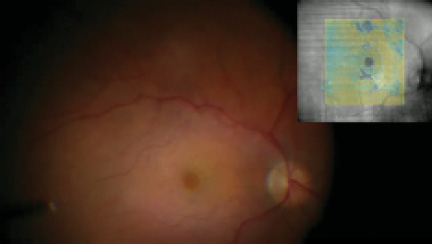
Preoperative imaging is rarely used to guide epiretinal membrane (ERM) peeling during surgery.1 Most surgeons rely on their experience to identify where to start peeling and to decide when to use intraoperative dyes to color the membrane. A new en face ERM report based on optical coherence tomography (OCT) scans can help surgeons detect elevated areas of ERM preoperatively to avoid excessive retinal contact during surgical manipulation.
In the future, such en face gliosis reports may be incorporated into computer-assisted surgery systems installed in the operating microscope’s oculars, serving as a source of intraoperative guidance for surgeons. Initial studies suggest that surgical guidance during membranectomy can facilitate the removal of ERM and reduce trauma.2
GAPMAP: A NEW REPORT
ERMs differ in their level of infiltration within the retina. There are areas of high infiltration with a high degree of retinal contact and areas of elevated ERM where the membrane maintains varying distances from the retina. These areas can be identified in an office setting using the line segmentation mode of an OCT device.
A new en face visualization mode that my colleagues and I developed in cooperation with Carl Zeiss Meditec is based on a macular OCT cube and provides a comprehensive overview of gaps between the ERM and the retina. This allows surgeons to use preoperative OCT information for intraoperative surgical guidance.
A macular cube of 512 by 128 scans is acquired using the Cirrus HD-OCT (4000 or 5000) system (Carl Zeiss Meditec). In the advanced visualization mode, the internal limiting membrane (ILM) slab is selected, and the software automatically identifies the surface of the ERM-retinal complex as a line (Figure 1). A second, lower white line is then fitted interactively to the lowest point on the vitreoretinal interface. The distance between the two lines depends on the elevation of the ERM from the retina; in our own investigation of 80 eyes, the mean distance was 45 ±8 µm.3
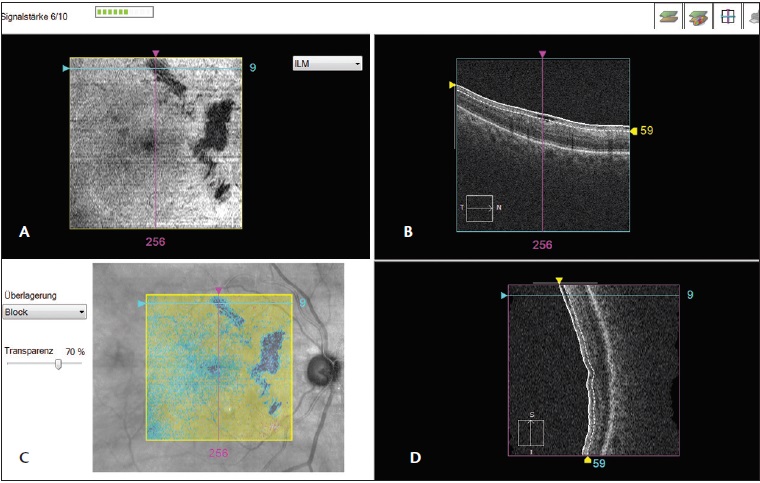
Figure 1. ERM and GapMap analysis in OCT advanced visualization mode (Cirrus HD-OCT 4000; Carl Zeiss Meditec). Step 1: selection of ILM slab (A); step 2: adaptation of lower line to reach the retinal level (B); step 3: projection of GapMap on LSO scans by selecting the slab/block option (C); step 4: set transparency level at approximately 70% (C). The vertical OCT line is also shown (D).
The ILM slab is projected en face onto a line-scanning ophthalmoscope (LSO) fundus image of the macula (70% transparency) to simultaneously identify the elevated ERM and retina (Figure 2). The black pixilated area in this image represents the gaps between the ERM and the retina; this en face representation is called the GapMap (Video).
OCT-BASED GUIDANCE DURING MEMBRANECTOMY
A paper printout of the GapMap can be used during surgery to choose an elevated portion of ERM to grasp for initial membrane peeling (Figure 3). A suitable target point is identified using the GapMap and then visually mapped onto the fundus image in the microscope.
My colleagues and I have previously shown that a large area of no retinal contact (elevated gliosis) was highly correlated with a low number of initial forceps grasps; this is likely indicative of a reduction in retinal trauma.3 Furthermore, better visual outcomes correlated with larger areas of elevated ERM in eyes in our study.
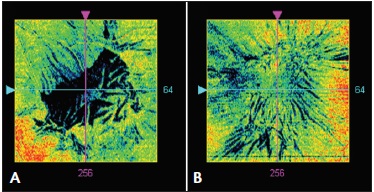
Figure 2. Elevated membrane areas (GapMap, black pixels) projected on LSO scan of the macula. GapMap with high elevation level (A); GapMap with high retinal infiltration and low elevation levels (B).
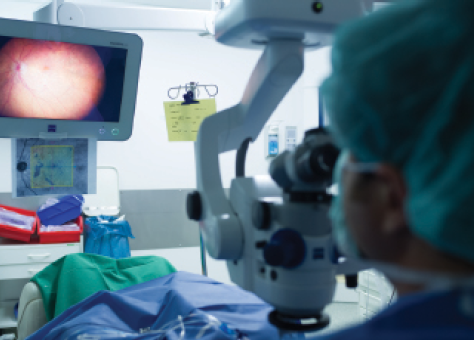
Figure 3. A GapMap printout is placed in the surgeon’s direct line of sight.
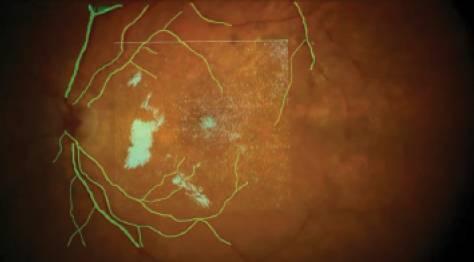
Figure 4. Segmented vessels overlaid with the GapMap, which is registered to microscopic fundus images during surgery. The retina is tracked to compensate for eye movements and to keep the overlay aligned. The GapMap is inverted for better visualization (ie, light-colored pixels correspond to black pixels in Figure 2).
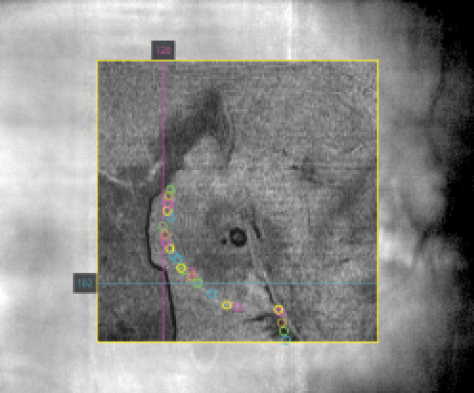
Figure 5. Projection of vitreomacular traction in an LSO image of the macula. Marked points represent adaptation borders of the vitreous to the macula. Black pixels represent elevated membrane borders (GapMap).
COMPUTER-ASSISTED RETINA SURGERY
At present, the optical field of surgical microscopes during vitrectomy generally encompasses only native fundus images. Novel visualization techniques can augment the microscopic view with additional information while matching the underlying retina during surgically induced eye movement.4
Prototypes that can inject preoperative information—including information provided by the GapMap—into the oculars of surgical microscopes have already been created (Figure 4). These developments will ultimately allow more precise location of elevated portions of ERM and thus improve surgical workflows.
Another interesting potential application of computer-assisted retinal surgery is the identification and intraoperative projection of landmarks. For instance, vitreomacular traction borders could be identified and marked on OCT scans using points and lines, respectively (Figure 5). Projecting these landmarks onto intraoperative retinal scans could help the surgeon to detach the vitreous from the macula in a more controlled, less traumatic manner by cutting around the vitreous and peeling it carefully using the aspiration mode of the cutter or forceps.
Additionally, ischemic extramacular area borders or retinal microaneuryms could be marked based on fluorescein angiography or OCT angiography with navigation points. These intraoperatively projected points could guide surgeons during endolaser coagulation treatment. Furthermore, one might in the future navigate areas of choroidal neovascularization in this manner to develop intraoperative subretinal treatments.
CONCLUSION
There is a new field of possibilities for navigation and intraoperative projection in retinal surgery. Novel visualization techniques will spark new intraoperative applications of preoperatively acquired scans that will eventually lead to computer-assisted retinal interventions similar to recently introduced computer-assisted cataract surgery suites.4
The elevated membrane report described here—the GapMap—will increase the safety of membrane peeling procedures because it can help the surgeon identify membrane tension structures and infiltration borders. This will allow the user to initiate safe peeling and to regrasp elevated parts of the membranes in an individual strategy. Furthermore, the GapMap will be helpful in the education of young retina surgeons.
Intraoperative retinal navigation promises to be another step forward in control and standardization of vitrectomy procedures. n

Fanis Pavlidis, MD, is director of the vitreoretinal department of Augencentrum Köln in Cologne, Germany. He states that he has no financial interest relevant to the software and products discussed in this article. Dr. Pavlidis may be reached at pavlidis@email.de.
1. Hirano Y, Yasukawa T, Ogura Y. Optical coherence tomography guided peeling of macular epiretinal membrane. Clin Ophthalmol. 2011;5:27-29.
2. Kreatsoulas J. Enhancing retinal surgery with augmented reality technology. Retina Today. 2011;6(3):18.
3. Pavlidis M, Georgalas I, Koerber N. Determination of a new parameter elevated epiretinal membrane by en face OCT as a prognostic factor for pars plana vitrectomy and safer epiretinal membrane peeling [published online ahead of print October 4, 2015]. J Ophthalmol. doi: 10.1155/2015/838646.
4. Lesieur G. Callisto Eye: seamless integration with other products. Cataract and Refractive Surgery Today Europe. September 2014;9(8):50-52.


_1784132761.jpg?auto=compress,format&w=75)





