


In February, the Diabetic Retinopathy Clinical Research Network released data detailing the results of the 2-year endpoint of the group’s Protocol T trial, the first head-to-head-to-head evaluation of three anti-VEGF agents for treatment of diabetic macular edema (DME).1 The 1-year study data, released in February 2015, showed that 2.0 mg aflibercept (Eylea, Regeneron), 1.25 mg bevacizumab (Avastin, Genentech), and 0.3 mg ranibizumab (Lucentis, Genentech) provided impressive visual improvements for DME patients, and that, among patients with starting baseline visual acuity of 20/50 or worse as measured on an ETDRS chart, those treated with aflibercept showed significantly better visual acuity gains at 1 year compared with patients treated with bevacizumab or ranibizumab.2
Watch it Now
Protocol T Year 2 Data: A Perspective From Outside the United States

But year 1 was only half of the story. Would the superiority of aflibercept in worse-seeing eyes be seen after 2 years of data, or would one of the other anti-VEGF agents be as effective? Would any of the treatment arms see a decline in visual acuity gains? Would safety signals crop up at the 2-year time point?
Retina Today and EyewireTV sat down with a number of retina specialists to hear their interpretation of the 2-year Protocol T data.
STUDY DESIGN AND DATA OUTLINE
In Protocol T, researchers randomly assigned 660 patients with DME to treatment with 2.0 mg aflibercept, 1.25 mg compounded bevacizumab, or 0.3 mg ranibizumab. Participants received laser therapy if DME persisted beyond 6 months. During year 1 of the study, patient visits occurred every 4 weeks, and the interval was extended up to every 4 months thereafter if visual acuity and macular thickness were stable.
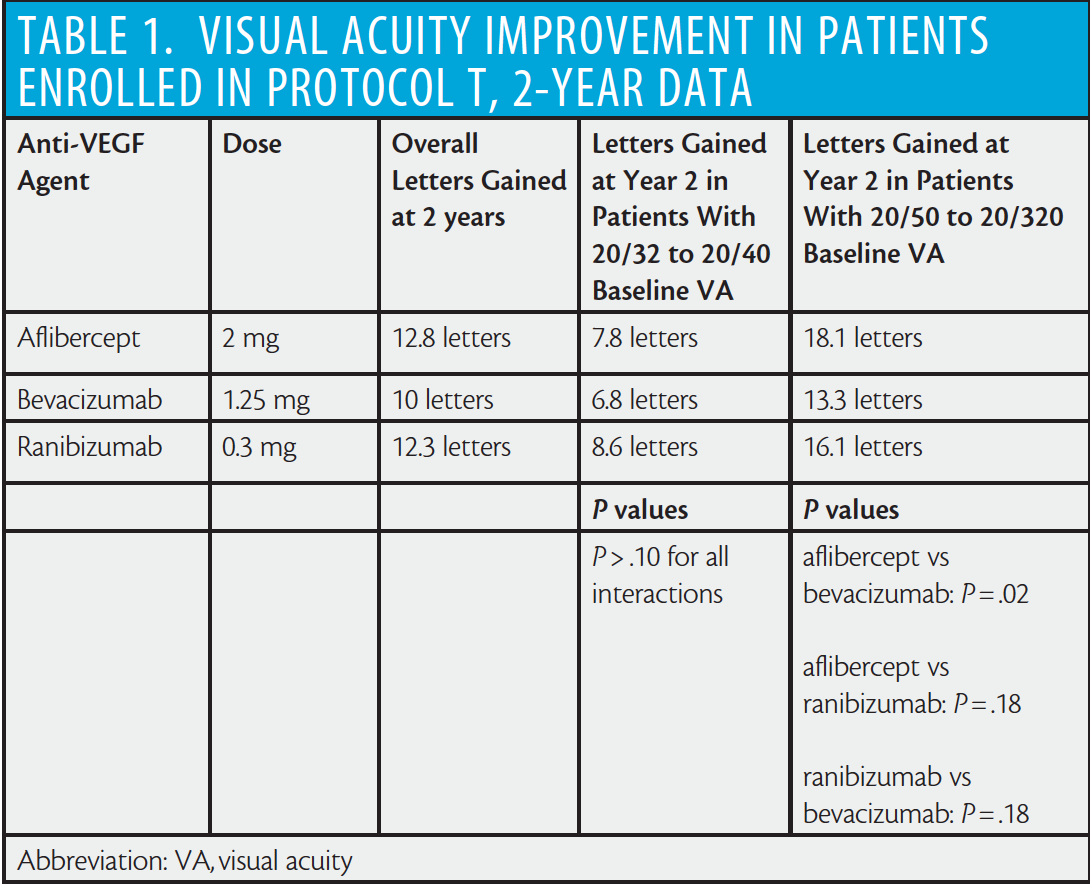
In patients with baseline visual acuity of 20/50 or worse, aflibercept treatment at first showed superior visual acuity improvement compared with bevacizumab, but the superiority of aflibercept over ranibizumab noted at the 1-year time point of the study was no longer seen at the 2-year time point; no difference in visual acuity result was observed between the ranibizumab and bevacizumab treatment arms for patients with baseline visual acuity of 20/50 or worse. In patients with baseline visual acuity of 20/32 to 20/40, all three anti-VEGF agents resulted in similar visual acuity outcomes.
Overall, 2-year mean visual acuity letter score improved by 12.8 letters in the aflibercept arm, 10.0 letters in the bevacizumab arm, and 12.3 letters in the ranibizumab arm (Table 1). In patients with baseline visual acuity of 20/32 to 20/40, mean improvement at 2 years was 7.8 letters in the aflibercept group, 6.8 letters in the bevacizumab group, and 8.6 letters in the ranibizumab group (P > .10 for pairwise comparisons). In patients with baseline visual acuity of 20/50 to 20/320, mean improvement at 2 years was 18.3 letters in the aflibercept arm, 13.3 letters in the bevacizumab arm, and 16.1 letters in the ranibizumab arm (aflibercept vs. bevacizumab, P = .02; aflibercept vs. ranibizumab, P = .18; ranibizumab vs. bevacizumab, P = .18).
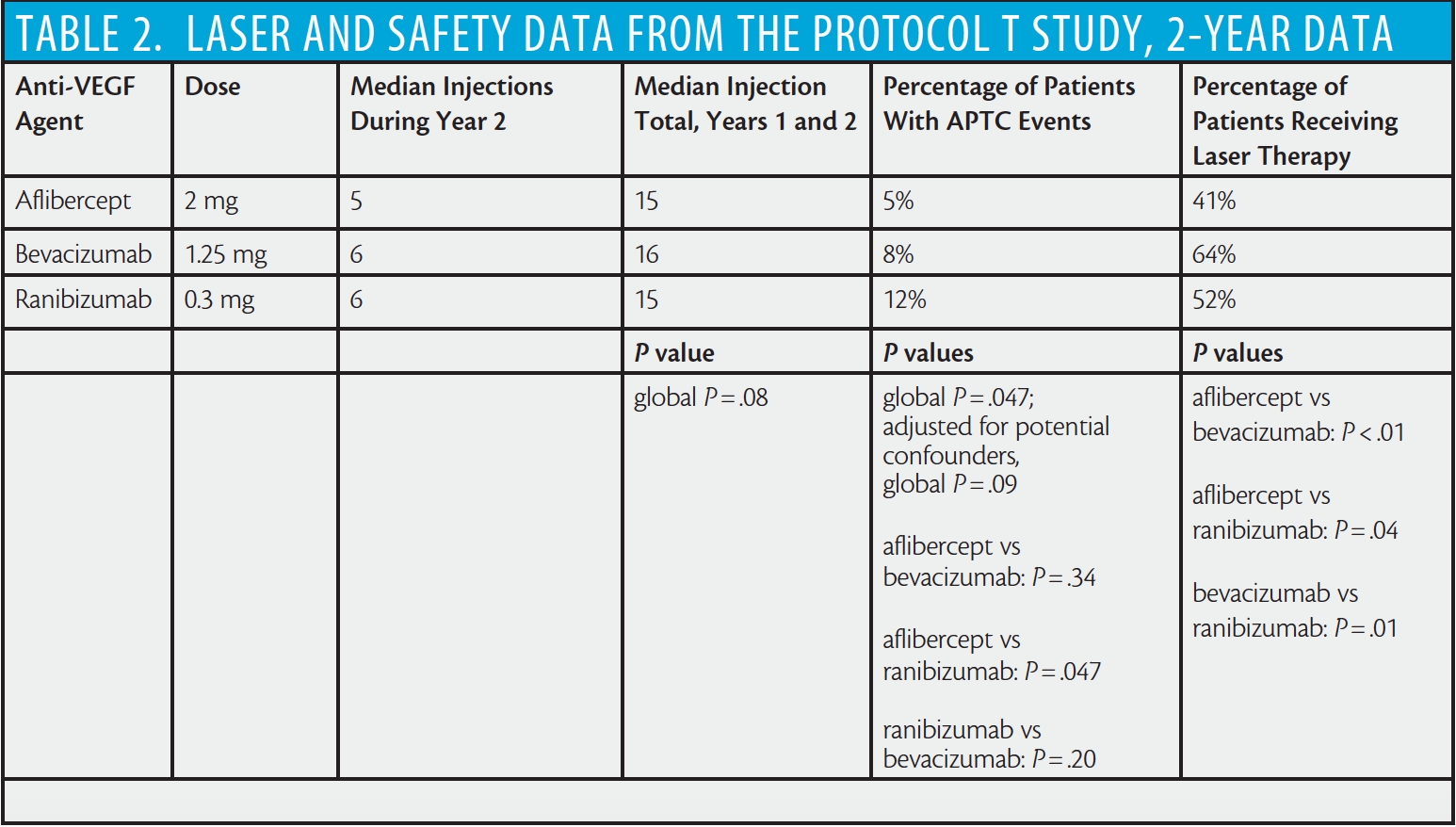
Focal or grid laser was administered in 41%, 64%, and 52% of patients in the aflibercept, bevacizumab, and ranibizumab groups, respectively; aflibercept treatment was associated with a significantly reduced percentage of patients treated with laser versus bevacizumab and ranibizumab, and ranibizumab treatment was associated with significantly less laser than bevacizumab (Table 2).
PHYSICIAN REACTION
In an interview with Retina Today, Marco Zarbin, MD, PhD, chair of the Institute of Ophthalmology and Visual Science at the Rutgers New Jersey Medical School, pointed out that the 2-year trial data showed that the median number of injections was not significantly different among the treatment arms. “The burden of treatment isn’t less with one agent versus another,” he said. Such a finding rules out the possibility that a retina specialist would have to consider treatment burden when choosing which anti-VEGF would best suit a DME patient.
Dr. Zarbin also pointed to the unique ways that researchers can parse data. He said that “only a minority of patients in any given study achieve the average visual outcome, so it’s important to look at the proportion of responders.” Dr. Zarbin discussed the data by noting the percentage of patients who gained at least 10 letters. The proportion of responders in a particular cohort indicates the likelihood of the patient having a clinically meaningful response to the treatment, he said.
“If you look at the percent of patients achieving a 10- or 15-letter gain in vision from baseline, there is no significant difference among the three drugs by year 2,” Dr. Zarbin said. “I think that means there is no clinically important difference in the visual outcome among the three different drugs by year 2, and approximately 80% of the patients in each cohort continued to require some injections in year 2.”
Patricio Schlottmann, MD, consultant ophthalmologist at the Organizacio Medica de Investigacion in Buenos Aires, Argentina, told Retina Today that retina specialists should focus on the long-term results of DME treatment rather than early results.
David Brown, MD, of Retina Consultants Houston, disagreed with Dr. Schlottmann. He told Retina Today that, although the gap between aflibercept and ranibizumab was closed by year 2, retina specialists should not ignore the data that showed superiority of aflibercept over ranibizumab and bevacizumab at year 1. “From a patient’s standpoint, the quicker you get to your best vision, the better it is for your quality of life,” he said.
Dr. Brown also pointed to the fact that gains for aflibercept at year 1 were sustained through year 2, which dispels the notion that “ranibizumab, for whatever reason, was unlucky and aflibercept performed better than expected” at year 1.
The results at year 2 “were a little bit surprising because they were not consistent with the year 1 data,” Rahul Khurana, MD, of Northern California Retina Vitreous Associates, told EyewireTV.
Surprises aside, Dr. Khurana praised the study because it provided data that retina specialists can use when choosing an anti-VEGF agent for DME treatment. “I believe the study does give us a lot of guidance, in the sense that this is the first study that really compared all three anti-VEGF agents for DME treatment,” he said.
Dr. Schlottmann said the ranibizumab rally at year 2 was likely a result of a return to the mean. “If you just wait long enough, you will see a return to the mean,” he said. “That is what we are seeing in the Protocol T 2-year results.”
Such results made sense in the context of comparable trials. “Reviewing VIVID and VISTA, RIDE and RISE, RESTORE, and Protocol I, we see that it was expected that ranibizumab and aflibercept should behave in a very similar way,” he said. “But that wasn’t the case [at year 1].”
SAFETY
The surprises Dr. Khurana mentioned may include the significantly higher number of Anti-Platelet Trialists’ Collaboration (APTC) events found in the ranibizumab arm in year 2.
The researchers found that APTC events occurred at a rate of 5% in the aflibercept arm, 8% in the bevacizumab arm, and 13% in the ranibizumab arm. There was a significant difference in this measure between the aflibercept and ranibizumab arms (P = .047), but the difference was not significant between the aflibercept and bevacizumab arms (P = .34) or the ranibizumab and bevacizumab arms (P = .20). The study authors noted that similar APTC events data had not been demonstrated consistently in previously reported clinical trials, and that the higher rate of APTC events in the ranibizumab arm warranted continued evaluation in future trials.
Dr. Zarbin said that, in general, retina doctors should consider safety when administering anti-VEGF agents. “I have always had a concern that these drugs do pose some degree of systemic safety risk for patients, and the reason I feel that way is because it is a class effect of the drugs,” he said. “In fact, if you look at the label for each drug, it very clearly states that a class effect of the drug is a risk of stroke, heart attack, and vascular death.”
Dr. Brown found the safety results surprising after considering the pharmacokinetics of the three drugs. “If anything, ranibizumab should have the best safety profile because it clears from the systemic circulation faster,” he remarked. “It could have been due to an imbalance in some cardiac issues at baseline,” Dr. Brown said, “but it’s hard to say.”
Dr. Brown noted that such APTC events were not seen in trials of similar scope that assessed anti-VEGF agents for ocular indications, and he said that it is important to remember that the population in a DME study is already at risk for safety issues. “These trials have much sicker patients,” he said, “and they are much more likely to show adverse events such as heart attacks and strokes.”
Dr. Zarbin said that the entry criteria for the trial could have an important influence on the rate of adverse events, and that in trials such as Protocol T, in which patients with a history of stroke were enrolled, it is unsurprising to see high rates of APTC events. Further, Dr. Zarbin said, the trial was simply not powered to detect an anti-VEGF agent’s effect on APTC event occurrence. “The ability to accurately identify the magnitude of risk of APTC events is not present in a study of this size given the expected incidence of these events in comparable diabetic patients,” he said.
Dr. Schlottmann said the APTC event difference was a unique finding, and pointed to other trials that demonstrated strange safety data. “If we look at Protocol I, the sham group had a higher rate of APTC events than those described in the Protocol T’s ranibizumab arm,” he said.
Dr. Brown agreed that the safety data were inconsistent with other trials’ findings and noted that the risk of APTC events was outweighed by the risk of blindness in a population of diabetic patients. “I think patients are, 99% of the time or more, going to say, ‘Hey, I want the shots,’ even though there is a theoretical risk of an APTC event,” he said.
Dr. Khurana was not as dismissive as his colleagues on the question of the safety data as an anomaly. “[The data do] give cause for concern,” he said. “However, I think we need more data and more information to put it into practical perspective on how that is going to influence which treatment we choose.”
INTERNATIONAL COMMENT
Dr. Schlottmann addressed a question on the minds of many doctors who assessed the Protocol T data outside of the United States: would the results of the trial be different if researchers used a 0.5-mg dose of ranibizumab instead of the 0.3-mg dose approved by the US Food and Drug Administration for the treatment of DME?
“From the point of view of somebody practicing outside of the United States and not using the 0.3-mg dose, I believe that the results would have been much different if a 0.5-mg dose were used,” Dr. Schlottmann said.
Dr. Schlottmann said that other trial data suggest that a 0.5-mg dose is more effective than a 0.3-mg dose for treating DME. “Several signals within the RISE and RIDE trials point out the possibility that a 0.5-mg dose is more powerful than a 0.3-mg dose, including data that show that patients in the 0.5-mg ranibizumab arm received less rescue laser during the RISE and RIDE studies than those in the 0.3-mg arm.”
Dr. Schlottmann said that RISE and RIDE were not powered to detect a difference between dosages; rather, they were powered to detect whether treatment was better than no treatment. Still, “from outside the Untied States, the main unanswered question is whether the results would have been the same or not had the researchers used a 0.5-mg dose,” he said.
Retina Today surveyed retina specialists outside the United States to find out how they use anti-VEGF therapy to manage patients with DME and how, if at all, the 2-year Protocol T study findings will affect their treatment strategies. The summarized survey results can be viewed at bit.ly/ProTsurvey.
OUTSIDE CONSIDERATIONS
Dr. Khurana noted that, although the Protocol T year 2 data provide “very valuable information in helping us pick the most appropriate anti-VEGF agent” for DME patients, there are areas of concern regarding how the data can be used. “Sometimes data like this are used by other players in the health care field, such as insurance companies, to mandate what doctors should be using,” Dr. Khurana said. “I think it is important that doctors have the choice to use all three agents for our patient population.”
Regardless of how industry treats the data, Protocol T delivered good news for patients and doctors: it showed that all three anti-VEGF agents used to treat DME are effective, meaning that retina doctors will continue to have a menu of options when initiating DME treatment. n
1. Wells JA, Glassman AR, Ayala A, et al. Aflibercept, bevacizumab, or ranibizumab for diabetic macular edema: two-year results from the comparative effectiveness randomized clinical trial [published online ahead of print February 27, 2016]. Ophthalmology.
2. Wells JA, Glassman AR, Ayala A, et al. Aflibercept, bevacizumab, or ranibizumab for diabetic macular edema. N Engl J Med. 2015;372(13):1193-1203.


_1784132761.jpg?auto=compress,format&w=75)





