




Since vitrectomy was introduced more than 40 years ago, advances in technology and instrumentation have typically preceded changes in surgical techniques, making our procedures safer and more efficient. In the past year alone, technology has incrementally improved the ease and safety with which we can perform our procedures. This article reviews some of the newest surgical devices and instruments to enter our field.
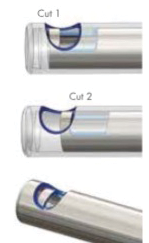
Figure 1. The Eva phacovitrectomy system uses a 92% duty cycle and performs two- dimensional cutting.
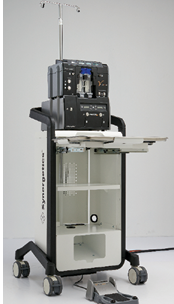
Figure 2. The VersaVIT 2.0 vitrectomy machine offers three vitrectomy pack options and 20, 23, 25, and 27 gauges.
IMAGING
iNview
Volk Optical’s iNview fundus imaging unit uses Apple devices to acquire wideangle digital color fundus images. It is available in iPhone 5s, 6, 6s, and iPod Touch (Generation 6) models and works in conjunction with the free Volk iNview app. Designed for use with dilated patients, the iNview provides a static 50˚ field of view with dynamic peripheral retinal views out to 80˚.
Panocam LT Widefield Imaging System
In 2015, the US Food and Drug Administration (FDA) cleared the Panocam LT Widefield Imaging System (Visunex Medical Systems) for imaging newborn infants. The compact wireless imaging system is designed to detect a number of external, posterior segment, and anterior segment disorders that may have long-term effects on the vision of pediatric patients.
VITRECTOMY SYSTEMS
Eva
Launched in Europe in 2012, the Eva phacovitrectomy system (DORC) is now available for the US market following FDA approval last year. The machine offers highspeed (up to 16 000 cpm) two-dimensional cutting with double cut and double aspiration in each cycle (Figure 1). Eva’s VacuFlow fluid control system uses a feature called valve timing intelligence to eliminate unwanted pulsation and flow. It offers an efficient 92% duty cycle, creating a constant aspiration flow, independent of the cut speed, ideally reducing turbulence and traction on surrounding tissues. Additionally, surgeons can choose between flow or vacuum fluidics, and Eva’s LED endoillumination system offers a consistent quality of light and increased safety, with integrated ultraviolet and infrared filters. The system has a built-in 532-nm laser with wireless foot control and is available with 23-, 25-, and 27-gauge vitrectomy packs.
VersaVIT 2.0
The VersaVIT 2.0 vitrectomy machine (Synergetics; Figure 2) features a cut rate of 6000 cpm and duty cycle control options. At 25 pounds, the system is portable, and it includes dual LED illumination filtered at 435 nm for longer-lasting and safer illumination. There are options for three different vitrectomy packs in 20, 23, 25, and 27 gauges.
Watch it Now
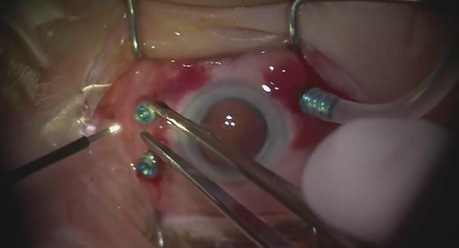
23-G Lens Fragmentation Procedure by Kevin J. Blinder, MD
LIGHT SOURCES
Adjustable Chandelier Fiber
An adjustable chandelier fiber optic illuminator is now available from Bausch + Lomb for the Stellaris PC Vision Enhancement System. In 23- and 25-gauge versions, the chandelier delivers uniform, diffuse lighting and offers modifiable light control to provide intraocular visibility and efficiency during vitreoretinal procedures, according to the company. The chandelier works transsclerally or integrates seamlessly with the company’s Entry Site Alignment valved cannulas.
27-Gauge Vivid Chandelier
Offered originally as a 25-gauge illumination system, the Vivid Chandelier (Synergetics) is now available in a 27-gauge system, which is ideal for bimanual cases.
Microscope Platform
Leica Microsystems’ Proveo 8 is the core of a new ophthalmic microscope platform for vitreoretinal and cataract surgery. It is equipped with FusionOptics, which combines 40% increased depth of field with high resolution, providing surgeons with a texture-rich image from the edges of a detached membrane to the periphery of the retina without refocusing. It also features CoAx4 illumination, which delivers light through four individual beam paths and allows adjustment of the illumination diameter.
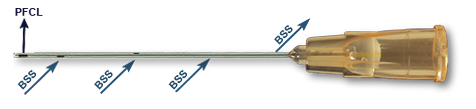
Figure 3. The DualBore SideFlo Cannula has an all-metal exterior for easy insertion through valved cannulas.
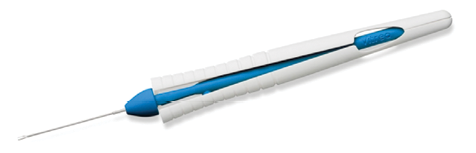
Figure 4. ILM forceps with the Eckardt tip design reduce membrane tearing.
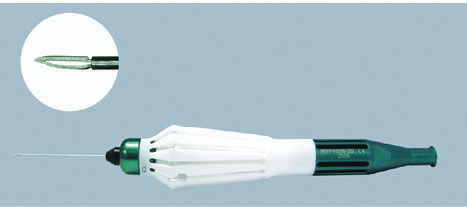
Figure 5. The stationary blade of the Kamei Sweeper Forceps is first positioned at the correct surgical plane before the moving blade is mobilized.
HANDHELD TOOLS
23-Gauge Fragmentation Needle
A 23-gauge fragmentation needle is available for the Stellaris PC Vision Enhancement System (Bausch + Lomb). The ultrasonic needle design can be used during vitreoretinal procedures to remove lens material from the posterior chamber with balanced irrigation and aspiration through 23-gauge incisions, providing enhanced intraoperative control and efficiency. The idea is to eliminate the need to enlarge the sclerotomy, as was necessary when using the previous 20-gauge instrument (Video).
Retractable Diamond Dusted Membrane Scraper
The Tano Diamond Dusted Membrane Scraper (Synergetics), for use in internal limiting membrane (ILM) and epiretinal membrane removal, is now available in a retractable version. The tool’s soft silicone tip ensures nontraumatic contact with the retina. It is available in 20-, 23-, and 25-gauge sizes.
DualBore SideFlo Cannula
The DualBore SideFlo Cannula (MedOne Surgical; Figure 3) allows use of a side port for fluid injection, which the company says eliminates the potential for retinal injury caused by a fluid jet stream. Multiple fluid egress vents allow faster pressure relief during injection than a previous model. This cannula has an
all-metal exterior for easy insertion through valved cannulas, and it is optimized for perfluorcarbon liquid and dye injections.
Steerable Laser Probe
Katalyst Surgical now offers a 90˚ steerable laser probe that features a reusable handle and disposable fiber. The laser fiber is the only part that is replaced. It is connected to an adaptor and reusable handle for one’s own specific laser.
Forceps
ILM Forceps
Vitreq’s ILM forceps, which now include an Eckardt tip, were designed to offer a wider grasping platform to reduce membrane tearing. They also feature a shortened instrument tip, which could allow stronger grasping (Figure 4).
Kamei Sweeper Forceps
Only one blade moves during the actuation of this novel tool by Katalyst Surgical. Ideally, the stationary blade is first positioned at the correct surgical plane, and then the moving blade is mobilized (Figure 5).
LENSES
Single-Use Sterile Lenses
Sterile disposable vitrectomy lenses for use in the office and the OR are now available from Sensor Medical Technology. This line includes a plano lens, a magnifier lens, a biconcave lens, a 20˚ prism lens, a 30˚ prism lens, a suture ring, and a suture ring with tabs. The products all have antireflective coating and come in individual sterile pouches.
Super View Disposable HTC
The Hassan-Tornambe Disposable Contact Lens is a single-use plano-concave contact lens from Insight Instruments with a 36˚ field of view. It incorporates an absorbent symmetrical foam ring with four supporting legs for increased stability during surgery. Sold in boxes of 10, the lens is ready to use right out of the pack and does not require assembly or suturing.
CONCLUSION
In the past 12 months, more instruments and devices have become available than most of us can keep track of. If we are lucky, this trend will continue in the following 12 months. We hope that this brief update has provided you with information that is new to you and that you may use in the quest to reduce surgical risks and improve visual outcomes. n
Paulo Ricardo Chaves de Oliveira, MD
• retinal research fellow at Toronto Retina Institute in Toronto, Canada
• financial interest: none acknowledged
• paulo@retina.com.br
David Robert Chow, MD, FRCS
• assistant professor of ophthalmology at the University of Toronto; codirector of the Toronto Retina Institute, both in Toronto, Canada
• financial interest: consultant to Alcon, Bayer, DORC, Synergetics, and Katalyst; a lecturer for Allergan, DORC, and Optovue
• davidrchow@me.com


_1784132761.jpg?auto=compress,format&w=75)





