



As experience with small-incision sutureless vitrectomy has grown, 23- and 25-gauge instruments have been widely adopted by retina specialists.1 Oshima et al described 27-gauge vitrectomy with a 0.4-mm incision in 2010, and, since then, several companies have introduced 27-gauge platforms.2 Although three-port pars plana vitrectomy (PPV) has overwhelmingly been the preferred procedure for nearly 40 years, interest has recently turned to using portable surgical technology and fewer ports for selected clinical indications, such as vitreous biopsy and removal of vitreous opacities.
One reason for this interest is the potential to move some procedures into the office setting. Manufacturers now produce vitrectomy systems that allow surgeons the flexibility to decide on the most appropriate location to perform a procedure.3
AT A GLANCE
• The mainstay of vitrectomy has been three-port PPV, but there has been recent interest in the use of portable systems and fewer ports for certain cases.
• Office-based surgery, by definition, must be tolerable under local anesthesia.
• The combination of portable vitrectors and minimally invasive surgical techniques may make office-based vitrectomy more commonplace for carefully selected patients.
The setting for surgical procedures is at the discretion of the surgeon based on clinical needs and preferences; there are no prohibitions on place of service based on the Medicare Physician Fee Schedule. If a vitrectomy is done in a hospital or ambulatory surgery center, Medicare pays a separate facility fee. For in-office vitrectomy, no facility fee is paid. The physician fee is the same (based on CPT code), regardless of additional overhead (eg, supplies) incurred by the practice.
My definition of a portable vitrector is any vitrectomy unit that is easily transported between the OR and office, compatible with office-based vitrectomy, and able to run on battery power. This article takes a look at available portable vitrectomy machines and their potential clinical uses.
PORTABLY SPEAKING
Intrector
The Intrector portable vitrectomy system (Insight Instruments) features a cutting speed of more than 1200 cpm. Its guillotine-style vitrector has a dual-lumen 23-gauge probe that contains a central infusion channel and peripheral aspiration/cutter channel connected to a 3-mL syringe for manual aspiration (Figure 1). Illumination can be provided either by an operating microscope or a binocular indirect ophthalmoscope with 20-D lens.
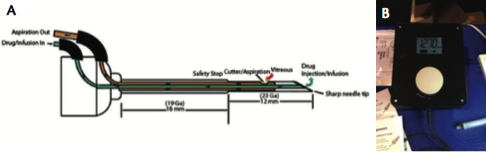
Figure 1. Schematic of the Intrector dual-lumen probe (A). Intrector control box (B).
The disposable Retrector vitrectomy probe (Insight Instruments) incorporates a retractable 23-gauge needle for insertion with a blunt-tipped vitrector aimed at making peripheral vitrectomy safer. An accompanying 26-gauge sharp-tipped infusion cannula is designed for optimal scleral retention.
VersaVIT 2.0
The VersaVIT 2.0 (Synergetics) is a high-speed, 6000-cpm fully functional vitrectomy system that can run on either a CO2 canister or compressed air (Figure 2). Easy-to-use duty cycle control offers the surgeon flow control independent of vacuum, and a dual LED light source provides safe, clear, long-lasting illumination. Weighing 25 lbs, the VersaVIT 2.0 has a built-in handle for easy portability and can be battery- or AC-powered. The device boots up in 10 seconds and features an intuitive setup and quick prime cycle. It includes illuminated endolaser probes, soft-tipped extrusion cannulas, and silicone oil removal cannulas that are available in 20-, 23-, 25-, and 27- gauges and can be inserted through valved ports. The device costs about half as much as full-sized systems, and the disposable packs are about 80% less expensive.
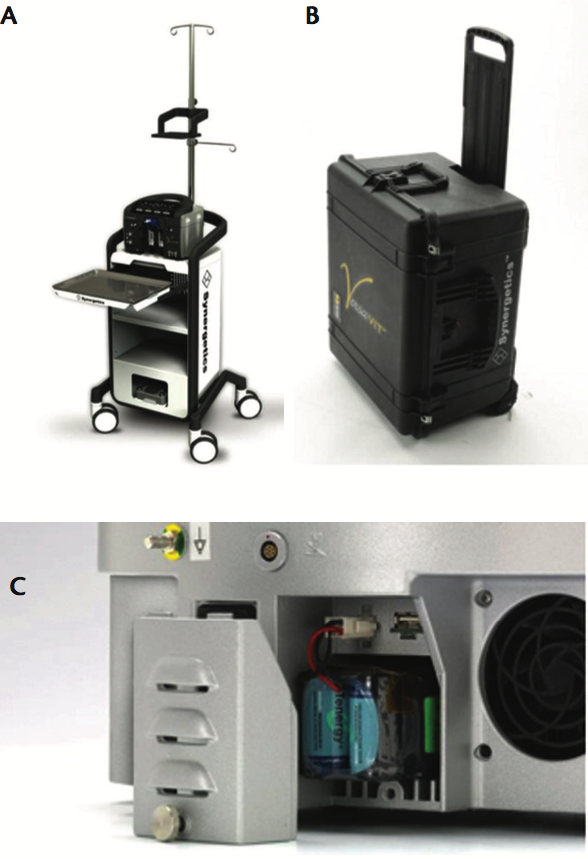
Figure 2. VersaVIT 2.0 system (A), wheeled carrying case (B), and battery power pack (C).
A PLACE FOR OFFICE-BASED VITRECTOMY
Portable vitrectors are not meant to replace current OR surgical technology, but they may be considered as complements to more advanced systems. By definition, because of the setting, office-based vitrectomy must be tolerable under local anesthesia.
Colluciello suggested that a short operating time and a smaller number of incisions contribute to the tolerability of office-based surgery.3 He performed two-port PPV in 12 patients with proliferative diabetic retinopathy and nonclearing vitreous hemorrhage. Clearance of vitreous hemorrhage was obtained in all cases without rebleeding, and the author suggested that the procedure could be accomplished in the office.
Gualtieri went one step further, performing one-port PPV with infusion through a limbal incision after posterior capsulotomy in pseudophakic patients or anterior and posterior capsulotomy with cataract extraction in phakic patients.4 Patients reportedly tolerated the procedure well.
CONCLUSION
It is likely that the vast majority of vitrectomies will continue to occur in an OR setting; however, the combination of improved portable vitrector technology and minimally invasive surgical techniques will make office-based vitrectomy possible for carefully selected patients. Promising indications include endophthalmitis, vitreous biopsy in uveitis, vitreous hemorrhage, vitreous opacity removal, and enhanced pneumatic retinopexy. n
1. Williams GA. 25-, 23-, or 20-gauge instrumentation for vitreous surgery? Eye (Lond). 2008;22(10):1263-1266.
2. Oshima Y, Wakabayashi T, Sato T, et al. A 27-gauge instrument system for transconjunctival sutureless microincision vitrectomy surgery. Ophthalmology. 2010;117(1):93-102.
3. Colucciello M. Two-port pars plana vitrectomy surgery: a prospective interventional case series. Eye (Lond). 2005;19(8):869-872.
4. Gualtieri W. One-port pars plana vitrectomy (by 25-G micro-incision). Graefes Arch Clin Exp Ophthalmol. 2009;247(4):495-502.
John D. Pitcher III, MD
• retina specialist, Eye Associates of New Mexico, in Albuquerque, N.M.
• financial interest: none acknowledged
• jdpitcher@eyenm.com


_1784132761.jpg?auto=compress,format&w=75)





