



Silicone oil can be an effective tamponade in complex cases of retinal detachment such as in giant retinal tears, trauma, proliferative vitreoretinopathy (PVR), and diabetic tractional detachment. In these cases, the oil provides a clear view of the fundus and retina, which is not possible in an air- or gas-filled eye. After a variable period of tamponade, it is standard practice to remove the silicone oil (except in certain situations, such as eyes with hypotony). However, removal of silicone oil can induce retinal redetachment. In fact, rates of retinal redetachment after silicone oil removal vary widely, between 6% and 28%.1-3 Also, a higher number of previously failed retinal detachment surgeries appears to be a significant risk factor for redetachment.2,4
AT A GLANCE
• Retinal redetachments can complicate the removal of silicone oil.
• New and preexisting retinal breaks may cause the retina to redetach after removal of silicone oil.
• Previously failed retinal detachment surgeries increase the risk for redetachment.
REASONS FOR REDETACHMENT
Other known risk factors for redetachment include the surgeon factor, the patient’s visual acuity prior to silicone oil removal, incomplete removal of vitreous base, absence of an encircling band in eyes with PVR in which an inferior retinotomy was not performed, indication for pars plana vitrectomy, and axial length of the eye.2,4 The duration of silicone oil tamponade does not appear to affect redetachment rate. Interestingly, 360˚ prophylactic laser retinopexy applied 1 to 3 months before silicone oil removal has shown some benefit in preventing retinal redetachment.5-8
In a review of 27 redetached retinae at my practice, the critical timing for a retinal redetachment to occur appears to be within postoperative weeks 1 to 4. Jonas et al reported a timeframe of 2 days to 5.5 months.9
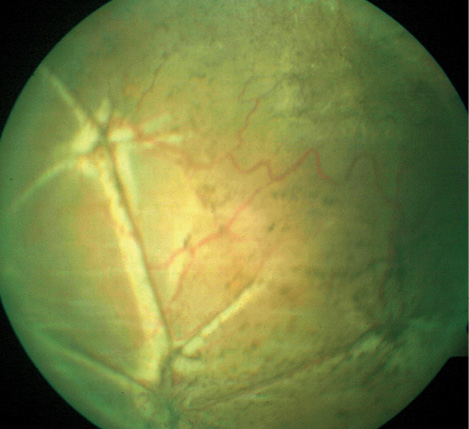
Figure 1. Inferior PVR retinal redetachment with marked fixed folds in the inferior retina of this eye occurred 6 months after silicone oil removal.
The retina may redetach after silicone oil removal due to formation of new retinal breaks in areas not previously treated with laser or cryotherapy. Alternatively, preexisting retinal breaks may have been missed and thus not treated effectively. Such breaks have the potential to reopen after silicone oil removal. It is not uncommon for new or missed breaks to occur in the macula as macular holes.
PVR is another potential cause of redetachment, and it may arise as a new process of proliferation after silicone oil removal or as progression of a preexisting PVR process. Proliferation exerts tractional forces on the retina and results in formation of fresh breaks or reopening of old breaks, as well as traction-induced folds on the retina. The PVR process can arise in any portion of the retina, although it has a predilection for the inferior retina (Figure 1). With the availability and common use of heavy silicone oil, the inflammatory milieu shifts to the superior aspect of the retina, thus predisposing the superior retina to PVR formation.
ADDRESSING REDETACHMENTS
If a retinal redetachment is localized within an area of prior laser photocoagulation (usually in the retinal periphery and sparing the macular area), then it may be decided to undertake no further attempt at retinal reattachment. Also, if a patient’s prognosis is deemed to be extremely poor, possibly due to advanced PVR with significant anterior proliferation and traction involving the ciliary body resulting in hypotony, surgery can be abandoned. Some trauma cases are better left observed.
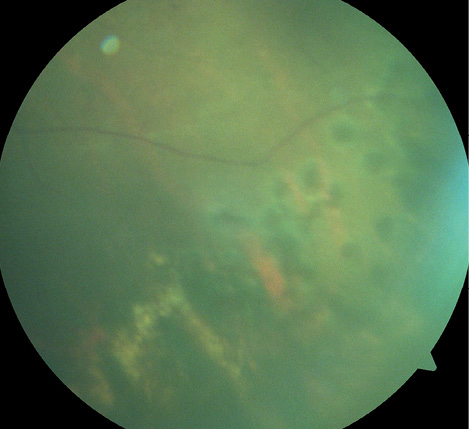
Figure 2. Attached inferior retina with retinal laser marks. An inferior retinal redetachment was managed with revitrectomy and short-term endotamponade using perfluorocarbon, which was exchanged with 20% SF6 gas after 3 weeks.
Repeat vitrectomy with endotamponade is the approach to retinal redetachment most commonly employed in our department. The vitrectomy usually involves addressing the cause of the redetachment, which often warrants PVR surgery. Thorough shaving of the peripheral vitreous base is accomplished using wideangle viewing systems and a scleral indentation technique. Both 23- and 25-gauge systems can be effective for shaving the peripheral vitreous, and the procedure can be more safely performed with higher-speed cutting and low vacuum settings. Vitreoretinal techniques such as retinotomy and retinectomy can be employed, as can scleral buckling. Most cases require peeling of epiretinal membrane, with or without the use of a vital dye, and removal of subretinal membranes. The inverted flap technique, in which elements of the surrounding peeled internal limiting membrane are inverted into the macular hole, can be useful to achieve macular hole closure.
Silicone oil is an excellent tamponade agent and is most commonly used for the majority of retinal detachments. Although it provides an effective tamponade for most superior retinal breaks, it may provide unsatisfactory results for inferior retinal breaks because the density of silicone oil is lower than that of water. This results in an aqueous inflammatory environment that may increase the possibility of inferior PVR development. In such a case, the use of a heavier-than-water silicone oil (ie, heavy silicone oil), can provide satisfactory and effective tamponade of the inferior PVR detached retina.10
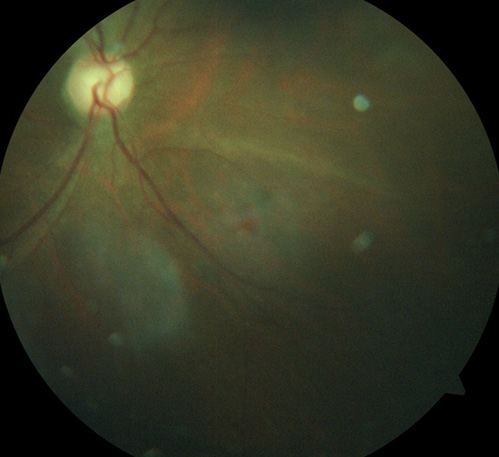
Figure 3. Attached retina with laser marks in the inferior retinal periphery (TOP). A longstanding PVR pseudophakic retinal detachment with an inferior retinal redetachment that was managed with 3 weeks of perfluorocarbon endotamponade that was finally exchanged with balanced salt solution (BOTTOM) .
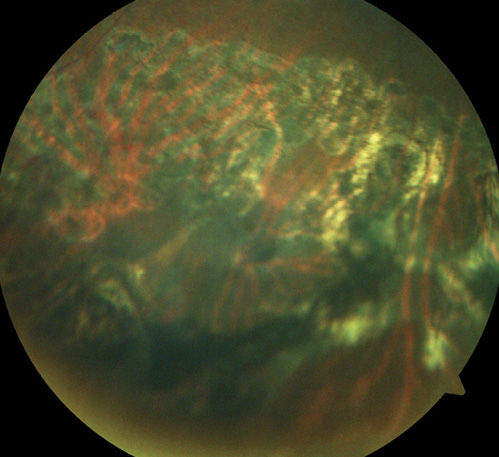
Heavy silicone oil is composed of a chemical mixture of silicone oil and a perfluorochemical. It has been used in repeat vitrectomy with good outcomes. We use heavy silicone oil as tamponade for between 3 and 6 months, but reports suggest that it can be retained for several months or years.10 Complications associated with heavy silicone oil use include emulsification, increased intraocular pressure, and intraocular inflammation. It is also a more difficult tamponade to remove from the eye. Care should be taken to avoid contact between heavy silicone oil and perfluorocarbon liquids (PFCLs), as this will result in sticky silicone oil. Thus, heavy silicone oil should be injected only after air-fluid exchange. Superior PVR can occur as a result of relocation of the PVR milieu to a superior retinal location.
Although PFCLs have been reported to cause toxicity in animal studies, they can be employed for short-term tamponade in human eyes.11 We have used PFCL for periods of 5 days to 4 weeks for inferior PVR redetached retina with good outcomes (Figures 2 and 3). The PFCL can then be replaced with saline, air, gas, or silicone oil, depending on retinal stability. We have found short-term use of PFCLs for inferior retinal tamponade to be a useful tool to rescue some difficult cases. We have noted inflammation and emulsification in eyes with up to 1 month of PFCL tamponade but not in eyes with tamponade of a shorter duration.
Another option for endotamponade is longer-acting gas (C3F8), which can be used in some cases with lesser degrees of PVR.
CONCLUSION
When addressing retinal redetachments, retina specialists should choose a tamponade based on case presentation and the site of the PVR process. Anatomic success rates after repeat vitrectomy can be high, thanks to available technology and effective tamponading options. Although visual outcomes may not always reflect the anatomic success achieved, they are typically quite good, with improved or stabilized vision in the majority of eyes. n
1. Abu El-Asrar AM, Al-Bishi SM, Kangave D. Outcome of temporary silicone oil tamponade in complex rhegmatogenous retinal detachment. Eur J Ophthalmol. 2003;13(5):474-481.
2. Jonas JB, Knorr HL, Rank RM, Budde WM. Retinal redetachment after removal of intraocular silicone oil tamponade. Br J Ophthalmol. 2001;85(10):1203-1207.
3. Nawrocki J, Ghoraba H, Gabel VP. Problems with silicone oil removal. A study of 63 consecutive cases. Ophthalmologe. 1993;90:258-263.
4. Lam RF, Cheung BT, Yuen CY, et al. Retinal redetachment after silicone oil removal in proliferative vitreoretinopathy: a prognostic factor analysis. Am J Ophthalmol. 2008;145(3):527-533.
5. Laidlaw DA, Karia N, Bunce C, et al. Is prophylactic 360-degree laser retinopexy protective? Risk factors for retinal redetachment after removal of silicone oil. Ophthalmology. 2002;109(1):153-158.
6. Nagpal MP, Videkar RP, Nagpal KM. Factors having implications on re-retinal detachments after silicone oil removal. Indian J Ophthalmol. 2012;60(6):517-520.
7. Tavares RL, Nóbrega MJ, Nóbrega FA, et al. Timing and outcomes after silicone oil removal in proliferative vitreoretinopathy: a retrospective clinical series. Int J Ret Vit. 2015;1:2.
8. Takeshi I, Young-Joon J, Brian CO. Effect of prophylactic 360° laser treatment for prevention of retinal detachment after phacovitrectomy: (Prophylactic 360° laser treatment for prevention of retinal detachment). BMC Ophthalmol. 2013;13:77.
9. Jonas JB, Budde WM, Knorr HL. Timing of retinal redetachment after removal of intraocular silicone oil tamponade. Am J Ophthalmol. 1999;128(5):628-631.
10. Prazeres J, Magalhães O Jr, Lucatto LF, et al. Heavy silicone oil as a long-term endotamponade agent for complicated retinal detachments. BioMed Res Int. 2014;2014:136031.
11. Drury B, Bourke RD. Short-term intraocular tamponade with perfluorocarbon heavy liquid. Br J Ophthalmol. 2011;95(5):694-698.
Section Editor Albert Augustin, MD
• professor and chairman of the department of ophthalmology, Staedtisches Klinikum Karlsruhe, in Karlsruhe, Germany
Section Editor Ehab N. El-Rayes, MD, PhD
• professor of ophthalmology, Institute of Ophthalmology in Cairo, Egypt; vitreoretinal consultant, The Retina Clinic, in Cairo, Egypt
Section Editor, Masahito Ohji, MD
• professor and chairman of the department of ophthalmology, Shiga University of Medical Science, in Otsu, Shiga, Japan
Section Editor, Stanislao Rizzo, MD
• chair of the department of ophthalmology, University of Florence, in Florence, Italy
Ogugua N. Okonkwo, MD, FRCS(Edin), FWACS
• surgeon at the Eye Foundation Retina Institute, in Lagos, Nigeria
• financial interest: none acknowledged
• +234-803-502-7308 o_okonkwo@yahoo.com


_1784132761.jpg?auto=compress,format&w=75)





