



As an eternal optimist and a lover of technology, I am excited to give you a glimpse into the vitreoretinal OR of the future. Mind you, it has been 30 years since Back to the Future came out. October 21, 2015, has come and gone and I still do not have a hoverboard, so take what you read here with a grain of salt.
AT A GLANCE
• With adoption of smaller-gauge surgery and fewer ports, surgical wounds will heal faster.
• Visualization in the future may be improved with novel endoscopes and nanofiber illumination solutions.
• In years to come, photocoagulation could become a preprogrammed, navigated, automated process guided by multispectral imaging ischemia maps.
INCREASED SURGICAL EFFICIENCY
Whether a retinal detachment repair or a membrane peel, much of what we do entails some sort of surgical procedure to address disorders of the vitreoretinal interface. The vitrector is an essential instrument we use to stop the vitreous from interacting with the retina. In the near future, these devices will change to improve efficiency and decrease recovery time from our procedures. The first change will likely be a move from pneumatic guillotine cutters to electrically controlled cutters, allowing cut rates of 50 000 cpm and above.
The next evolution will involve eliminating the guillotine blade altogether. Liquefaction of vitreous will be accomplished through ultrasonic disruption or by using a femtosecond or attosecond laser to disrupt vitreous strands and allow safe and efficient vitreous removal.
Surgical healing will take less time as we move to smaller-gauge surgery and fewer ports. We will be going to two- and even one-port systems for many procedures in the future as the functions of instruments are combined. Some day we may also not need our fiberoptic light pipes, thus reducing the need for another incision.
UNDER PRESSURE
Current vitreoretinal systems have intraocular pressure (IOP)–sensing technologies and control systems. We can now run vitrectomies at IOPs as low as 15 mm Hg with a stable eye. IOP stabilization technology will improve further so that we can safely perform vitrectomies with rock-steady IOPs at any level. Imagine running at 7 mm Hg for an advanced glaucoma patient without any fluctuation in IOP and no collapse or distortion of the eye.
Watch it Now
Pravin Dugel, MD, talks with Jonathan L. Prenner, MD, and Richard Kaiser, MD, about 3-D imaging in the OR of tomorrow in episode 32 of the Retina Today Journal Club.
YOU ARE IN CONTROL
Most mode switching during surgery is now either performed by footpedal actuation or by asking our surgical staff to make the changes. In the future, voice command and thought-based electroencephalography commands will become commonplace. Advanced sensing and logic will anticipate the ideal machine settings needed and implement them for us, much in the way that advanced avionics in military aircraft automatically change flight controls and deploy countermeasures for pilots.
Visualize operating on a diabetic patient and a vessel starts bleeding. The system, either through optical or chemical sensors, detects the unexpected hemorrhage and automatically increases the IOP to tamponade it while also automatically changing the instrument you are holding to diathermy and aspiration mode so you can quickly stop the bleeding and move on with your procedure. There would be no time wasted, no lost view due to dispersed hemorrhage, and no need for instrument changes.
Additionally, increased stability of surgical instruments in the eye will be aided by robotic stabilizers. This may allow us to treat vein and artery occlusions via intravascular cannulation and thrombus or embolus disruption, fragmentation, or lysis.
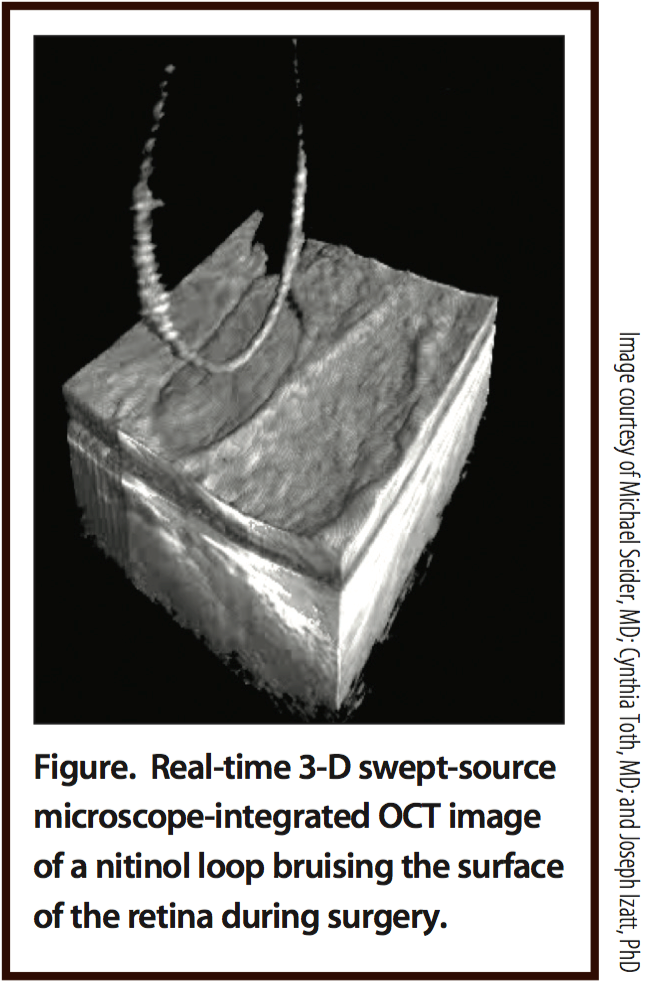
Figure. Real-time 3-D swept-source microscope-integrated OCT image of a nitinol loop bruising the surface of the retina during surgery.
WHEN THERE’S A VIEW, THERE’S A WAY
While the microscope was invented more than 350 years ago, its days are numbered in vitreoretinal surgery. Novel 3-D viewing systems are the future. Initially, we will operate by looking above the patient at high-resolution (4K, 8K, or 16K) displays, but eventually virtual or augmented reality units such as the Rift (Oculus), HoloLens (Microsoft), or that of Magic Leap will allow us to visualize surgery from inside the eye with multiple viewing angles and infinite zoom capabilities.
Multimodal and multispectral preoperative and intraoperative imaging technologies will become commonplace. Imagine being able to register and manipulate optical coherence tomography (OCT) scans inside the eye during surgery. This will allow more precise planning of a complicated membrane dissection.
Intraoperative imaging will also be available as OCT technology continues to improve, and it will allow us to visualize and manipulate registered volumetric renderings in real time to more safely and effectively perform surgery (Figure).
Visualization will be improved with novel endoscopes and nanofiber illumination solutions. So repairing a retinal detachment in a patient with an opaque cornea will be performed as safely and easily as it would be in patients with clear media. We will move out of the visible spectrum of illumination to prevent phototoxicity. Infrared spectrum illumination would aid in retinal surface visualization in the setting of vitreous hemorrhage.
Surgery itself will become safer in the future as our instruments will someday be autotracked in relation to their proximity to the retina. Just as a current day neurosurgeon uses stereotactic instrumentation to determine the precise 3-D location of a tumor in a patient’s brain, we will know exactly where we are in the globe on a micrometer scale. Picture using stereotactic tools to approach an epiretinal membrane and then using real-time 3-D OCT renderings to help you peel it while wearing a virtual or augmented reality headset to control your views, magnification, orientation, imaging layovers, and surgical modes with your voice or your mind.
NOVEL THERAPEUTICS
The ways we deliver therapy will also change. There may be different methods of retinal tamponade besides gas and oil that will not require postoperative positioning or second surgeries. Laser will be delivered in a patterned manner similar to using the Pascal laser (Topcon). Eventually, photocoagulation will become a preprogrammed, navigated, automated process guided by multispectral imaging ischemia maps, with laser fluence titrated based on pigment density detection or predetermined density maps.
On the pharmacologic front, it is only a matter of time before neuroprotective agents are developed that mitigate the microtrauma of vitreoretinal surgery and prevent proliferative vitreoretinopathy formation and cataract formation.
ADVANCES IN ANESTHESIA
The primary goal of anesthesia is to facilitate the safe and effective completion of surgical goals. A decade or two ago, vitreoretinal surgeons performed most cases under general anesthesia. Now most cases are performed under a regional anesthetic block that provides both analgesia and akinesia.
Perhaps the increased precision and safety that we expect from future surgical systems, together with machine-aided control of surgical instrumentation that can react and accommodate to ocular movement, will allow us to transition from retrobulbar anesthesia to subconjuctival or topical anesthesia.
CONCLUSION
No one can predict the future, but if any of this becomes reality, remember: You read it here first. There will be naysayers to what I have envisioned. Adopting technological advances is sometimes a painful process, and some of us will be dragged screaming into the future. So set your flux capacitors to December 25, 2045, and hang on. It is going to be a wild ride. (If we are going 30 years into the future, we might as well arrive on Christmas Day!) n
Theodore Leng, MD, MS
• director of ophthalmic diagnostics at the Byers Eye Institute at Stanford University; clinical assistant professor of ophthalmology at the Stanford University School of Medicine, in Palo Alto, Calif.
• financial interest: none acknowledged
• +1-650-498-4264; tedleng@stanford.edu; Twitter:@tedleng


_1784132761.jpg?auto=compress,format&w=75)





