




Diabetic retinopathy (DR) is damage to the blood vessels and the neurosensory retina of patients with diabetes. Evaluation of the condition has been centered around the presence of vascular changes and their consequences (eg, microaneurysms, hemorrhages, exudates, and neovascularization). However, when DR is defined merely by appearance, without consideration of function, there are two consequences for the patient: a delay in establishing a comprehensive preventive treatment against the development of DR, and a lack of data that define the onset of retinal damage. A combined structural-functional assessment of the neurovascular unit can provide a more comprehensive assessment of the diabetic patient. The following case report illustrates how.
AT A GLANCE
• FA can detect vascular obliteration and leakage from diabetic damage, but SD-OCT is needed to qualitatively and quantitatively analyze distinct retinal layers.
• Prominent capillary nonperfusion can usually be detected using FA by the time patients develop moderate NPDR.
• Visual function testing can complement standard clinical assessment in patients with diabetes.
CASE REPORT
A 59-year-old man presented with a 40-year history of type 1 diabetes complicated by systemic arterial hypertension, dyslipidemia, diabetic peripheral neuropathy, and foot ulcer, but not diabetic nephropathy. His body mass index was 38 kg/m2. He had been diagnosed with DR 2 years ago, and he presented with 20/50 and 20/60 BCVA in the right (OD) and left eyes (OS), respectively. Clinical examination revealed nonproliferative diabetic retinopathy (NPDR) and diabetic macular edema (DME) OD and mild proliferative diabetic retinopathy (PDR) OS that had been treated with panretinal photocoagulation (PRP).
Fundus photographs OD showed microaneurysms and hard exudates without clinically significant macular edema (Figure 1). Fluorescein angiography (FA) demonstrated hyperfluorescent points in the posterior pole and small nonperfused areas temporal to the fovea, but no intraretinal microvascular abnormalities or vascular proliferation (Figure 2). In the small nonperfused areas temporal to the fovea, a spectral-domain optical coherence tomography (SD-OCT) scan showed complete disorganization of the inner retina layers (Figure 3), specifically the nerve fiber layer (NFL) and ganglion cell layer (GCL).
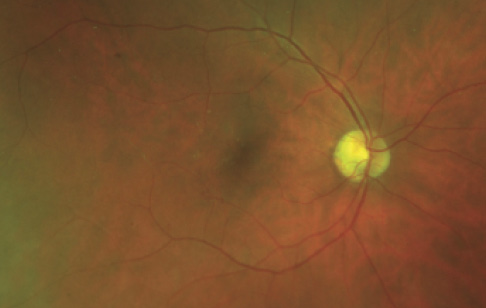
Figure 1. Photograph of the patient's right eye, showing moderate NPDR.
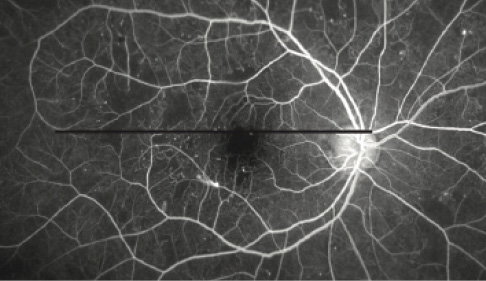
Figure 2. FA confirms the NPDR and shows nonperfused areas temporal to the fovea. Black line corresponds to SD-OCT line scan shown in Figure 3.
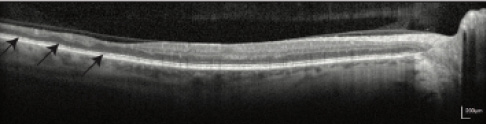
Figure 3. SD-OCT line scan of the nonperfused area seen in Figure 2 shows retinal thinning and disruption of the inner retinal layers (arrows).
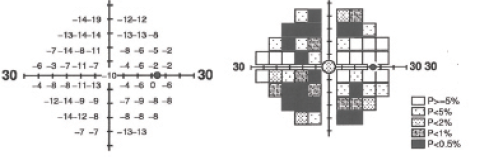
Figure 4. Matrix FDP of the right eye. FDP shows decreased sensitivity temporal to the fovea, corresponding to the nonperfused area on FA. Threshold values in dB (Left) and grayscale graphic of the threshold with corresponding P value (Right).
Visual field testing OD via frequency-doubling perimetry (FDP) demonstrated severe reduction of sensitivity in the temporal, superior, and inferior macula, corresponding with nonperfused areas. The patient's macular sensitivity was reduced by -10 dB in the fovea and depressed by as much as -19 dB in the temporal macula, with less damage closer to the optic disc (Figure 4).
DISCUSSION
This case illustrates close correspondence between altered retinal structure, vascular integrity, and retinal function. In other words, there is a marked and visually significant reduction of visual field sensitivity throughout the macula, even in regions that appear to have intact vascular perfusion. Interestingly, the regions of nonperfusion show the greatest reductions of sensitivity. Loss of visual field sensitivity may result from subtle defects in retinal perfusion that are below the resolution of FA, or it may be a consequence of impaired neuroretinal integrity independent of vascular compromise. It is currently not possible to point to the exact cause.
Dodo and colleagues recently showed that nonperfused areas observed with FA exhibited disorganization of the inner retinal layers in the macula and midperipheral retina on corresponding SD-OCT imaging. Specifically, SD-OCT showed absence of boundaries between the NFL/GCL and inner plexiform layers and an indistinct Henle layer in nonperfused areas.1,2 FA can detect vascular obliteration and leakage, but SD-OCT is required to analyze distinct layers qualitatively and quantitatively. The exact histologic changes that cause disorganization of the inner retina are uncertain, but they are likely related to neuroglial cell death and gliosis, as proposed by Bek, who showed a consistent correlation in regions of microvascular perfusion with loss of inner retinal cells, dendrites, and axons.3
By the time patients have at least moderate NPDR, prominent capillary nonperfusion can usually be detected with FA. The degree of visual field compromise and neuroretinal loss in these regions is not detected by ophthalmoscopic examination or photographic grading schemes.
A visual field defect of -6 dB would be considered of great concern in a patient suspected of having glaucoma. Much greater defects were demonstrated in this case. We submit that visual field impairment in persons with DR should receive as much consideration regarding impact on vision-related quality of life as is given for patients with glaucoma. Data from LALES showed that NEI-VFQ-25 composite and driving scores decreased rapidly in persons with ETDRS grade 43 retinopathy or greater.4
CONCLUSION
Although the patient in this case exhibited marked damage of his neurovascular unit, the process of DR began long before this stage. Patients with diabetes and mild or no NPDR also show reductions in visual field sensitivity using standard automated perimetry or FDP.5,6 Once these functional defects are identified, efforts to optimize diabetes control and other known risk factors must be enacted.
The findings detailed here show that diabetes causes early and progressive disruption of the entire neurovascular unit and that visual function testing can complement standard clinical assessment. Additional work is clearly needed to better understand the relationship between these clinical and cellular features of DR, particularly as new imaging modalities are used. n
1. Sun JK, Lin MM, Lammer J, et al. Disorganization of the retinal inner layers as a predictor of visual acuity in eyes with center-involved diabetic macular edema. JAMA Ophthalmol. 2014;132(11):1309-1316.
2. Dodo Y, Murakami T, Uji A, et al. Disorganized retinal lamellar structures in nonperfused areas of diabetic retinopathy. Invest Ophthalmol Vis Sci. 2015;56(3):2012-2020.
3. Bek T. Transretinal histopathological changes in capillary-free areas of diabetic retinopathy. Acta Ophthalmol (Copenh). 1994;72(4):409-415.
4. Mazhar K, Varma R, Choudhury F, et al; the Los Angeles Latino Eye Study Group. Severity of diabetic retinopathy and health-related quality of life: the Los Angeles Latino Eye Study. Ophthalmology. 2011;118(4):649-655.
5. Hellgren KJ, Agardh E, Bengtsson B. Progression of early retinal dysfunction in diabetes over time: results of a long-term prospective clinical study. Diabetes. 2014;63(9):3104-3111.
6. Jackson GR, Scott IU, Quillen DA, et al. Inner retinal visual dysfunction is a sensitive marker of non-proliferative diabetic retinopathy. Br J Ophthalmol. 2012;96(5):699-703.
Vinicius Castro, MD, PhD
• research fellow at the W.K. Kellogg Eye Center, University of Michigan, in Ann Arbor, Mich.
• financial interest: none acknowledged
Thomas Gardner, MD, MS
• professor of ophthalmology and visual sciences, molecular and integrative physiology and internal medicine at the W.K. Kellogg Eye Center, University of Michigan, in Ann Arbor, Mich.
• financial interest: none acknowledged
• tomwgard@umich.edu


_1784132761.jpg?auto=compress,format&w=75)




