



Since the description by Machemer of vitrectomy in the 1970s, instrumentation and settings for the procedure have improved greatly. Although the basics of vitrectomy technology have remained similar for a long time, many advances have been introduced into routine vitrectomy during the past decade.
AT A GLANCE
• With design of the cutter optimized, the flow rate during vitrectomy provides more safety and efficiency.
• In SPEEP mode, which allows a peristaltic pump to mimic a venturi-based system, the maximum values for flow and vacuum can be set independently.
• The full range, from a single cut to a cutting rate of 10 000 cuts/min, can be controlled using the increased linear excursion of the OS4 footpedal.
The development of new designs of cutters, along with the implementation of electronics for control of duty cycle, aspiration, and other variables, has allowed the miniaturization of probes down to 23, 25, and now 27 gauge. Additionally, the ability to perform combined cataract and vitrectomy surgery has been established, and the combination has been seen to be beneficial in many patients with significant cataract concomitant with posterior segment pathology.
A NEW GENERATION
With all of these developments, it is vital for modern ophthalmic surgery systems to provide the best solutions for both anterior and posterior segment surgery. The OS3 vitrectomy machine (Oertli Instrumente) has served these purposes in many surgery centers where vitrectomy is routinely performed and in referral centers for refractory cases requiring anterior and posterior segment surgery. The device offers a systems software-independent platform providing a high degree of versatility. It utilizes both venturi and peristaltic pump systems and offers dual linear control of functions in anterior and posterior segment surgery.
With the OS3, Oertli also introduced its EasyPhaco technology, which provides increased efficiency of phacoemulsification energy at the tip combined with increased holdability. The EasyPhaco technology includes a miniaturized phaco tip 1.6 mm in diameter, allowing coaxial microincision cataract surgery to be performed without generating surgically induced astigmatism.
Oertli has now made available the next generation of its surgical platforms, the OS4. According to the company, two of the main goals for the development of its OS4 system were to increase the direct control of the surgeon’s actions and to decrease surgery time. With an increase of the cutting speed from 3000 cuts/min (OS3) to 10 000 cuts/min (OS4), naturally surgery time is decreased. However, the shortened surgery time is also due to a number of other innovations found in the OS4.
For example, the newly designed “continuous-flow” cutter provides a continuous flow, which eliminates the duty cycle. Rossi and colleagues1,2 found that the design of the cutter—mainly the position and the shape of the port, referred to as the blade—plays an important role in allowing a constant flow through the cutter opening. This is especially important at high cutting rates. With a single-blade design cutter, vitreous aspiration becomes ineffective if the duty cycle is not adapted.3 Several other factors have also been shown to contribute to the safe and effective performance of the cutter.4
PUMP IMPROVEMENTS
While flow rate and vacuum play important roles for both effectiveness and safety of a cutter’s profile, fluid (and thus tissue) acceleration is highly dependent on the cutter’s blade design; a small opening and different shapes of the cutting edge formed by the port result in higher acceleration of fluid in several models. Thus, by optimizing the design of the cutter, the flow during vitrectomy can be improved to become continuous while acceleration of the fluid is decreased. The flow is continuous at any time.
Acceleration of fluid is a major challenge when working on the vitreous base. During shaving of the vitreous base in an attached retina, the reduction of fluid acceleration helps to avoid small retinal tears that may lead to a secondary retinal detachment following vitrectomy, for example after macular peeling.
It has been shown by Rossi that fluid acceleration is higher when a peristaltic pump is used for vitrectomy.1 On the other hand, peristaltic pumps offer the advantage of viscosity-independent determination of flow. (With venturi, the flow is not directly controlled; rather it is controlled via vacuum, and thus the final resulting flow is dependent on viscosity.)
Which pump is chosen in a given vitrectomy setting is highly dependent on the surgeon’s own experience and preference. Many surgeons prefer venturi pump systems due to their faster rise times for flow and more direct control at the tip of the cutter. Others prefer to rely on peristaltic pump systems for generating flow, as they offer more controllable and viscosity-independent suction.
Given these facts—that fluid acceleration is lower with venturi systems and that flow is independent from viscosity in peristaltic systems—a mixture of the dynamics of both types of pumps would be desirable.
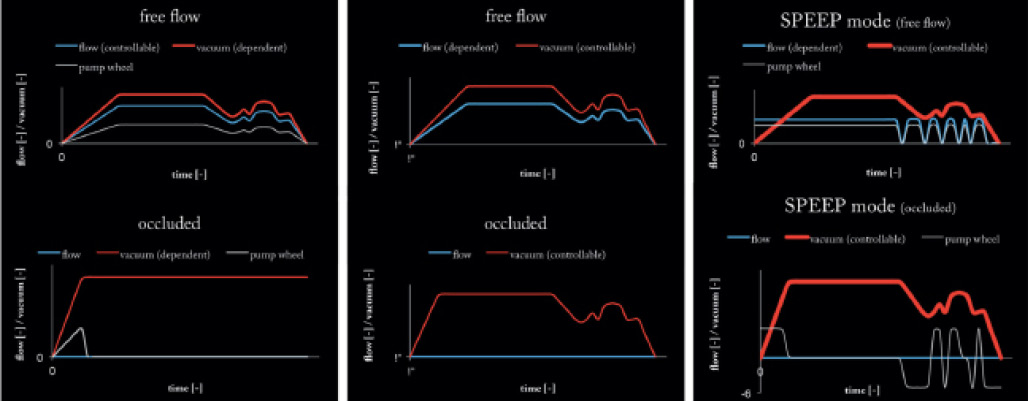
Figure. Flow and vacuum performance in three pump systems. Peristaltic system (left column) in unoccluded (top) and occluded (bottom) states. Flow is controllable but vacuum-dependent. Venturi system (middle column) in unoccluded (top) and occluded (bottom) states. Flow is independent of vacuum, so in occluded state there is no flow. SPEEP mode (right column) in unoccluded (top) and occluded (bottom) states. This mode offers the advantage of setting the maximum values for flow and vacuum independent of one another. Thus, it offers the instant availability of flow with controllable vacuum.
With the OS4, Oertli has introduced the SPEEP (speed and precision) mode, which allows a peristaltic pump to mimic a venturi-based system. In this mode, the maximum values for flow and vacuum can be set independently. The benefit of the SPEEP pump system is the instant availability of vacuum in combination with flow control (Figure). In our experience, this capability makes critical maneuvers—at the vitreous base, for example—more controllable and thus safer. The SPEEP mode also allows more effective resection of vitreous remnants in surgery for a detached retina.
BEHIND THE SCENES
The development of the SPEEP mode was possible only due to a behind-the-scenes technical improvement. During the development of the OS4, Oertli engineers aimed to develop so-called high-definition dynamic direct control (HDC) for the technology. In a technical sense, this meant that especially the affect-control-effect loop was greatly improved. For example, the venturi sensor measures 8000 values per second, resulting in a highly controllable vacuum.
An improvement of the peristaltic pump control to 1000 control loops/sec with 800 gears (in comparison with the OS3’s peristaltic pump characteristics of 100 control loops/sec with 256 gears) finally made the SPEEP mode possible.
The reasons for development of HDC during the design of the OS4 can be found in several other aspects of the system: for example, the configuration of the pedal with improved ergometric design and more functions. With a short learning curve, the full range, from a single cut to a cutting rate of 10 000 cuts/min, can be controlled using the increased linear excursion of the pedal.
Overall, the improvements found in the OS4, together with a simple-to-operate Linux-based control panel, allowed us to adopt the new system with a short learning curve. n
1. Rossi T, Querzoli G, Angelini G, et al. Introducing new vitreous cutter blade shapes: a fluid dynamics study. Retina. 2014;34(9):1896-1904.
2. Charles S. Fluidics and cutter dynamics. Dev Ophthalmol. 2014;54:31-37.
3. Fang SY, DeBoer CM, Humayun MS. Performance analysis of new-generation vitreous cutters. Graefes Arch Clin Exp Opthal. 2008;246(1):61-67.
4. Steel DH, Charles S. Vitrectomy fluidics. Ophthalmologica. 2011;226 Suppl 1:27-35.
Section Editor Dean Eliott, MD
• associate director, retina service, Massachusetts Eye and Ear, Boston, Mass.
Section Editor Ingrid U. Scott, MD, MPH
• professor of ophthalmology and public health sciences, Penn State Hershey Eye Center, Hershey, Pa.
Armin Wolf, MD, FEBO
• consultant, anterior and posterior segment surgery/surgical and medical retina/ocular trauma, Ludwig-Maximilians-Universität department of ophthalmology, Munich, Germany
• financial interest: none acknowledged
• armin.wolf@med.uni-meunchen.de


_1784132761.jpg?auto=compress,format&w=75)





