





Changes in health care policy and medical coverage have focused attention on health economics and outcomes research (HEOR), including consideration of cost versus quality. Our research team recently presented a cost-effectiveness analysis of US Food and Drug Administration (FDA)–approved anti-VEGF treatments for diabetic macular edema based on the Diabetic Retinopathy Clinical Research Network’s Protocol T data.1 An integral component of that analysis was the difference in the quality-adjusted life year (QALY) benefit associated with the two FDA-approved treatments.
AT A GLANCE
• Retina specialists may gain valuable insights into patients’ health-related quality of life if they evaluate outcomes beyond visual acuity and anatomic outcomes.
• The quality-adjusted life year (QALY) is a metric that has been used to evaluate health-related quality of life.
• Published algorithms can be used to translate patient visual acuity data into utilities, which approximate health-related quality of life. Utility scores, combined with duration of life, are then used to calculate QALYs.
• The QALY metric allows comparisons of treatments between different diseases or of different treatments for the same disease.
Not all ophthalmologists and retina specialists are familiar with HEOR terms. Our goal in this article is to familiarize clinicians with QALY and other HEOR phraseology. A thorough understanding of these terms will be helpful in navigating the rapidly evolving trend toward health care policy focused on quality over volume.
VISUAL ACUITY AND HEALTH ECONOMICS
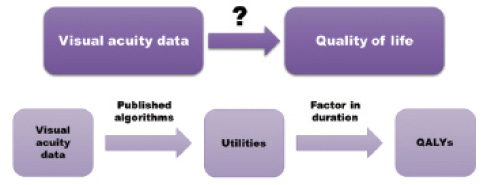
Figure 1. Measuring health-related quality of life using VA data from ophthalmology trials.
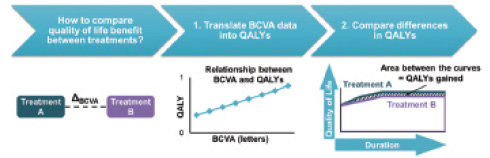
Figure 2. Comparing health-related quality-of-life benefit between treatments.
In ophthalmology, most studies collect data on visual acuity (VA). Less frequently, researchers collect data on patients’ health-related quality of life. How can changes in VA be translated into quality-of-life data? In order to translate VA letters into values in health economics, two concepts are fundamental to understand: the QALY and the utility. QALY is a measure of health that combines duration and health-related quality of life, and utility is a weighting mechanism to account for the health-related quality of life associated with a specific health state.
If a study does not have the means of eliciting utilities, as is the case with most ophthalmology trials, published algorithms can be used to translate VA data into utilities. Utility scores, combined with duration of life, can then be used to calculate QALYs (Figure 1). The difference in QALY between treatments can then be used to compare the differences in quality-of-life benefit (Figure 2).
This article will further elaborate on the basic concepts of QALYs and utilities and will provide examples of how they can be determined and applied in ophthalmology.
QALY 101
What is a QALY and what is its purpose?
A QALY is a health outcome that estimates health status over time by combining both duration and quality of life.
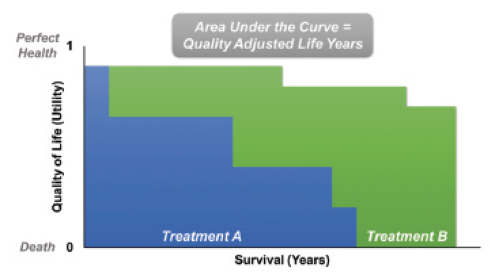
Figure 3. Generic schematic representing the components of the QALY calculation (both health-related quality of life and duration of a health state).
A useful feature of QALYs as an outcome measure is that it allows comparison of treatments between different medical specialties or within the same disease. For example, relying solely on clinical measures, it would be difficult to compare the benefits of treating hypertension (measured in mm Hg reduction) with a screening program for breast cancer (measured by stage at diagnosis, time to treatment initiation, or survival). However, in this example or across other disparate diseases, QALYs could be calculated and compared.
How are QALYs determined?
QALYs are composed of two elements: 1) duration or survival, and 2) utility associated with the specific health state. Typically, utilities are measured on a scale of 0 to 1, with 0 representing death and 1 representing perfect health.
Figure 3 illustrates a scenario in which QALYs associated with two different interventions are calculated over an individual’s remaining life expectancy. Quality of life (utility) is plotted against duration (survival), and the area under the curve represents QALYs. In this case, treatment B provides benefit in terms of better utility (higher values on the y axis) and increased survival. The difference in the colored areas under each curve represents the additional QALYs gained by providing treatment B instead of treatment A.
How are utilities determined in ophthalmology?
In ophthalmology, it is unusual for interventions to extend a person’s life. Instead, most interventions affect a person’s ability to see and his or her time spent with better vision. Therefore, the QALY outcome tends to be based on improvement in utility. Numerous publications have documented the relationship between VA and utility in ocular diseases.2-10
How is VA used in determining utilities?
Several methods and instruments have been designed to calculate (or translate) utilities. Two methods that have been used most frequently in ophthalmology studies are the standard gamble (SG) and time tradeoff (TTO) techniques, due to their sensitivity to changes in vision.11-13
SG is structured as a gamble between perfect health (utility = 1) and death (utility = 0). For example, a patient has chronic back pain. He decides he is indifferent about continuing to have chronic back pain if the probability of perfect health is 0.8 and probability of death is 0.2. In this example, 0.8 is the utility associated with that health state.
TTO is based on how many years in the current health state a person with a health condition would give up in exchange for a reduced number of years in perfect health. In our example of a patient with chronic back pain, if he is willing to trade 10 years with chronic back pain for 7 years of perfect health, the utility estimate is 7 divided by 10, or 0.7.
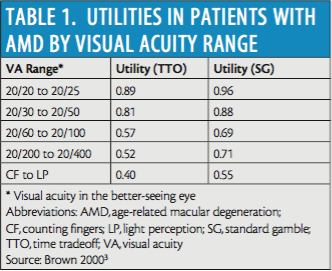
Brown and colleagues used these methods to create algorithms for translating VA data into utilities.3 Using both TTO and SG techniques in interviews with 72 patients with age-related macular degeneration (AMD), the authors reported decreasing utility with decreasing VA (Table 1). That is, as VA worsened, so did the patient’s reported health-related quality of life.
Although the actual utility value may be slightly different depending on whether SG versus TTO is used, generally only a single method is used to calculate utility in any given study.
Utilities obtained from patients with eye diseases other than AMD have shown relationships with VA similar to those presented in Table 1. For example, Szabo and colleagues used the TTO method to gather utilities associated with different VA ranges in patients with diabetic retinopathy.14 Patients with VA in the better-seeing eye ranging from 20/20 to 20/200 reported utilities of 0.98 to 0.67, respectively. Again, as VA worsens, so does a patient’s reported utility.
How can formulas be used to calculate utilities?
A methodological limitation of early utility studies was that VA ranges were traditionally predefined. Since the Brown et al publication in 2000,3 several groups have developed algorithms that allow utilities to be calculated using formulas rather than VA ranges.9,15 The equations generated by two groups are illustrated in Table 2, with examples of calculated utilities for patients with VA of 20/40 or 20/200.
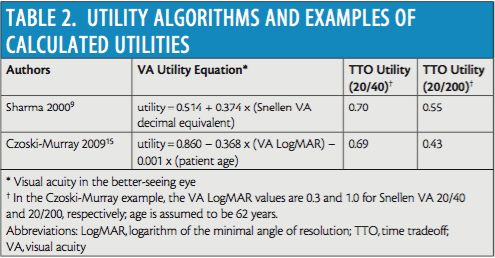
Although the actual utility value may be slightly different depending on whether a formula-based equation or a predefined VA range method is used, only a single method is used to calculate the utility for both treatments being compared. The health economics field is trending toward using these formula-based algorithms in ophthalmology, given the greater flexibility they provide.
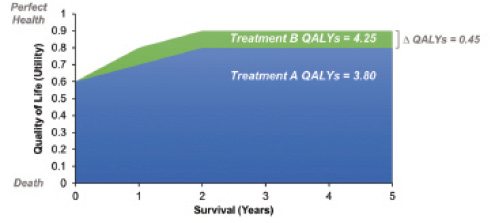
Figure 4. Graph of two interventions that improve VA (and utility) over time.
How are utilities used to calculate QALYs in ophthalmology?
A hypothetical example (Figure 4) illustrates the impact of two treatments on VA and, by extension, on utilities and QALYs. The total QALYs for each treatment would be calculated using the area under the curve, which is a sum of the QALYs over 5 years. Each 1-year QALY increment is presented in the following equations:
Treatment A = (0.65 x 1) + (0.75 x 1) + (0.80 x 1) + (0.80 x 1) + (0.80 x 1) = 3.80 QALYs
Treatment B = (0.70 x 1) + (0.85 x 1) + (0.90 x 1) + (0.90 x 1) + (0.90 x 1) = 4.25 QALYs
On average, patients receiving treatment B would be expected to gain an additional 0.45 QALYs (3.80 subtracted from 4.25) over the 5-year time horizon. Whether this gain represents good value depends not only on the magnitude of the difference in QALYs but also on the additional cost required to achieve this incremental QALY benefit. The next section discusses cost-effectiveness analysis.
How are QALYs and ICERs used in cost-effectiveness analyses?

Figure 5. How to calculate an ICER.
QALYs are perhaps most well known for their role in cost-effectiveness analysis. This is a method used to compare the costs and outcomes (such as QALYs) associated with two or more interventions. An incremental cost-effectiveness ratio (ICER) is calculated as the difference in the total intervention costs divided by the difference in outcomes, or QALYs (Figure 5). An ICER is essentially a measure of the value provided by one intervention relative to another. The ICER may be used to inform public policy or reimbursement decision-making.
ICERs are compared with a cost-effectiveness threshold to determine whether the cost per QALY gained for a particular intervention is reasonable. At this time, the United States does not have published guidelines for a universal cost-effectiveness threshold. However, based on a review of more than 1500 US-based cost-utility analyses published from 1990 to 2012, Neumann and colleagues recommend using a cost-effectiveness threshold of either $100 000 or $150 000 per QALY.16 An ICER less than the threshold would be considered cost-effective, whereas an ICER more than the threshold would not be considered cost-effective.
LITERATURE-BASED CASE STUDY
Stein and colleagues examined the costs and QALYs associated with three interventions in patients with newly diagnosed mild open-angle glaucoma (OAG): laser trabeculoplasty (LTP), prostaglandin analogue (PGA), or observation.17 Over 25 years, costs for no treatment, LTP, and PGA were $2700, $13 788, and $18 101, respectively. Total QALYs for the three treatment strategies were 16.06, 16.71, and 17.14, respectively.
Based on ICERs of $16 824 per QALY gained (LTP vs. no treatment) and $14 179 per QALY gained (PGA vs. no treatment), the authors concluded that both LTP and PGA are cost-effective options when compared with observing newly diagnosed mild OAG. Although PGA provided more QALYs in the initial analysis, when more realistic levels of PGA medication adherence were considered, LTP was ultimately deemed to be the more cost-effective alternative.
THE BETTER- VS. WORSE-SEEING EYE
One nuance that is unique to ophthalmology is the impact of differential VA (better- and worse-seeing eye) on utility and QALYs. The examples in Tables 1 and 2 all consider VA in the better-seeing eye and do not explicitly consider the VA in the worse-seeing eye. This is under the assumption that increases or decreases in VA in the worse-seeing eye do not affect quality of life, as long as the better-seeing eye remains the better-seeing eye. However, this underlying assumption has been challenged. Based on a review of the ophthalmology literature, Hirneiss concluded that both the better- and the worse-seeing eye affect patients’ quality of life, despite the common belief that only or mostly the better-seeing eye affects vision-related quality of life.18 The magnitude of the effect may differ by disease and its impact on central versus peripheral vision.
The practical implication of this issue is that different results and conclusions could be drawn about the relative value of new treatments depending on the assumptions associated with the impact of the worse-seeing eye on quality of life. Given the potential impact on policy and reimbursement decisions, a clearer understanding of this issue and more research in this area are warranted.
APPLICATION TO CLINICAL PRACTICE
In ophthalmology, we often become focused on the change in letters on an eye chart or on micron-scale differences on optical coherence tomography images. However, we may need to take a step back and evaluate how these differences in VA or anatomic outcomes affect patients’ health-related quality of life.
Although use of QALYs as a measure of health outcomes has limitations, it is an important health economic outcome to consider. By providing a better understanding of QALYs and their role in ophthalmology, we hope to enable retina specialists to consider the bigger picture of treatment impact on patients’ health-related quality of life. n
1. Cimberle M. Analysis: Lucentis may be more cost-effective than Eylea for DME. Ocular Surgery News. July 20, 2015.
2. Brown GC. Vision and quality-of-life. Trans Am Ophthalmol Soc. 1999;97:473-511.
3. Brown GC, Sharma S, Brown MM, Kistler J. Utility values and age-related macular degeneration. Arch Ophthalmol. 2000;118(1):47-51.
4. Brown MM, Brown GC, Sharma S, Busbee B. Quality of life associated with visual loss: a time tradeoff utility analysis comparison with medical health states. Ophthalmology. 2003;110(6):1076-1081.
5. Brown MM, Brown GC, Sharma S, Kistler J, Brown H. Utility values associated with blindness in an adult population. Br J Ophthalmol. 2001;85(3):327-331.
6. Brown MM, Brown GC, Sharma S, Shah G. Utility values and diabetic retinopathy. Am J Ophthalmol. 1999;128(3):324-330.
7. Espallargues M, Czoski-Murray CJ, Bansback NJ, et al. The impact of age-related macular degeneration on health status utility values. Invest Ophthalmol Vis Sci. 2005;46(11):4016-4023.
8. Lloyd A, Nafees B, Gavriel S, Rousculp MD, Boye KS, Ahmad A. Health utility values associated with diabetic retinopathy. Diabet Med. 2008;25(5):618-624.
9. Sharma S, Brown GC, Brown MM, et al. Converting visual acuity to utilities. Can J Ophthalmol. 2000;35(5):267-272.
10. Sharma S, Oliver-Fernandez A, Bakal J, Hollands H, Brown GC, Brown MM. Utilities associated with diabetic retinopathy: results from a Canadian sample. Br J Ophthalmol. 2003;87(3):259-261.
11. Torrance GW. Measurement of health state utilities for economic appraisal. J Health Econ. 1986;5(1):1-30.
12. Torrance GW, Thomas WH, Sackett DL. A utility maximization model for evaluation of health care programs. Health Serv Res. 1972;7(2):118-133.
13. Von Neumann J, Morgenstern O. Theory of Games and Economic Behavior, 3rd ed. New York: Wiley; 1953.
14. Szabo SM, Beusterien KM, Pleil AM, et al. Patient preferences for diabetic retinopathy health states. Invest Ophthalmol Vis Sci. 2010;51(7):3387-3394.
15. Czoski-Murray C, Carlton J, Brazier J, Young T, Papo NL, Kang HK. Valuing condition-specific health states using simulation contact lenses. Value Health. 2009;12(5):793-799.
16. Neumann PJ, Cohen JT, Weinstein MC. Updating cost-effectiveness--the curious resilience of the $50,000-per-QALY threshold. N Engl J Med. 2014;371(9):796-797.
17. Stein JD, Kim DD, Peck WW, Giannetti SM, Hutton DW. Cost-effectiveness of medications compared with laser trabeculoplasty in patients with newly diagnosed open-angle glaucoma. Arch Ophthalmol. 2012;130(4):497-505.
18. Hirneiss C. The impact of a better-seeing eye and a worse-seeing eye on vision-related quality of life. Clin Ophthalmol. 2014;8:1703-1709.
Steven B. Duff, MS
• founder of Veritas Health Economics Consulting, Carlsbad, Calif.
• financial interest: consultant to Genentech
• steveduff@veritashec.com
Nancy M. Holekamp, MD
• director of retina diseases, Center for Macular Degeneration, Pepose Vision Institute, Chesterfield, Mo.
• financial interest: consultant to Genentech, Regeneron, Allergan, Alimera Sciences, and Katalyst
• nholekamp@gmail.com
Yamina Rajput, MS
• health economist, Genentech, South San Francisco, Calif.
• rajput.yamina@gene.com
Third-party writing assistance was provided by Grace H. Lee, PharmD, of Envision Scientific Solutions, and funded by Genentech. Genentech participated in the review and approval of the manuscript.


_1784132761.jpg?auto=compress,format&w=75)





