


Premature and low–birth weight babies are at risk for developing retinopathy of prematurity (ROP), a blinding disease caused by abnormal development of retinal blood vessels in infants. Of an estimated 3.9 million infants born each year in the United States, roughly 14 000 are affected by ROP.1 Of these, some 1100 to 1500 infants develop ROP severe enough to require medical treatment, and between 400 and 600 become legally blind from ROP each year.1
AT A GLANCE
• The ROP service at the Bascom Palmer Eye Institute provides exams and treatment for babies diagnosed with the disease.
• The service consists of six members who work together to manage patients and explore new treatments for ROP.
Most ROP resolves without causing damage to the retina, but, when the condition is severe, it can cause the retina to pull away or detach from the wall of the eye and potentially cause blindness.1 Babies weighing 1250 g or less and those born before 31 weeks gestation are at highest risk.1 Fortunately, with appropriate assessment, management, and treatment (when warranted), the vast majority of visual complications from this disease can be prevented.
The ROP service at the Bascom Palmer Eye Institute, University of Miami, performs screening for babies at risk of developing the disease and provides examinations and treatment for those diagnosed with ROP. This article provides a brief overview of the ROP service at Bascom Palmer Eye Institute.
THE ROP SERVICE AT BASCOM PALMER EYE INSTITUTE
Babies are screened, diagnosed, and treated at the neonatal intensive care unit (NICU) at Holtz Children's Hospital (HCH). The ROP team conducts an extensive screening examination including photography, optical coherence tomography, and ultrasound. Once discharged, infants who have active disease or who have been treated with injections or laser are followed in the clinical setting at Bascom Palmer Eye Institute, where digital photography is performed at every visit. This service has been in operation since before the CRYO-ROP trials, which were run by one of the founding fathers of Bascom Palmer Eye Institute and an important figure in ROP, John T. Flynn, MD.2 In 2002, Audina M. Berrocal, MD, became director of the service, which screens nearly 600 babies and performs roughly 1200 examinations each year. This includes babies born at HCH and those who are transferred to HCH for eye care.
Nationwide improvements in neonatal intensive care over the past few decades has improved survival of earlier preterm infants and, in turn, increased the total number of ROP cases. In our unit, approximately 50% of babies born at 22 to 23 weeks gestation survive. To handle the increasing patient load, the ROP team has expanded to six members, all of whom work together to streamline the process.
TEAM MEMBERS
NICU Nurse
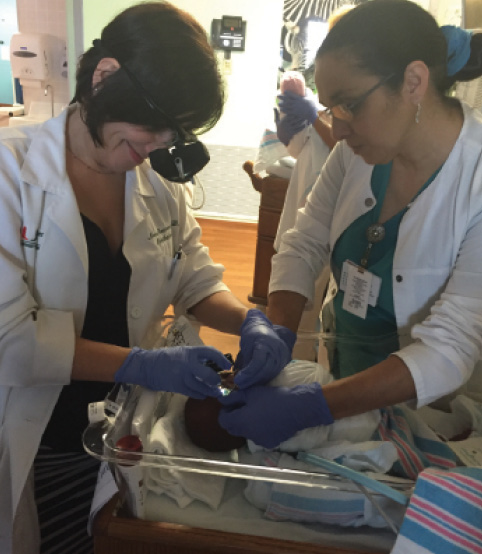
Figure 1. Dr. Berrocal (left) and Anna Rodriguez, RN, (right) perform a beside screening examination.
A NICU nurse is responsible for coordinating the list of babies to be seen each day, including new babies that need screening, babies that have been transferred, and those requiring follow-up. She also prepares the babies for examination and treatment with dilating drops and anesthetic medications, respectively. She is at the bedside during examinations preparing babies for the exams and holding them during the exams (Figure 1). If a baby is not tolerating an exam, she addresses the issue so that the team can complete his or her screening or treatment. The NICU nurse coordinates educational sessions with parents and other family members to explain what ROP is and why the screening and examination are important. She is available to talk to parents, neonatologists, and other nurses to coordinate examinations and to keep open communication among all involved parties.
Clinical Coordinator
This member of the ROP service makes sure there is doctor-to-doctor communication. She also ensures that patients who require additional follow-up but are being discharged from the NICU are given appropriate follow-up in the clinic at Bascom Palmer Eye Institute. If patients do not show up for visits, she is responsible for making sure they are seen, even if this requires the involvement of the local sheriff or child protective services.
This is probably the most important role in the service. Because HCH is not part of the University of Miami electronic health record (EHR) system, the continuity of care is sometimes a challenge. The coordinator makes sure that babies who have active ROP do not get lost in the system. And when a baby is transferred out of state, which happens quite often due to the service's geographic location, she makes sure communication occurs with all of the important parties, including the accepting facility ophthalmologist and the parents. She also makes sure photographs are given to the parents and that a discussion occurs regarding the importance of the infant getting an eye examination upon arrival to the accepting unit.
Retinal Photographer
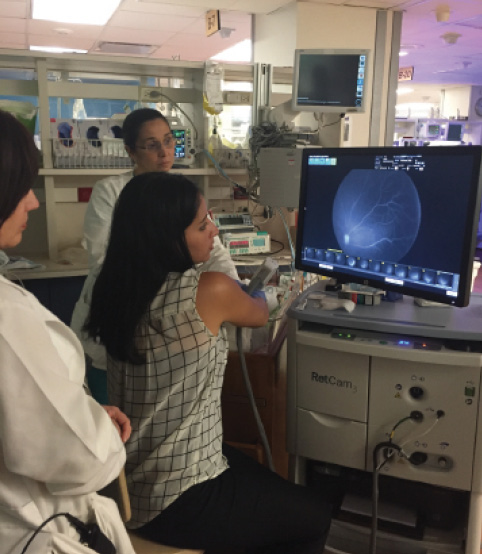
Figure 2. Photographer Brenda Fallas and nurse Rodriguez perform fluorescein angiography at a patient's bedside.
A retinal photographer takes fundus photographs and occasionally performs fluorescein angiography in babies prior to treatment as well as those at increased risk for disease progression (Figure 2). The photographer also makes sure that babies being transferred to another unit are photographed prior to and following transfer. Many times the patients' families are given copies of the photographs so they can share them with the ophthalmologist at the new NICU. Additionally, the photographer makes sure that images are loaded into the Bascom Palmer Eye Institute's EHR server. This way, when babies are followed up, photography and fluorescein angiograms are available for review.
Two Fellows
One surgical retina fellow and one pediatric ophthalmology
fellow participate in the examination and treatment of the babies in both the NICU and in the clinical setting. This hands-on involvement is an integral part of the education
of future doctors who might later be taking care of babies with ROP.
Team Leader
Dr. Berrocal is the leader of the team. She oversees the entire process, makes evaluation and management decisions, performs examinations and treatments, and discusses disease assessment and treatment options with parents and families. Many transfers occur during the year, and Dr. Berrocal is able to work with pediatric ophthalmologists and retina specialists in the community and outside the United States to aid in the diagnosis and surgical management of these critical infants.
Dr. Berrocal reports that she finds the ROP service to be a rewarding opportunity and that she has built many great relationships with the families of her patients throughout the years. In fact, she said, she continues to follow many patients with ROP into adulthood with yearly examinations in the clinic. She constantly strives to improve the efficiency of the service and the experience of the families. Dr. Berrocal is currently performing a multicenter National Eye Institute–funded study to better identify babies at high risk of disease progression, to understand the genetics of ROP, and to evaluate which novel treatment options on the horizon may be beneficial for this patient population.
In a retrospective 10-year review of the Bascom Palmer Eye Institute/HCH data, Dr. Berrocal found that progression to retinal detachment occurred in two (1.1%) treated babies screened at HCH.3 Both babies who progressed were very ill. One was too sick to receive laser treatment (no anti-VEGF therapy was available at that time); the second infant was born with many congenital anomalies, and the family declined treatment. These data speak for a team approach and the importance of timely screenings and treatments in this preventable disease.
HARD WORK HELD IN HIGH REGARD
Although NICUs throughout the state of Florida provide screening and examinations for ROP, many do not have the resources or expertise to perform treatment when needed. Dr. Berrocal often receives transfer requests or referrals to the NICU at HCH and the pediatric retina clinic at Bascom Palmer Eye Institute, respectively, for babies requiring complicated management decisions or varying levels of treatment. Bascom Palmer Eye Institute has developed a reputation for quality eye care that extends to the management of pediatric retinal diseases, and Bascom Palmer physicians and scientists have earned international recognition for pioneering research into the causes and prevention of ROP. The team continues to explore novel treatments for ROP, including ocular injections, to combat the formation of abnormal blood vessels. n
1. American Association for Pediatric Ophthalmology and Strabismus. Retinopathy of prematurity. July 2013. www.aapos.org/terms/conditions/94. Accessed February 4, 2016.
2. Clinicaltrials.gov. Cryotherapy for Retinopathy of Prematurity (CRYO-ROP) - Outcome Study of Cryotherapy for Retinopathy of Prematurity. February 3, 2014. https://clinicaltrials.gov/ct2/show/NCT00000133. Accessed February 5, 2016.
3. Kaakour AH, Hansen ED, Aziz HA, et al. Changing treatment patterns of ROP at a tertiary medical center between 2002 and 2012. Ophthalmic Surg Lasers Imaging Retina. 2015;46(7):752-754.
Basil K. Williams Jr, MD
• surgical retina fellow at Bascom Palmer Eye Institute, University of Miami, Miller School of Medicine, in Miami, Fla.
• basilkwilliams@gmail.com


_1784132761.jpg?auto=compress,format&w=75)





