




Diabetic macular edema (DME) is an important cause of visual impairment in patients with diabetes. In developed nations, it has been estimated that approximately 93 million people are affected by diabetic retinopathy (DR) and 21 million by DME. The Wisconsin Epidemiologic Study of Diabetic Retinopathy found the 10-year incidence of DME in the United States to be 20.1% in type 1 diabetics, 25.4% in type 2 insulin-dependent diabetics, and 13.9% in type 2 diabetics not using insulin therapy.1
DME is characterized by increased vascular permeability mediated by many inflammatory cells, cytokines, and inflammatory mediators including VEGF, resulting in accumulation of intraretinal fluid and macular thickening. Although the multifactorial nature of DME has become clearer, the most commonly used treatments now largely focus on VEGF.
AT A GLANCE
• Because intravitreal triamcinolone acetonide injections must be repeated every 2 to 4 months to maintain effect, sustained-release steroid preparations that prolong the intervals between treatments may be beneficial.
• The 0.7-mg dexamethasone implant and the 0.59-mg fluocinolone acetonide implant are good options for patients with DME refractory to previous treatment and in vitrectomized patients with DME.
• Although cataract progression is a risk of steroid use, most patients with DME will develop visually significant cataracts anyway.
Multiple trials have shown the efficacy of the steroid class in treatment of DME. The mechanisms underlying the effectiveness of corticosteroids for treatment of DME are clearly multifactorial. Leukostasis, upregulation of adhesion molecules and prostaglandins, and retinal accumulation of macrophages occur in diabetes. Steroids, which are nonspecific antiinflammatory agents, act to stabilize the blood-retina barrier and reduce capillary permeability by inhibiting leukocyte recruitment and enhancing the activity of endothelial cell tight junctions.2,3 Corticosteroids also inhibit the action of and regulate expression of VEGF, thereby affecting vascular permeability and angiogenesis.4,5 They also affect a broad range of peptides involved in the inflammatory processes related to DME.
However, the side effects of steroids are a concern, especially considering the availability of anti-VEGF medications that have minimal ocular side effects. The main downsides of using intravitreal corticosteroids for DME are cataract progression and development of glaucoma. Consequently, steroid treatment is sometimes considered relatively contraindicated in patients with glaucoma or ocular hypertension.
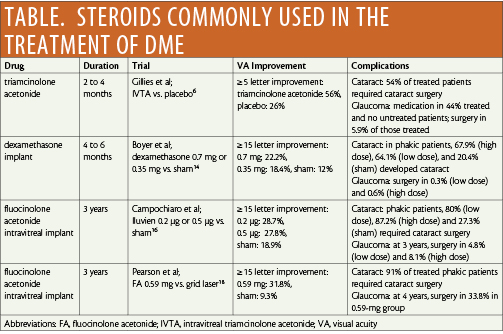
Where do today’s steroid options fit in the current management of DME? Under the broad heading of steroid therapy exist many options (Table). This article examines some of the available options and the rationales for and against their use in treatment of DME.
TRIAMCINOLONE ACETONIDE
The use of intravitreal triamcinolone acetonide (IVTA) for DME has been investigated in multiple clinical trials. IVTA has been shown to be more effective than placebo for improving vision in patients with refractory DME, and its efficacy has been studied in multiple clinical trials.6-11 The Diabetic Retinopathy Clinical Research Network Protocol I trial reported that IVTA plus laser had efficacy similar to ranibizumab (Lucentis, Genentech) plus laser in pseudophakic patients at 2 years.10,11 More recently, IVTA combined with anti-VEGF injections has been shown to provide more benefit than anti-VEGF injections alone for some patients with DME.12
IVTA is available in four preparations: triamcinolone acetonide injectable suspension 40 mg/mL (Triescence, Alcon); triamcinolone acetonide 80 mg/mL (Trivaris, Allergan); triamcinolone acetonide injectable suspension 40 mg/mL or 10 mg/mL (Kenalog, Bristol-Myers Squibb) formulated for intramuscular or intraarticular use; and preservative-free triamcinolone acetonide prepared by a compounding pharmacy. All formulations are used off-label for DME. The 40-mg/mL and 80-mg/mL formulations of triamcinolone acetonide have been approved for intravitreal injection and are prepackaged and preservative-free, thus avoiding potential sterile inflammatory reaction to preservative or to contaminants in compounded triamcinolone acetonide. The formulation of triamcinolone acetonide for intramuscular or intraarticular use contains preservatives and is not approved by the US Food and Drug Administration for intraocular use, but it is nevertheless commonly used by ophthalmologists off label.13
Injections of IVTA must be repeated every 2 to 4 months to maintain effect. For this reason, sustained-release steroid preparations have been developed to prolong the intervals between treatments.
DEXAMETHASONE IMPLANT
The sustained-release biodegradable 0.7-mg dexamethasone implant (Ozurdex, Allergan) has a duration of action of 4 to 6 months and is approved for the treatment of DME in pseudophakes and patients scheduled for cataract surgery.
In two 3-year parallel phase 3 randomized clinical trials in which patients were given either a 0.7-mg dexamethasone implant, a 0.35-mg dexamethasone implant, or sham procedure, 22.2%, 18.4%, and 12% of patients, respectively, met the primary endpoint of at least a 15-letter gain in visual acuity from baseline.14 There were high rates of cataract development in both dexamethasone groups compared with the sham group, but only two patients in the 0.7-mg dexamethasone group and one in the 0.35-mg dexamethasone group required incisional glaucoma surgery.14 A subgroup analysis of patients who had previously been treated for DME found that 21.5% of patients who received the 0.7-mg dexamethasone implant compared with 11.1% of patients in the sham group met the primary endpoint.15
Approved on the basis of these trials, the 0.7-mg dexamethasone implant has since demonstrated efficacy for DME treated primarily, for DME refractory to previous treatment, and for treatment of DME in vitrectomized patients. Its advantages include a longer duration of action (up to 6 months, compared with 1-month duration for anti-VEGF agents) and efficacy in patients unresponsive to other treatments. Like other intraocular corticosteroid treatments, disadvantages of the 0.7-mg dexamethasone implant include the development of cataract in most patients and elevated intraocular pressure (IOP) in some patients.
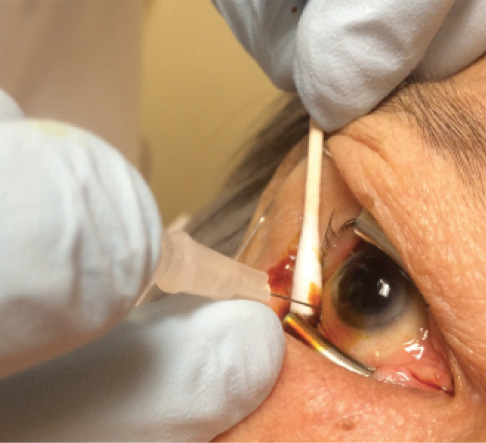
Figure. Steroid is injected intravitreally into a patient’s eye.
FLUOCINOLONE ACETONIDE IMPLANT 0.19 MG
The fluocinolone acetonide (FA) intravitreal implant 0.19 mg (Iluvien, Alimera) is an extended-release injectable nonbiodegradable device with a duration of action of 3 years. It is approved for treatment of DME in patients who did not have a significant pressure response to a previous course of corticosteroid therapy.
Efficacy of the 0.19-mg FA implant in DME was established in the FAME studies, two parallel phase 3 randomized clinical trials in which patients were randomly assigned 1:2:2 to sham injection, 0.2 µg/day insert, or 0.5 µg/day insert. The primary endpoint of the study was the percentage of patients with improvement of 15 or more letters from baseline. At month 24, approximately 28% of patients in both treatment groups achieved this endpoint, compared with 16% of patients who received sham injection.16,17 At 3 years, there was sustained visual acuity improvement, most notably in patients with duration of DME of at least 3 years prior to baseline, compared with those with DME duration of less than 3 years.17 Not surprisingly, almost all phakic patients who received the implant developed cataract, but visual improvement in these patients after cataract surgery was as good as in those who were pseudophakic at baseline. Incisional glaucoma surgery at month 36 was required in 4.8% of patients in the low-dose group and 8.1% of patients in the high-dose group. Of note, patients in the low-dose insert group who had glaucoma surgery had equally good visual outcomes compared with those who did not.17
Given its long duration of action, the 0.19-mg FA implant therefore offers promise for patients with longstanding DME refractory to other treatments, as well as for difficult-to-treat vitrectomized eyes. An added benefit to the patient is the need for far fewer injection procedures, although frequent monitoring is still required to watch for IOP elevation. As with other steroid formulations, its disadvantages include cataract development and elevated IOP.
FLUOCINOLONE ACETONIDE IMPLANT 0.59 MG
The FA intravitreal implant 0.59 mg (Retisert, Bausch + Lomb) is a surgically implanted sustained-release implant with a duration of action of approximately 2.5 years. Placing the implant requires suturing through a scleral incision at the pars plana. Although the implant is not FDA approved for treatment of DME, its use has been studied in this condition.
In a randomized clinical trial comparing the 0.59-mg FA intravitreal implant with laser in patients with refractory DME, a higher percentage of patients met the endpoint of 15 letter improvement in vision compared with those receiving laser treatment (31.8% vs. 9.3%) at 2-year follow-up.18 Although the efficacy of the device was demonstrated, 91% of phakic eyes required cataract surgery and 33.8% of patients required glaucoma surgery at 4 years. With these high complication rates, plus the need for incisional surgery to implant the device, this option is not widely used for treatment of DME. Furthermore, the device costs more than the other options mentioned above, and insurance coverage is less than straightforward.
CONCLUSION
Although intravitreal anti-VEGF injections, with or without laser, have become first-line treatment for DME, steroids (Figure) are important second-line treatments. They are available in multiple formulations that allow clinicians to select shorter-acting or sustained-release preparations tailored to individual patient needs.
We suspect that those with an excellent response to anti-VEGF therapy who are willing and able to be seen every 1 to 2 months will opt to remain on anti-VEGF therapy, while patients who have transportation issues, strong preferences for reduced frequency of injections, or minimal pressure response to IVTA will be the most likely candidates for the FA implant.
We typically recommend a stepwise approach to DME treatment, beginning with a course of three to six injections of bevacizumab (Avastin, Genentech) in all patients with DME. Suboptimal responders are typically switched to aflibercept (Eylea, Regeneron) for three or more injections. For patients who still show insufficient response (lack of normalization of thickness on spectral-domain optical coherence tomography or a dry macula), we next administer a preservative-free formulation of IVTA to gauge IOP response and retinal drying. If IOP response is muted, we either continue with IVTA injections every 3 or 4 months or consider a longer-acting steroid preparation. We have seen patients have a poor response to IVTA but have an excellent response to the dexamethasone implant, which is a logical step for suboptimal responders to IVTA. We often move more quickly to steroid therapy in vitrectomized patients.
Regarding side effects, we largely discount cataract formation because most DME patients will have early visually significant cataracts anyway and because modern cataract surgery is safe and effective. Likewise, considering the risk associated with continued anti-VEGF injections on a 1- to 2-month basis, we feel that sustained-release intravitreal implants add minimal risk and are a good option, even in the long run, assuming they show efficacy in a given patient. n
1. Klein R, Klein BE, Moss SE, Cruickshanks KJ. The Wisconsin Epidemiologic Study of Diabetic Retinopathy. XV. The long-term incidence of macular edema. Ophthalmology. 1995;102(1):7-16.
2. Tamura H, Miyamoto K, Kiryu J, et al. Intravitreal injection of corticosteroid attenuates leukostasis and vascular leakage in experimental diabetic retina. Invest Ophthalmol Vis Sci. 2005;46(4):1440-1444.
3. Felinski EA, Antonetti DA. Glucocorticoid regulation of endothelial cell tight junction gene expression: novel treatments for diabetic retinopathy. Curr Eye Res. 2005;30(11):949-957.
4. Edelman JL, Lutz D, Castro MR. Corticosteroids inhibit VEGF-induced vascular leakage in a rabbit model of blood-retinal and blood-aqueous barrier breakdown. Exp Eye Res. 2005;80(2):249-258.
5. Zhang X, Bao S, Lai D, et al. Intravitreal triamcinolone acetonide inhibits breakdown of the blood-retinal barrier through differential regulation of VEGF-A and its receptors in early diabetic rat retinas. Diabetes. 2008;57(4):1026-1033.
6. Gillies MC, Sutter FK, Simpson JM, et al. Intravitreal triamcinolone for refractory diabetic macular edema: two-year results of a double-masked, placebo-controlled, randomized clinical trial. Ophthalmology. 2006;113(9):1533-1538.
7. Dehghan MH, Ahmadieh H, Ramezani A, et al. A randomized, placebo-controlled clinical trial of intravitreal triamcinolone for refractory diabetic macular edema. Int Ophthalmol. 2008;28(1):7-17.
8. Ip MS, Bressler SB, Antoszyk AN, et al. A randomized trial comparing intravitreal triamcinolone and focal/grid photocoagulation for diabetic macular edema: baseline features. Retina.2008;28(7):919-930.
9. Yilmaz T, Weaver CD, Gallagher MJ, et al. Intravitreal triamcinolone acetonide injection for treatment of refractory diabetic macular edema: a systematic review. Ophthalmology. 2009;116(5):902-911.
10. Elman MJ, Aiello LP, Beck RW, et al; Diabetic Retinopathy Clinical Research Network. Randomized trial evaluating ranibizumab plus prompt or deferred laser or triamcinolone plus prompt laser for diabetic macular edema. Ophthalmology. 2010;117(6):1064-1077.
11. Elman MJ, Bressler NM, Qin H, et al; Diabetic Retinopathy Clinical Research Network. Expanded 2-year follow-up of ranibizumab plus prompt or deferred laser or triamcinolone plus prompt laser for diabetic macular edema. Ophthalmology. 2011;118(4):609-614.
12. Jin E, Luo L, Bai Y, Zhao M. Comparative effectiveness of intravitreal bevacizumab with or without triamcinolone acetonide for treatment of diabetic macular edema. Ann Pharmacother. 2015;49(4):387-397.
13. Watanabe A, Tsuzuki A, Arai K, et al. Efficacy of intravitreal triamcinolone acetonide for diabetic macular edema after vitrectomy. J Ocul Pharmacol Ther. 2016;32(1):38-43.
14. Boyer DS, Yoon YH, Belfort R Jr, et al. Three-year, randomized, sham-controlled trial of dexamethasone intravitreal implant in patients with diabetic macular edema. Ophthalmology. 2014;121(10):1904-1914.
15. Augustin AJ, Kuppermann BD, Lanzetta P, et al. Dexamethasone intravitreal implant in previously treated patients with diabetic macular edema: subgroup analysis of the MEAD study. BMC Ophthalmol. 2015;15(1):150.
16. Campochiaro PA, Brown DM, Pearson A, et al. Long-term benefit of sustained-delivery fluocinolone acetonide vitreous inserts for diabetic macular edema. Ophthalmology. 2011;118(4):626-635.
17. Campochiaro PA, Brown DM, Pearson A, et al. Sustained delivery fluocinolone acetonide vitreous inserts provide benefit for at least 3 years in patients with diabetic macular edema. Ophthalmology. 2012;119(10):2125-2132.
18. Pearson PA, Comstock TL, Ip M, et al. Fluocinolone acetonide intravitreal implant for diabetic macular edema: a 3-year multicenter, randomized, controlled clinical trial. Ophthalmology. 2011;118(8):1580-1587.
18. Nguyen QD, Brown DM, Marcus DM, et al. Ranibizumab for diabetic macular edema: results from 2 phase III randomized trials: RISE and RIDE. Ophthalmology. 2012;119(4):789-801.
Margaret A. Greven, MD
• clinical instructor of ophthalmology at Byers Eye Institute, department of ophthalmology, Stanford University School of Medicine, in Palo Alto, Calif.
• financial interest: none acknowledged
• margaret.greven@gmail.com
Peter Karth, MD, MBA
• assistant clinical professor at Byers Eye Institute, department of ophthalmology, vitreoretinal section, Stanford University School of Medicine, and co-director of Stanford ophthalmic innovation fellowship, in Palo Alto, Calif.
• financial interest: none acknowledged
• peterkarth@gmail.com


_1784132761.jpg?auto=compress,format&w=75)





