





Choroidal hemangioma is a vascular hamartoma that generally manifests in young to middle-aged adults with painless blurred vision. Visual acuity loss is due to one or a combination of several findings, including subretinal fluid (SRF) leakage, intraretinal edema, tumor-induced hyperopia, and long-standing amblyopia related to macular location of the tumor.1
AT A GLANCE
• Choroidal hemangioma is a vascular hamartoma that generally manifests in young to middle-aged adults with painless blurred vision. It is classified as either circumscribed or diffuse choroidal hemangioma (DCH).
•Although photodynamic therapy is the preferred treatment for circumscribed choroidal hemangioma, it is not often used for DCH because patients are young and potentially uncooperative.
• Plaque brachytherapy can deliver a precise and localized dose of radiotherapy to a selected field with minimal damage to surrounding tissues.
Based on the extent of choroidal hemangioma, this lesion is classified as either circumscribed (localized) or diffuse (involving a major portion of the fundus). The circumscribed form is sporadic, is usually located in the macular or perimacular region, and generally measures about 6 mm in basal dimension and 3 mm in thickness.2 The circumscribed form is most often controlled with photodynamic therapy (PDT).1
Diffuse choroidal hemangioma (DCH) is usually seen as a manifestation of Sturge-Weber syndrome, in association with venous angioma/telangiectasia involving the facial skin (port wine stain) and leptomeninges.1 Less commonly, ocular manifestations include vascular anomalies in the conjunctiva, episclera, and retina as “twin vessels.” Glaucoma can be a major finding of Sturge-Weber syndrome.1 Management of DCH is challenging because of the varied findings. Here we present a case of DCH with total exudative retinal detachment (RD) treated with low-dose iodine-125 (I-125) plaque radiotherapy.
CASE REPORT
A 6-year-old boy with known Sturge-Weber syndrome noted a gradual decrease in vision in his left eye (OS). He had a history of anisometropic hyperopia with refractive amblyopia OS, with previous baseline BCVA of 20/80 in both eyes (OU) at age 5 years. As an infant he underwent treatment of cutaneous port wine stain with a dermatologic tunable dye laser.
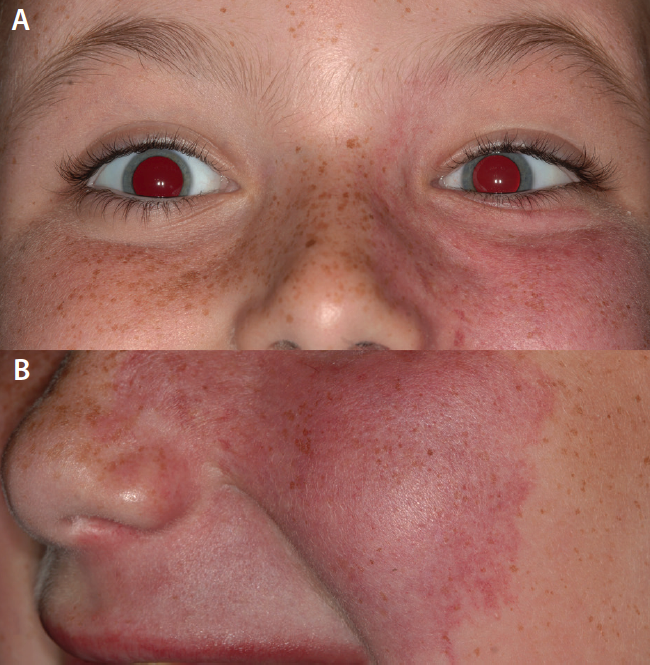
Figure 1. A 6-year-old boy with Sturge-Weber syndrome had decreased vision OS. External examination showed the laser-treated port wine stain of the left malar region (A, B).
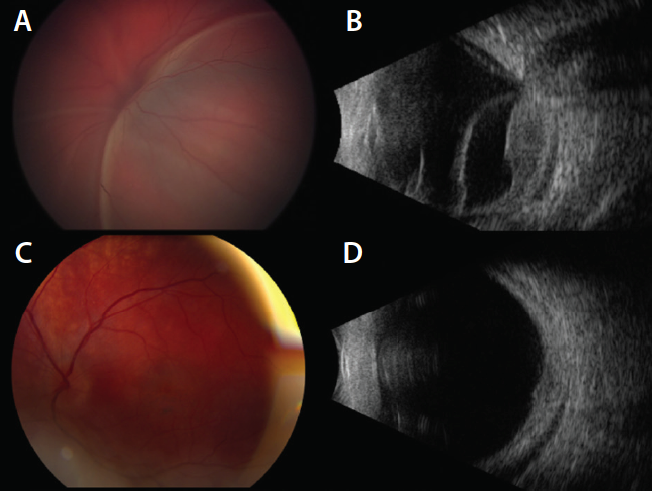
Figure 2. The fundus of the left eye disclosed a total retinal detachment overlying a diffuse choroidal hemangioma that was most prominent inferiorly (A). B-scan ultrasonography demonstrated diffuse thickening of the choroid measuring 13 mm in basal dimension and 5.6 mm in thickness (B). After plaque radiotherapy, the retinal detachment resolved (C), and the choroidal hemangioma regressed to a thickness of 2.8 mm (D).
On our examination, there was a mild residual port wine stain involving the left malar region and 10 prism diopters of left esotropia (Figure 1). Ocular motility was full OU. BCVA was 20/20 in the right eye (OD) and hand motions OS. Intraocular pressures were within normal limits OU. The right eye was unremarkable. The left eye showed minimally dilated superior conjunctival vessels with no other anterior segment abnormalities. The fundus OS disclosed total RD overlying a barely perceptible DCH that was more prominent inferiorly (Figure 2A and 2B). B-scan ultrasonography confirmed diffuse thickening of the choroid with a mass measuring 13 x 13 mm in basal dimension and 5.6 mm in thickness. Fluorescein angiography documented retinal vascular staining from the chronic RD and enhancement of the choroidal mass. MRI of the brain was within normal limits.
These findings were consistent with DCH with serous RD and visual acuity loss in a child with Sturge-Weber syndrome. The tumor was treated with I-125 plaque radiotherapy delivering a 17-mm radiation field with a tumor apex dose of 3,500 cGy over 98 hours.
Three months after plaque radiotherapy, the retina OS demonstrated nearly complete reattachment, and the tumor was regressed to 4.5 mm in thickness. At 7-month follow-up, the choroidal hemangioma was completely regressed to 2.3 mm thickness, and there was no SRF (Figure 2C and 2D). Visual acuity OS remained hand motions. At 17 months after treatment, the patient remained stable with a flat retina, regressed hemangioma, and no sign of radiation retinopathy or papillopathy. Visual acuity remained stable, and amblyopia patching therapy was advised.
DISCUSSION
Various therapeutic modalities have been proposed for DCH with exudative RD. Options include laser photocoagulation, PDT, propranolol, proton beam radiotherapy, and plaque radiotherapy.1 Laser photocoagulation is sometimes effective for eyes with shallow SRF, with the goal of treating specific sites of tumor leakage. However, PDT has largely replaced conventional laser treatment.
PDT is the treatment of choice for circumscribed choroidal hemangioma, with more than 95% success in control of related SRF. However this technology is not often used for DCH, as most patients are young and potentially uncooperative with treatment. Additionally, most tumors are large with near total RD and are judged too advanced for PDT. Anand reported the use of PDT for DCH with bullous RD in which previous conventional external beam radiation therapy had failed. In that case, the RD resolved completely by 8 weeks after standard dose PDT.3 Singh et al reported flattening of DCH with visual acuity improvement and complete resolution of SRF 6 months after standard dose PDT using a modified protocol.4 In such cases, multiple large spots and multiple sessions may be necessary for tumor control.3-5 We believe that PDT for DCH can be considered as an alternative therapy, but often the high RD behind the lens, the poor visibility of the tumor, and the young age or lack of cooperation of the patient makes this office-based therapy less successful.
Propranolol has been popularized for treatment of cutaneous capillary hemangioma of infancy, and some have proposed its use for DCH.6-8 Exudative RD associated with DCH resolved with the use of 40 mg propranolol twice daily for 6 weeks in a case described by Arevalo et al.7 Thapa and Shields described a 17-year-old boy with Sturge-Weber and DCH who was successfully treated with propranolol over a period of 7 months and demonstrated complete resolution of RD by 1 month follow-up.8 More recently, Dave et al described a patient with Sturge-Weber syndrome and DCH with exudative RD successfully managed with oral propranolol.9 However this therapy is not always effective; Krema et al10 documented two cases with lack of response, and we have documented six cases of DCH with no response (unpublished data). Based on the variable results, we tend not to employ propranolol as an alternative, as we do not want to delay retinal reattachment and visual recovery in a child.
The use of proton beam radiotherapy for choroidal hemangioma was explored in the late 1990s by Zografos et al,11 who found successful treatment of 48 circumscribed choroidal hemangiomas and six DCHs using a radiation dose ranging from 1,640 cGy to 2,730 cGy delivered in four fractions.11 Within 6 months, treated eyes showed resolution of exudative RD in 100% of cases.11 Limitations can arise when positioning a child to perform treatment. Some clinicians deliver proton therapy under general anesthesia.12,13 Further review found DCH to be less responsive to proton beam radiation than circumscribed hemangioma.12 Complications of proton beam radiation can include vitreous hemorrhage, cataract, and radiation retinopathy.11,12 Yonekawa et al13 described the use of low-dose proton radiotherapy of 2,000 cGy over 10 sessions in two cases, with resolution of SRF in both cases and a reduced risk of complications. Long-term studies with a larger number of cases are needed to determine lasting efficacy and safety.
Plaque brachytherapy delivers a precise and localized dose of radiotherapy to a selected field with minimal damage to surrounding tissues. In the treatment of DCH, the plaque is placed while the child is under anesthesia, and radiotherapy is delivered over an average of 4 days with apex dose of 3,500 cGy. Chao et al14 reported successful results with the use of plaque brachytherapy for circumscribed choroidal hemangioma with total RD up against the back of the lens. Recently, Arepalli et al15 described five patients with DCH treated with custom-designed I-125 plaque radiotherapy with mean radiation duration of 95 hours and mean apex dose of 3,500 cGy. The mean tumor basal diameter was 16 mm, and mean thickness was 5 mm. Complete tumor regression with resolution of SRF was achieved in 100% of eyes at 4 months (n=4) or at 7 months (n=1), lasting over a mean follow-up of 3 years.15 Visual acuity was stable or improved in four patients, and no radiation-related complication was seen. Others have shown similar results with ruthenium-106 plaque application.16,17
CONCLUSION
In our case, low-dose plaque radiotherapy led to complete tumor regression and complete resolution of total RD, allowing avoidance of iris neovascularization. We suspect the poor visual outcome was partly related to the tumor directly, as well as to the long-standing RD with photoreceptor atrophy and amblyopia. There was no evident radiation-related retinopathy. n
1. Shields JA, Shields CL. Diffuse choroidal hemangioma. In Shields JA, Shields CL, eds. Intraocular Tumors: An Atlas and Textbook. 3rd ed. Philadelphia, PA: Lippincott Williams & Wilkins; 2016:264-269.
2. Shields CL, Honavar SG, Shields JA, et al. Circumscribed choroidal hemangioma. Clinical manifestations and factors predictive of visual outcome in 200 consecutive cases. Ophthalmology. 2001;108(12):2237-2248.
3. Anand R. Photodynamic therapy for diffuse choroidal hemangioma associated with Sturge Weber syndrome. Am J Ophthalmol. 2003;136(4):758-760.
4. Singh AD, Rundle PA, Vardy SJ, Rennie IG. Photodynamic therapy of choroidal haemangioma associated with Sturge-Weber syndrome. Eye (Lond). 2005;19(3):365-367.
5. Ang M, Lee SY. Multifocal photodynamic therapy for diffuse choroidal hemangioma. Clin Ophthalmol. 2012;6:1467-1469.
6. Léauté-Labrèze C, Hoeger P, Mazereeuw-Hautier J, et al. A randomized, controlled trial of oral propranolol in infantile hemangioma. N Engl J Med. 2015;372(8):735-746.
7. Arevalo JF, Arias JD, Serrano MA. Oral propranolol for exudative retinal detachment in diffuse choroidal hemangioma. Arch Ophthalmol. 2011;129(10):1373-1375.
8. Thapa R, Shields CL. Oral propranolol therapy for management of exudative retinal detachment from diffuse choroidal hemangioma in Sturge-Weber syndrome. Eur J Ophthalmol. 2013;23(6):922-924.
9. Dave T, Dave VP, Shah G, Pappuru RR. Diffuse choroidal hemangioma masquerading as central serous chorioretinopathy treated with oral propranolol. Retin Cases Brief Rep. 2016;10(1):11-14.
10. Krema H, Yousef YA, Durairai P, Santiago R. Failure of systemic propranolol therapy for choroidal hemangioma of Sturge-Weber syndrome: a report of 2 cases. JAMA Ophthalmol. 2013;131(5):681-683.
11. Zografos L, Egger E, Bercher L, et al. Proton beam irradiation of choroidal hemangiomas. Am J Ophthalmol. 1998;126(2):261-268.
12. Höcht S, Wachtlin J, Bechrakis NE, et al. Proton or photon irradiation for hemangiomas of the choroid? A retrospective comparison. Int J Radiat Oncol Biol Phys. 2006;1;66(2):345-351.
13. Yonekawa Y, MacDonald SM, Shildkrot Y, Mukai S. Standard fractionation low-dose proton radiotherapy for diffuse choroidal hemangiomas in pediatric Sturge-Weber syndrome. J AAPOS. 2013;17(3):318-322.
14. Chao AN, Shields CL, Shields JA, et al. Plaque radiotherapy for choroidal hemangioma with total retinal detachment and iris neovascularization. Retina. 2001;21(6):682-684.
15. Arepalli S, Shields CL, Kaliki S, et al. Diffuse choroidal hemangioma management with plaque radiotherapy in 5 cases. Ophthalmology. 2013;120(11):2358-2359.
16. Murthy R, Honavar SG, Naik M, et al. Ruthenium-106 plaque brachytherapy for the treatment of diffuse choroidal hemangioma in Sturge-Weber syndrome. Indian J Ophthalmol. 2005;53(4):274-275.
17. Kubicka-Trzaska A, Karska-Basta I, Oleksy P, Romanowska-Dixon B. Management of diffuse choroidal hemangioma in Sturge-Weber syndrome with ruthenium-106 plaque radiotherapy. Graefes Arch Clin Exp Ophthalmol. 2015;253(11):2015-2019.
Lara Queirós, MD
• ophthalmologist at Braga Hospital and Portuguese Institute of
Oncology, Porto, Portugal
• laraqueiros.md@gmail.com
Carol L. Shields, MD
•co-director of the Ocular Oncology Service, Wills Eye Hospital,
Thomas Jefferson University in Philadelphia, Pa.
•member of the Retina Today editorial advisory board
• carolshields@gmail.com
Kareem Sioufi, MD
•research intern of the Ocular Oncology Service, Wills Eye Hospital,
Thomas Jefferson University in Philadelphia, Pa.
•member of the Retina Today editorial advisory board
• kareem.sioufi@gmail.com
No conflicting relationship exists for any author.
Support provided by Eye Tumor Research Foundation, Philadelphia, Pa. (CLS). The funders had no role in the design and conduct of the study, in the collection, analysis and interpretation of the data, and in the preparation, review or approval of the manuscript. Carol L. Shields, MD, has had full access to all the data in the study and takes responsibility for the integrity of the data and the accuracy of the data analysis.


_1784132761.jpg?auto=compress,format&w=75)





