


The widespread adoption of optical coherence tomography (OCT) across ophthalmology has significantly influenced clinical care for ophthalmic diseases. Recently, several clinical papers have shown that intraoperative OCT can now provide surgeons with valuable information that cannot be gathered through the conventional view of a microscope.1,2 The integration of an intraoperative OCT system into a microscope affords clinicians the ability to see the surgical procedure in real time from a different perspective. In this article, I share my early experience with and impressions of intraoperative OCT.
AT A GLANCE
• Integration of an intraoperative OCT system into the surgical microscope allows the surgeon to view additional information on procedures in real time.
•The author reports his experience using the Opmi Lumera 700 microscope and the Rescan 700 intraoperative OCT at Moorfields Eye Hospital for surgical decision-making, intraoperative diagnostics, and training.
• Intraoperative OCT enables better visualization of ocular structures during surgical procedures and allows the detection of details not visible through conventional microscopes.
EXPERIENCE WITH INTRAOPERATIVE OCT
At Moorfields Eye Hospital we began using the Opmi Lumera 700 microscope (Carl Zeiss Meditec) and Rescan 700 intraoperative OCT (Carl Zeiss Meditec) for surgical decision-making, intraoperative diagnostics, and training over the past year. We have found it to be a valuable tool in posterior segment surgery.
The Rescan 700 is a real-time intraoperative OCT system that can be fully integrated into the Opmi Lumera 700 microscope and controlled from the microscope footpedal, allowing surgeons to take videos, snapshots, and 3-D OCT images without looking up or interrupting surgery. Additionally, the Rescan 700 allows the surgeon to simultaneously see the surgical field in both a planar view and a cross-sectional view in real time.
HOW WE USE IT
We employed intraoperative OCT scanning for routine and complex vitreoretinal cases using 23-, 25-, and 27-gauge vitrectomy during a 3-month period. The surgeries were performed either by me or by my senior fellows under my supervision. The integrated data injection system (IDIS) superimposes the intraoperative OCT B-scans into the eyepieces in real time. Both this visualization technology and the external video screen showing the OCT information were evaluated for retinal and macular surgery. The microscope ocular displays, the live feed for the OCT line scans, the video screen monitor, and the touchscreen monitor allow the surgeon to adapt the OCT images to his or her needs as far as size, centering, and rotation during surgical steps. A total of 20 patients underwent surgery; the case mix included diabetic and sickle cell retinopathy delamination surgery, macular pucker surgery, vitreoschisis and epiretinal membrane (ERM) dissection, rhegmatogenous retinal detachment (RRD), vitreomacular traction, acute retinal necrosis, optic disc pit maculopathy, diabetic vitreous hemorrhage, and macular hole surgery.
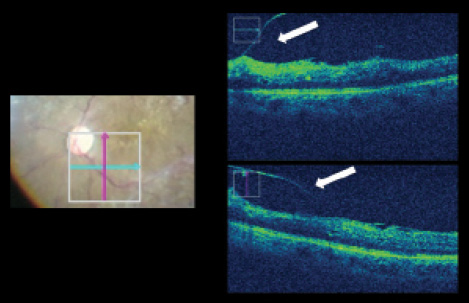
Figure 1. Patient with ERM and persistent vitreous attachments with vitreoschisis (arrows).
OUR ASSESSMENT
The Rescan 700 intraoperative OCT had significant advantages to enhance surgical decision-making, and it was excellent for teaching and training the surgical fellows. The intraoperative OCT technology provided high-resolution visualization of the effects of surgical maneuvers on the microarchitecture of the retina and surrounding tissues, including additional information for a better understanding of the pathophysiology and prognostic factors of vitreomacular disorders. Intraoperative OCT was helpful in acquiring extra information such as the presence of invisible membranes (eg, ERMs, subretinal membranes, intraretinal fibrosis, and proliferative vitreoretinopathy), the location of small tears, and the identification of the retinal plane under suboptimal conditions for microscope visualization during vitreoretinal surgery.
Detection of Architectural Changes During ERM Peeling
With intraoperative OCT, it was possible to detect and monitor retinal architectural changes that can occur during ERM peeling. Following posterior vitreous detachment (PVD), the Rescan 700 was a valuable surgical tool for intraoperative visualization of vitreoschisis (Figure 1). Despite surgical confirmation of PVD with no residual vitreous using intravitreal triamcinolone, intraoperative OCT offered immediate visualization of persistent vitreous layers and retinal anatomy before ERM peeling. In ERM and internal limiting membrane peeling, intraoperative OCT technology contributed significantly to the understanding of intraoperative traumatic changes caused by the peeling procedure, and the ability to assess intraretinal thickness and intraretinal cysts intraoperatively was very useful.
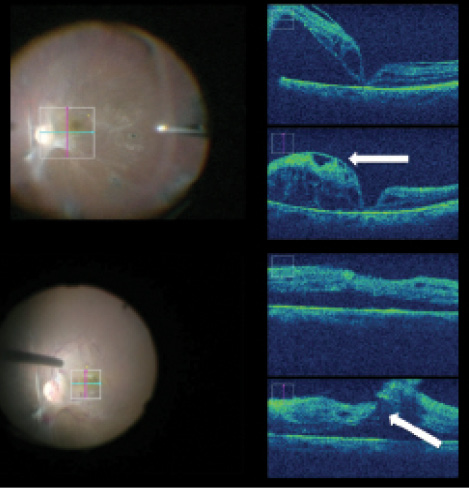
Figure 2. Patient with tractional retinal detachment and ERM (top right, arrow). After delamination surgery, reduced preretinal traction with a full thickness macular hole can be visualized (bottom right, arrow).
Vital Information During Vitrectomy Surgery
During delamination surgery in diabetics, it is often not possible, even with ultrasound, to visualize details of the macula and retina due to preoperative vitreous hemorrhage. During vitrectomy surgery, there are complex vitreomacular adhesions caused by preretinal neovascularization and vitreoschisis. In one patient with a tractional retinal detachment involving the fovea, microscope-integrated intraoperative OCT with real-time feedback provided important information to the surgeon to guide surgical maneuvers (Figure 2). This imaging technology was also useful to visualize macular hole formation after peeling intraoperatively during repair of complex retinal detachments, and it informed further discussion of the choice of intraocular tamponade in such cases.
Enhanced Visualization During Vitrectomy in Patients With Sickle Cell Disease
Intraoperative OCT has also been useful during pars plana vitrectomy in patients with sickle cell disease, allowing visualization of corresponding changes in the retinal architectural and the vitreoretinal interface in the peripheral quadrants (Figure 3). Following vitrectomy, the peripheral sickle complexes present challenges, as the endpoint of surgery can be difficult to confirm. In cases of tractional vitreous hemorrhage and RRD with tractional tears or holes, the Rescan 700 intraoperative OCT system was useful for detecting epiretinal traction and retinal breaks so that they could be treated comprehensively. Intraoperative OCT was also able to delineate the entire sickle fibrovascular complex, both on direct peripheral scanning and on intraoperative peripheral examination during scleral indentation. The presence of residual vitreoretinal traction, tractional holes, and tears was easily identified with the Rescan 700.
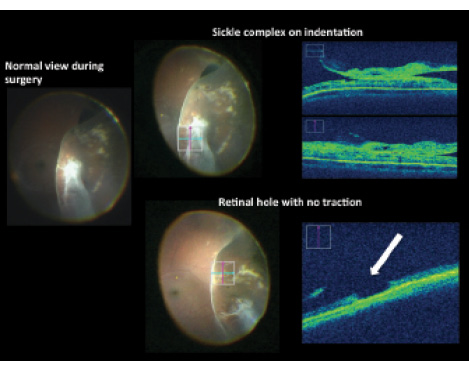
Figure 3. Sickle complex on indentation (top right) and retinal hole with no traction (bottom right, arrow) cannot be seen with the normal microscope view during surgery (left), but can be visualized with intraoperative OCT.
The IDIS enabled rapid tracking and precise evaluation of the vitreoretinal interface and macular and peripheral retinal layers. In my opinion, the Rescan 700 is an excellent teaching tool that allows detailed evaluation of surgical steps. It was also rated highly by my surgical fellows. In our experience, use of the Rescan 700 influenced us to alter our management of complications in the majority of cases.
INTRAOPERATIVE OCT: A VALUABLE TOOL FOR SURGICAL DECISION-MAKING
Intraoperative OCT is a significant advance for vitreoretinal surgeons. It enables better visualization of ocular structures during the surgical procedure, and it allows detection of details not visible through conventional microscopes. In vitreoretinal surgery, the combination of a high-resolution microscope and an intraoperative OCT system is valuable in the decision-making process for complex and routine surgery cases. Because the system is fully integrated into the surgical workflow, there is no interruption of the procedure. n
1. Ehlers JP, Kaiser PK, Srivastava SK. Intraoperative optical coherence tomography using the RESCAN 700: preliminary results from the DISCOVER study. Br J Ophthalmol. 2014;98(10):1329-1332.
2. Ehlers JP, Goshe J, Dupps WJ, et al. Determination of feasibility and utility of microscope-integrated optical coherence tomography during ophthalmic surgery: the DISCOVER Study RESCAN Results. JAMA Ophthalmol. 2015;133(10):1124-1132.
Mahi Muqit, PhD, FRCOphth
• consultant ophthalmologist and vitreoretinal surgeon at
Moorfields Eye Hospital, City Road, London, United Kingdom
• financial interest: none acknowledged
• Mahi.Muqit@Moorfields.nhs.uk


_1784132761.jpg?auto=compress,format&w=75)





