




Patients undergoing intraocular surgery, whether cataract or vitreoretinal surgery, are routinely examined on the day after surgery. This is driven by concerns of infection, wound leaks, and elevated intraocular pressure (IOP). In the vast majority of cases, the postoperative day 1 (POD1) exam is unremarkable, especially if the surgery was uncomplicated.
AT A GLANCE
• Many surgical specialties see postoperative patients several weeks after uncomplicated outpatient surgeries, but the standard for eye surgery is a postoperative day 1 exam.
• These exams are usually unremarkable, especially if the surgery was uncomplicated.
• Instituted with proper safeguards, a postoperative day 2 exam could offer greater convenience for patients without sacrificing safety.
As retina practices become larger and include multiple office locations sometimes distant from where patients live or where their surgery was performed, scheduling and logistics become more challenging. Ideally, patients would have their POD1 exam with the operating surgeon at an office close to their home. But with multioffice practices, the surgeon may be in an office across town or even across the state, leaving patients with the choice of either a long drive or seeing a different surgeon whom they do not know.
A postoperative day 2 (POD2) examination may eliminate some of these issues if it allows patients to be seen by their own surgeon and at a convenient office. The concern is patient safety: whether skipping the POD1 visit places patients at increased risk of complications or adverse outcomes. We undertook a study to answer this question.
STUDY SPECIFICS
A single surgeon (BCJ) in a 12-physician retina-only practice in metropolitan Denver decided to see some postoperative patients on the second postoperative day, rather than on the first. The decision was made on a case by case basis and was influenced by scheduling and logistics, not the actual type of surgery performed or the underlying disease. A typical scenario was as follows: A patient living in the south of Denver had surgery in an ambulatory surgery center (ASC) on that same side of town. The surgeon was in an office north of Denver on POD1 but worked at the office attached to the south side ASC on POD2. Having the exam on POD2 allowed the surgeon to see his own patient at an office location that was convenient and familiar for the patient. Approximately 130 surgical cases were identified for which the patient had a POD2 exam.
What Happened on POD1?
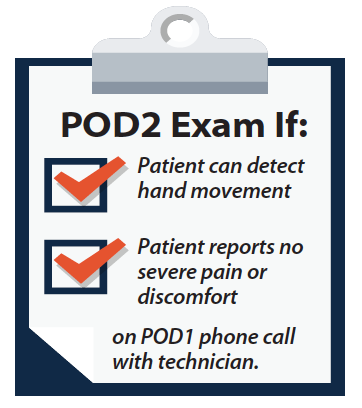
On POD1, all patients received a technician phone call to check on them, review drop and positioning instructions, and answer any questions. Specifically, all patients were asked whether they could see their hand moving in front of their eye and whether they were experiencing any pain or discomfort that they would rate as severe. If vision was less than hand movements or pain was severe, an office visit was scheduled for that same day.
What Surgeries Were Performed?
The surgical cases were all vitrectomy; a few also included a scleral buckle. The vast majority of vitrectomies were 23-gauge and 27-gauge cases. About a third of cases involved membrane peeling. Half had endolaser, and almost all had either nonexpansile gas or air left in the eye. A few had silicone oil. Again, the decision to see the patient on POD2 rather than on POD1 was not affected by the type of surgery, only by scheduling and logistic issues. These cases were representative of the types of surgery performed by the surgeon and by the entire practice.
What Problems Were Encountered?
At POD2 exams, IOP ranged from single digits to mid-
50s mm Hg, with an average of 16 mm Hg. Only one patient triggered a POD1 office visit based on severe pain identified during the technician phone call. That patient was examined in the office on POD1 and was noted to have an IOP of 46 mm Hg, which was treated with a vitreous gas tap. No other patient required a POD1 exam. Those with a high IOP on POD2 were treated medically, resulting in normalization of IOP.
No cases of wound leak or endoph-thalmitis were seen. All patients had a postoperative course consistent with their underlying disease and treatment.
WHAT DOES THIS MEAN?
The three main complications occurring acutely after vitreoretinal surgery are wound leak, elevated IOP, and endophthalmitis. The purpose of the POD1 or POD2 exam is to identify and treat these complications should they occur.
Wound leak may occur after small-gauge sutureless vitrectomy. A recent review paper noted that hypotony (IOP < 6 mm Hg) occurred in 0% to 25% of cases, but it was transient and typically resolved spontaneously.1 In our series, only one patient met this criterion for hypotony. The surgeon’s preference is to suture small-gauge sclerotomies only if silicone oil is placed, not for gas or air.
Elevated IOP is known to occur after pars plana vitrectomy (PPV). A series published in 1989 noted that about a third of patients had acute IOP elevation greater than 30 mm Hg after vitrectomy.2 Of note, this was the era of sutured 20-gauge sclerotomies. The vast majority of vitrectomy surgery today is done using small-gauge instrumentation and a sutureless technique. The advantage of a small-gauge sutureless sclerotomy is that it can act as a relief valve, allowing expression of gas in the event of elevated IOP.
Endophthalmitis, the third complication of concern, fortunately is quite rare after PPV, with an incidence ranging from 0.03% to 1.55%.3 A large 2-year national surveillance study in the United Kingdom reported an incidence of 0.058%.3 Endophthalmitis presents, on average, 3 days after vitrectomy, and the vast majority of patients experience pain.4 Presentation on POD1 is rare.4
Thus, it is unlikely that a significant complication will be missed by examining a patient on POD2 rather than on POD1. This is especially the case when a technician phone call on POD1 is conducted, using the triggers of severe pain and/or extremely poor vision to immediately schedule a POD1 examination. This allows patients with significantly elevated IOP or the potentially rare complication of endophthalmitis to be identified and promptly managed.
It is always possible, albeit unlikely, that a serious complication might be missed using this strategy to determine whether to conduct a postoperative visit on day 1 or on day 2. Then again, if the patient is examined on POD1, he or she might not be seen again for another 1 or 2 weeks. IOP elevation may manifest a few days after surgery if there is gas expansion or a steroid response from postoperative drops. Endophthalmitis typically appears 3 days after surgery, after the POD1 exam. When such complications occur, we rely on the patient reporting increasing pain or decreasing vision and being examined promptly, regardless of the postoperative day.
Advantages of this strategy for the patient include being seen by the operating surgeon in a convenient office location. Because many vitreoretinal surgical patients are elderly or may not be comfortable driving shortly after surgery, especially with a gas bubble and poor vision in one eye, office visits depend on a family member or caregiver, meaning two individuals are affected by the logistics of the postoperative office visit. Physicians are now being graded on quality, including the “patient experience of care” of the Institute for Healthcare Improvement’s Triple Aim.5 More flexible scheduling of these visits would enhance this metric.
FLEXIBILITY IN THE FUTURE?
Most other surgical specialties see postoperative patients several weeks after uncomplicated orthopedic, plastic, urologic, gynecologic, or general surgical procedures performed on an outpatient basis. The standard for eye surgery is a POD1 exam. Hopefully more studies such as the one described here can help to gradually shift the standard of care in a more patient-friendly direction without sacrificing patient safety. n
1. Khanduja S, Kakkar A, Majumdar S, Vohra R, Garg S. Small gauge vitrectomy: Recent update. Oman J Ophthalmol. 2013;6(1):3-11.
2. Han DP, Lewis H, Lambrou FH Jr, Mieler WF, Hartz A. Mechanisms of intraocular pressure elevation after pars plana vitrectomy. Ophthalmology. 1989;98(9):1357-1362.
3. Dave VP, Pathengay A, Schwartz SG, Flynn HW. Endophthalmitis following pars plana vitrectomy: a literature review of incidence, causative organisms, and treatment outcomes. Clin Ophthalmol. 2014;8:2183-2188.
4. Kunimoto DY, Kaiser RS; Wills Eye Retina Service. Incidence of endophthalmitis after 20- and 25-gauge vitrectomy. Ophthalmology. 2007;114(12):2133-2137.
5. The IHI Triple Aim. Institute for Healthcare Improvement. 2016. www.ihi.org/engage/initiatives/tripleaim/pages/default.aspx. Accessed September 15, 2016.
Section Editor Dean Eliott, MD
• associate director, retina service, Massachusetts Eye and Ear Infirmary, Boston, Mass.
Section Editor Ingrid U. Scott, MD, MPH
• professor of ophthalmology and public health sciences, Penn State Eye Center, Penn State College of Medicine, Hershey, Pa.
Brian C. Joondeph, MD, MPS
• a partner at Colorado Retina Associates, Denver
• financial interest: none acknowledged
• @retinaldoctor; bjoondeph@retinacolorado.com
Jon Zick, OSC
• ophthalmic technician at Colorado Retina Associates, Denver
• financial interest: none acknowledged


_1784132761.jpg?auto=compress,format&w=75)





