





Thanks to the technological advances that have occurred in the past decade, pars plana vitrectomy (PPV) has become a more reliable procedure than it once was. The choice of which of the many available modern vitrectomy machines to use is usually determined by the surgeon’s predilections and by the surgical techniques he or she typically performs.
In this article, we share our impressions after several months of using the R-Evolution CR (Optikon), a new surgical platform designed for performing both anterior and posterior segment procedures, as well as combined procedures.
AT A GLANCE
• The R-Evolution CR is a surgical platform designed for combined anterior and posterior segment procedures.
• Illumination in this system comes from two high intensity discharge lamps, each with four filters that protect patients’ retinas from phototoxicity.
• A new cutter enables vitrectomy to be performed with high cutting rates, resulting in low traction on the retina.
UPGRADEABLE TECHNOLOGY
The R-Evolution CR can be continually upgraded based on the demands of the surgeon. Hardware and software updates are simply accomplished by plugging in a USB drive. Features include a 19-inch high-definition touch screen, a user-friendly interface, and a stylish design, accompanied by a motorized retractable tray and a wireless ergonomic footpedal. Other specifications are broken down by category below.
Irrigation
Fluid delivery with the R-Evolution CR is accomplished with a standard gravity-fed system governed by the height of the irrigation bottle. The system allows two different heights for simultaneous use of two bottles, as is often necessary in combined procedures.
The machine is also capable of forced irrigation with continuous monitoring of intraocular pressure (IOP). This latter feature, although complex and expensive, offers the advantage of IOP monitoring throughout the surgical procedure.
Illumination
The R-Evolution CR comes with two high intensity discharge lamps operating at 4,300 kelvin (K) and 5,000 K, respectively. The 5,000 K lamp provides a bright white light that is ideal for short procedures that require high precision and detail. The 4,300 K lamp can be used to maintain a safer profile during longer procedures. Each lamp contains two outputs to allow the use of multiple chandeliers.
Each lamp also has four filters, which is useful because they allow users to offer the patient some protection against phototoxicity on long procedures and to increase the contrast for viewing during gas-fluid exchanges and when addressing membranes.
Aspiration
Both peristaltic and venturi pump types are incorporated into the R-Evolution CR. Because surgeons can encounter different degrees of vitreous adherence to the retina, this versatile vitrectomy system makes it possible to perform a quick core vitrectomy in the presence of a fluid vitreous using the venturi pump. Conversely, in the presence of a dense vitreous gel or during shaving of the vitreous base, it may be advisable to use the peristaltic pump.
Vitrectomy
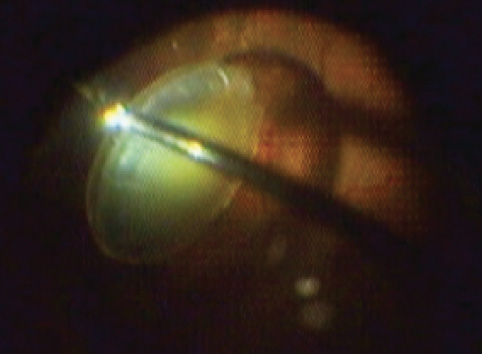
Figure 1. Vitreous shaving in an eye with a subluxated lens. The constant flow and high cut rates possible with the Twedge cutter allowed safe removal of the zonule fibers from the vitreous base.
The R-Evolution CR allows the use of 20-, 23-, and 25-gauge instrumentation. It offers a standard guillotine-shaped cutter handpiece that achieves cutting rates of 60 to 6,000 cuts per minute. This module is available with an adjustable duty cycle in three modes: open, 50% open, and closed. The asymmetric duty cycle system allows rapid core vitrectomy in the open mode. Patients with a mobile retina can be operated on using the 50% open mode. Vitreous shaving is carried out using the closed mode (Figure 1).
The standard cutter has certain limitations, including fluctuation (and even decrease) of aspiration flow rate at high cut rates, which, in turn, makes cutting inefficient. This results in a procedure that could potentially cause iatrogenic holes as mobile, detached retina dangerously approaches the port during every cutting cycle.
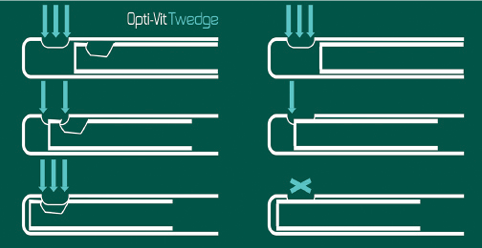
Figure 2. The Opti-Vit blade (left) cuts both ways, at the proximaland distal ends of its run, and the enlarged port surface remains open in both cases, in contrast with the standard cutter (right).
Image courtesy of Optikon
To address this issue, a new cutter, the Opti-Vit Twedge cutter (Optikon), available with the R-Evolution CR platform, offers advantages that ensure safer vitrectomy. The cutter has an outer shaft with a slightly enlarged port. Its inner cylinder has a rectangular opening and a double beveled blade that cuts at both the proximal and distal ends, leaving the entire port surface open (Figure 2). This nearly doubles the number of cuts per minute that can be performed.
Additionally, because the cutter keeps the port always open, the duty cycle stays open virtually 100% of the time. Continuous aspiration flow and low fluctuation of kinetic energy (acceleration of vitreous fibers entering into the port while the cutter slides) is thus obtained, resulting in less retinal traction exerted through the fibers and allowing a more gentle and safe vitrectomy,1 while also reducing surgical time.
SUCCESSFUL SURGERY WITH THE R-EVOLUTION CR
Case No. 1
A 61-year-old woman with a history of myopia and cataract surgery in both eyes 2 years previously presented with the complaint of loss of vision in her left eye lasting about 15 days. Her visual acuity was 20/20 in the right eye and hand movement in the left. Examination of the patient’s left eye revealed a total, bullous, mobile retinal detachment that involved the pars plana in some sectors. Additionally, a peripheral tear was spotted in the superotemporal retina. The right eye examination was unremarkable. After discussion with the patient, we performed a 23-gauge PPV using the R-Evolution CR.
The presence of an elevated and mobile retinal detachment that compromises the retina beyond the ora can be a surgical challenge even to the most experienced surgeon. The Opti-Vit Twedge cutter allowed us to perform safe and steady vitrectomy even in this dangerous environment, without the need for heavy liquids in the first stages of the procedure to stabilize the retina (Figure 3). For the most part, exchanges with different tamponades were performed using the same cutter as an active aspiration instrument so as not to waste time with unnecessary instrument exchange. A 14% mixture of C3F8 was left in the eye with no major issues.
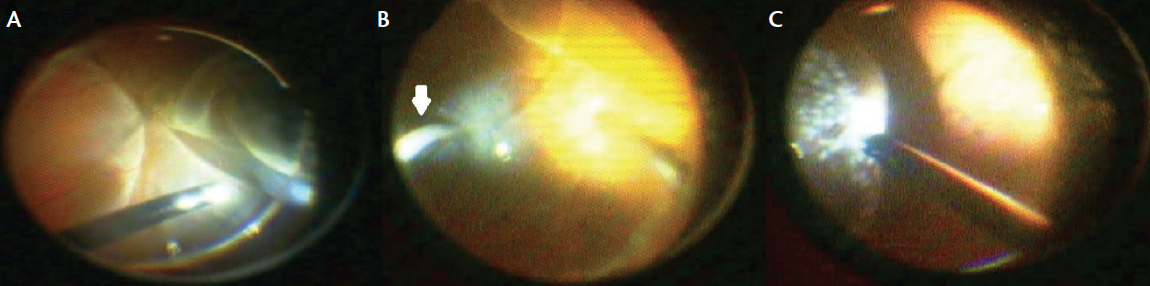
Figure 3. A secure vitrectomy is performed using the Opti-Vit Twedge cutter to address a mobile and bullous retinal detachment (A). During the exchange with perfluorocarbon, a viscous, yellowish liquid (arrow) appeared from underneath the retina through the peripheral tear (B). Laser spots can be seen around the tear; a safe perfluorocarbon-air exchange was performed using the cutter with active aspiration (C).
Case No. 2
A 33-year-old man was referred to us; he had been assessed at another hospital 1 month earlier after experiencing ocular trauma in his right eye while hammering metal in his workshop. The patient’s visual acuity was counting fingers in the right eye and 20/20 in the left. Examination of his right eye revealed a self-sealed central corneal wound accompanied by a traumatic cataract, with some signs of siderosis in the anterior chamber. Although fundus examination could not be performed because of the lens opacity, ocular ultrasound and CT scan strongly suggested the presence of an intraocular foreign body (IOFB) with the retina still attached. The left eye examination was unremarkable. A phacovitrectomy with intraocular lens (IOL) implantation and IOFB extraction, if possible, was planned for the patient’s right eye.
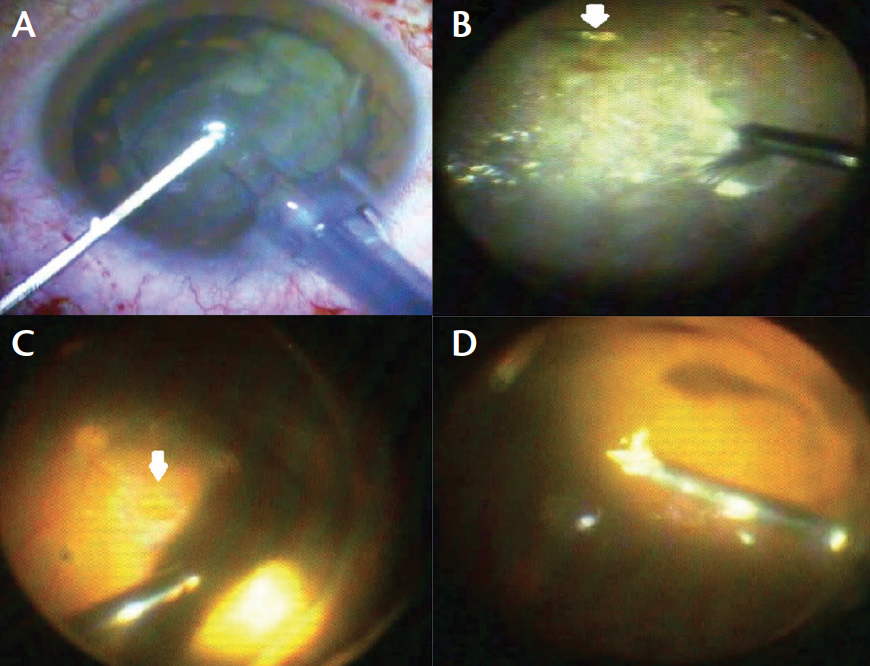
Figure 4. A smooth phacoemulsification is performed in a patient with IOFB and some signs of siderosis in the anterior chamber (A). The IOFB can be seen (arrow) as the posterior vitreous is detached using active aspiration in a safe fashion (B). The impact zone is visible far behind the superior arcade (arrow) as vitreous shaving is performed at the peripheral site selected for the IOFB extraction (C). The IOFB is gripped and ready for extraction (D).
The R-Evolution CR enabled us to perform a combined procedure without any delay, proceeding from phacoemulsification with IOL implantation to vitrectomy and IOFB extraction (Figure 4).
For this case, a mixed 23- and 20-gauge vitrectomy was performed with no issues over an attached retina. Employing a combination of the redesigned port of the Opti-Vit Twedge cutter and the two vacuum pumps, we achieved an active posterior vitreous detachment. The entire vitrectomy was done with high cutting rates, allowing us to exert low traction over the retina. Special care was taken in the peripheral zone to facilitate IOFB extraction, which was performed with forceps. At the end, silicone oil was injected because of an impact site caused by the IOFB that we spotted in the posterior pole.
A SOLID PERFORMER
The R-Evolution CR vitrectomy system is a viable option for current retina surgery trends, and, in our opinion, this machine promises to stand the test of time and to change with the times, thanks to its ability to be upgraded in the future. n
1. Rossi T, Querzoli G, Malvasi C, et al. A new vitreous cutter blade engineered for constant flow vitrectomy. Retina. 2014;34(7):1487-1491.
Section Editor Albert Augustin, MD
• professor and chairman of the department of ophthalmology, Staedtisches Klinikum Karlsruhe, in Karlsruhe, Germany
Section Editor Ehab N. El-Rayes, MD, PhD
• professor of ophthalmology, Institute of Ophthalmology in Cairo, Egypt; vitreoretinal consultant, The Retina Clinic, in Cairo, Egypt
Section Editor, Masahito Ohji, MD
• professor and chairman of the department of ophthalmology, Shiga University of Medical Science, in Otsu, Shiga, Japan
Section Editor, Stanislao Rizzo, MD
• chair of the department of ophthalmology, University of Florence, in Florence, Italy
Roberto Alejandro Guerra Garcia, MD
• a member of the Retina-Vitreous Service at the Instituto Cubano de Oftalmología and a research associate at the University of La Habana, Cuba
• financial interest: none acknowledged
• ralejandrogg2011@gmail.com
Beatriz N. Rodriguez Ridriguez, MD
• head of the Retina-Vitreous Service at the Instituto Cubano de Oftalmología and a research associate at the University of La Habana, Cuba
• financial interest: none acknowledged
• brr110564@gmail.com
Violeta R. Rodriguez Ridriguez, MD
• a member of the Retina-Vitreous Service at the Instituto Cubano de Oftalmología and a research associate at the University of La Habana, Cuba
• financial interest: none acknowledged
• violevr@yahoo.es


_1784132761.jpg?auto=compress,format&w=75)




