





In 2015, an estimated 1 million US adults aged 40 years and older were blind and 3.2 million were visually impaired.1 These numbers are projected to double by 2050. Some of these patients, especially those over age 70 years, also have hearing loss, and this combination of sensory impairments can result in substantial deficiencies in the ability of these individuals to perform activities of daily living (ADL)2 such as reading, walking, cooking, recognizing faces, shopping, handling money, taking medications, and participating in social interactions.
AT A GLANCE
• Low vision is more than special magnifiers and devices; it is also about helping the visually impaired lead more independent, happier lives.
• When visual impairment is in its early stages, the amount of magnification and special devices a patient requires are less intensive, and the patient may more readily accept these interventions.
• Early involvement with a low vision specialist and referral to a psychosocial specialist may improve overall functional outcomes.
According to the National Eye Institute (NEI),3 low vision is defined as best corrected visual acuity (BCVA) of less than 6/12 (20/40) in the better-seeing eye of a patient not considered blind.
By definition, the vision of patients with low vision cannot be further improved (to better than 20/40) with standard refraction or currently available pharmacologic or surgical interventions. Low vision specialists seek to maximize these patients’ remaining vision through the use of devices such as telescopes, magnifiers, video magnifiers, special absorptive filters, and computer technologies.
With the number of patients with age-related macular degeneration (AMD), diabetic retinopathy, and other related conditions on the rise, it is important for retina specialists to determine how patients with low vision can best be served.
THE IMPORTANCE OF REFERRING EARLY
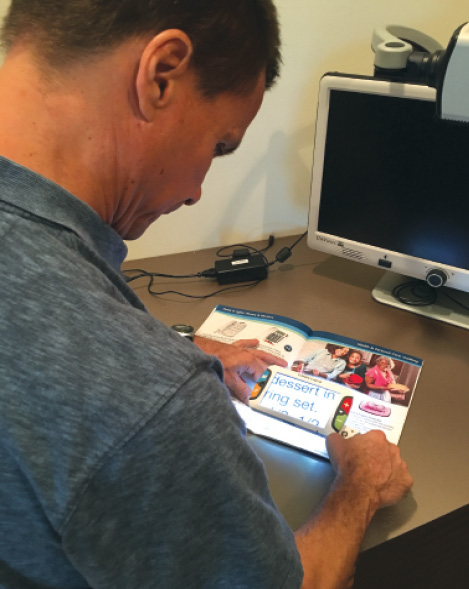
Figure. Demonstration of the use of a handheld video magnifier. Photo courtesy of Armando Monroig.
In general, it is better to refer a patient to a low vision expert earlier rather than later for several reasons. First, when visual impairment is in its early stages, the magnification and special devices a patient requires will be relatively less intensive, and the patient may more readily accept these interventions. At early stages, these aids may include electronic reading devices (eg, Kindle, Nook, iPad), brighter reading lights (eg, OttLite), high-plus reading lenses, and handheld magnifiers (Figure). Additionally, patients may benefit from simply holding reading material closer.
Second, when a patient is referred to a low vision specialist in the early stages of visual impairment, he or she may be more accepting of additional interventional measures, such as assistive technologies like the Job Access With Speech (JAWS; Freedom Scientific) screen reader. Third, earlier referrals allow more time for the patient and the low vision specialist to build a rapport and reduce or prevent stress, anxiety, or depression, any of which may interfere with visual rehabilitation.
WHEN TO REFER
Patients with reasonably good BCVA may still have substantial visual deficits. The NEI Visual Function Questionnaire 25 (NEI VFQ-25) has been validated in many studies,4,5 and has been reported effective as a way of tracking visual rehabilitation outcomes in patients with low vision.6
Outside of the clinical trial setting, it may be cumbersome to administer the NEI VFQ-25 in a busy clinical practice. The following circumstances are examples of when a referral from a retina specialist to a low vision expert may be warranted.
LOW VISION RESOURCES
Time to have the low vision talk with your patient? The organizations listed below are some of the many available to help patients, their caregivers, and their health care practitioners find low vision specialists and various information and additional resources.
FIND A LOW VISION SPECIALIST
The Vision Council
http://whatislowvision.org/find-a-low-vision/
STEER PATIENTS IN THE RIGHT DIRECTION
American Association for the Deaf-Blind
American Council of the Blind
Envision
Lighthouse Guild
http://www.lighthouseguild.org
National Eye Institute, National Institutes of Health
http://www.nei.nih.gov/lowvision
Prevent Blindness America
http://lowvision.preventblindness.org
VisionAware
EDUCATE YOURSELF
American Academy of Ophthalmology’s Preferred Practice Pattern Guidelines on Vision Rehabilitation
BCVA 20/60 or Worse in the Better Eye
With this level of visual acuity, a patient will have difficulty reading a newspaper or writing checks. He or she will also have difficulties with distance tasks such as driving, reading street signs, and recognizing faces. Magnification, glare control, and illumination devices may help patients see small objects better.
Specific Task-Related Complaints
If a patient complains of difficulties with such ADL as reading, watching television, and recognizing faces, the use of special magnification devices such as telescopes, microscopes, and video magnification may help him or her to perform these tasks more effectively.
Glare or Photophobia
Many patients with visual loss experience light sensitivity both indoors and outdoors. Photophobic patients may benefit from special filtering lenses to reduce glare and enhance contrast.
Mobility Concerns
Although retina specialists typically treat diseases of the macula, other eye diseases associated with visual field loss (eg, glaucoma, retinitis pigmentosa, and neurologic field loss) may increase patients’ risk of bumping into objects or falling while walking. Special prisms and mirrors may help to enhance their visual fields.
Blind Spots and Distortion
Many patients with macular diseases complain of missing letters while reading or of not perceiving noses when looking at faces (in person or on television). Although magnification and contrast enhancement may not be effective for these patients, a low vision specialist may be able to work with an occupational therapist and/or other specialists to help such patients use the peripheral retina with eccentric viewing techniques.
Depression and Anxiety
Many visually impaired patients experience depression or anxiety, which may put them in a vicious cycle of feeling left out, helpless, and unable to cope.7 Depression has been reported to be significantly associated with reduced NEI VFQ-25 scores independent of demographics, visual acuity, mental status, and general health.8 Early involvement with a low vision specialist, and referral to a psychosocial specialist when appropriate, may improve overall functional outcomes.
MORE TO IT THAN READING DEVICES
The low vision specialist may work with a variety of other practitioners to help rehabilitate patients. A community-based organization, such as Lighthouse for the Visually Impaired and Blind or a similar entity, may provide valuable counseling and other services (see “Low Vision Resources”). Orientation and mobility specialists can provide instruction in safe community mobility, especially with respect to using a cane and navigating public transportation. Occupational therapists can also contribute to the multidisciplinary team.9
The busy retina specialist should keep in mind the potential importance of a low vision evaluation for patients with advanced AMD and other sight-threatening conditions. Using a multidisciplinary approach, substantial improvements in reading, mobility, and emotional well-being may be achieved in patients with ophthalmologic disease who are no longer amenable to refractive correction or to pharmacologic or surgical therapy and who have not yet been evaluated by a low vision specialist.10 Low vision is not just about special magnifiers and devices to help patients read better; it is about helping visually impaired patients to lead more independent, happier lives. n
1. Varma R, Vajarant TS, Burkemper B, et al. Visual impairment and blindness in adults in the United States: demographic and geographic variations from 2015 to 2050. JAMA Ophthalmol. 2016;134(7):802-809.
2. Crews JE, Campbell VA. Vision impairment and hearing loss among community-dwelling older Americans: implications for health and functioning. Am J Public Health. 2004;94(5):823-829.
3. National Eye Institute (NEI). Low vision. https://nei.nih.gov/eyedata/lowvision. Accessed August 17, 2016.
4. Maguire M; Complications of Age-Related Macular Degeneration Prevention Trial Research Group. Baseline characteristics, the 25-item National Eye Institute Visual Functioning Questionnaire, and their associations in the Complications of Age-Related Macular Degeneration Prevention Trial (CAPT). Ophthalmology. 2004;111(7):1307-1316.
5. Orr P, Rentz AM, Margolis MK, et al. Validation of the National Eye Institute Visual Function Questionnaire-25 (NEI VFQ-25) in age-related macular degeneration. Invest Ophthalmol Vis Sci. 2011;52(6):3354-3359.
6. Stelmack JA, Stelmack TR, Massof RW. Measuring low-vision rehabilitation outcomes with the NEI VFQ-25. Invest Ophthalmol Vis Sci. 2002;43(9):2859-2868.
7. Sturrock BA, Xie J, Holloway EE, et al. Illness cognitions and coping self-efficacy in depression among persons with low vision. Invest Ophthalmol Vis Sci. 2016;57(7):3032-3038.
8. Owsley C, McGwin G Jr. Depression and the 25-item National Eye Institute Visual Function Questionnaire in older adults. Ophthalmology. 2004;111(12):2259-2264.
9. Bachelder JM, Harkins D Jr. Do occupational therapists have a primary role in low vision rehabilitation? Am J Occup Ther. 1995;49(9):927-930.
10. Lamoureux EL, Pallant JF, Pesudovs K, et al. The effectiveness of low-vision rehabilitation on participation in daily living and quality of life. Invest Ophthalmol Vis Sci. 2007;48(4):1476-1482.
Scott Gartner, OD • director of low vision solutions and low vision consultant to Lighthouse for the Blind of the Palm Beaches in West Palm Beach, Fla., Miami Lighthouse for the Blind and Visually Impaired in Miami, and Lighthouse of Collier in Naples, Fla.
• financial interest: none acknowledged
• garash@earthlink.net
Stephen G. Schwartz, MD, MBA
• associate professor of ophthalmology, University of Miami Miller School of Medicine, Miami, Fla.; medical director, Bascom Palmer Eye Institute at Naples in, Fla.; member of the board of directors, Lighthouse of Collier in Naples; and member of the board of governors, Preserve Vision Florida in Seminole
• financial interest: none acknowledged
• sschwartz2@med.miami.edu
Ingrid U. Scott, MD, MPH
• Jack and Nancy Turner Professor, professor of ophthalmology and public health sciences, Penn State College of Medicine in Hershey, Pa.
• financial interest: none acknowledged
• iscott@hmc.psu.edu


_1784132761.jpg?auto=compress,format&w=75)





