




Vitreoretinal instruments get better with each passing year. They are more versatile and smaller than ever before. Instrument size, or gauge, is a commonly discussed aspect of today’s tools, and retina surgeons have become well versed in 20-, 23-, 25-, and 27-gauge instrumentation. The different gauges and the instruments designed for each vitrectomy platform provide multiple options for tackling challenging cases. Although surgeons usually have a preference for one gauge over another, some cases can benefit from a hybrid approach. This article describes an approach we have dubbed hybrid 27-gauge vitrectomy.
AT A GLANCE
• The ideal surgical platform would embrace the benefits of 23-, 25-, and 27-gauge systems while downplaying their weaknesses.
• In the hybrid 27-gauge approach, a 27-gauge vitreous cutter is used through 23- or 25-gauge valved cannulas.
• Instruments of different gauges are used interchangeably through all cannulas in hybrid 27-gauge surgery to tackle selected challenging cases in an elegant manner.
A TREND TOWARD SMALLER GAUGES
Most surgeons have now switched from using conventional 20-gauge vitrectomy systems to 23- or 25-gauge systems. The 27-gauge system is the newest addition, and although it offers many advantages, it also comes with some drawbacks.
Advantages
There is no denying that 23- and 25-gauge vitrectomy systems carry several advantages over conventional 20-gauge systems, including superior wound construction, less postoperative inflammation, and smaller spheres of influence that allow safer vitreous removal. These benefits are most apparent with the 27-gauge platforms.1-4 In particular, the small profile of 27-gauge vitreous cutters allows these instruments to enter tight spaces to safely manipulate, cut, and peel tissues as multifunctional tools.
Disadvantages
A relative drawback of 27-gauge vitrectomy systems is the flexibility of the instruments; anterior maneuvers occasionally cause them to bend. The smaller bore of the 27-gauge cutter also makes vitreous removal relatively less efficient, and the variety of instrumentation is limited with 27-gauge systems. Dual-function instruments, such as lighted endolasers and lighted picks, for example, are not available in 27-gauge.
Best of Both Worlds
The ideal platform would permit the benefits of 23-, 25-, and 27-gauge systems while minimizing their drawbacks. One method of achieving this goal is to combine gauges in a surgical technique we have termed hybrid 27-gauge vitrectomy,2 wherein 27-gauge instruments are used through 23- or 25-gauge cannulas (Figure). This allows the use of instruments of multiple gauges, whichever are the most appropriate for the procedure at hand.2,5,6 Hybrid surgical approaches have been well-described in other fields, such as cardiovascular surgery, where open surgery is combined with endovascular procedures in order to address multiple levels of the vascular tree simultaneously.7
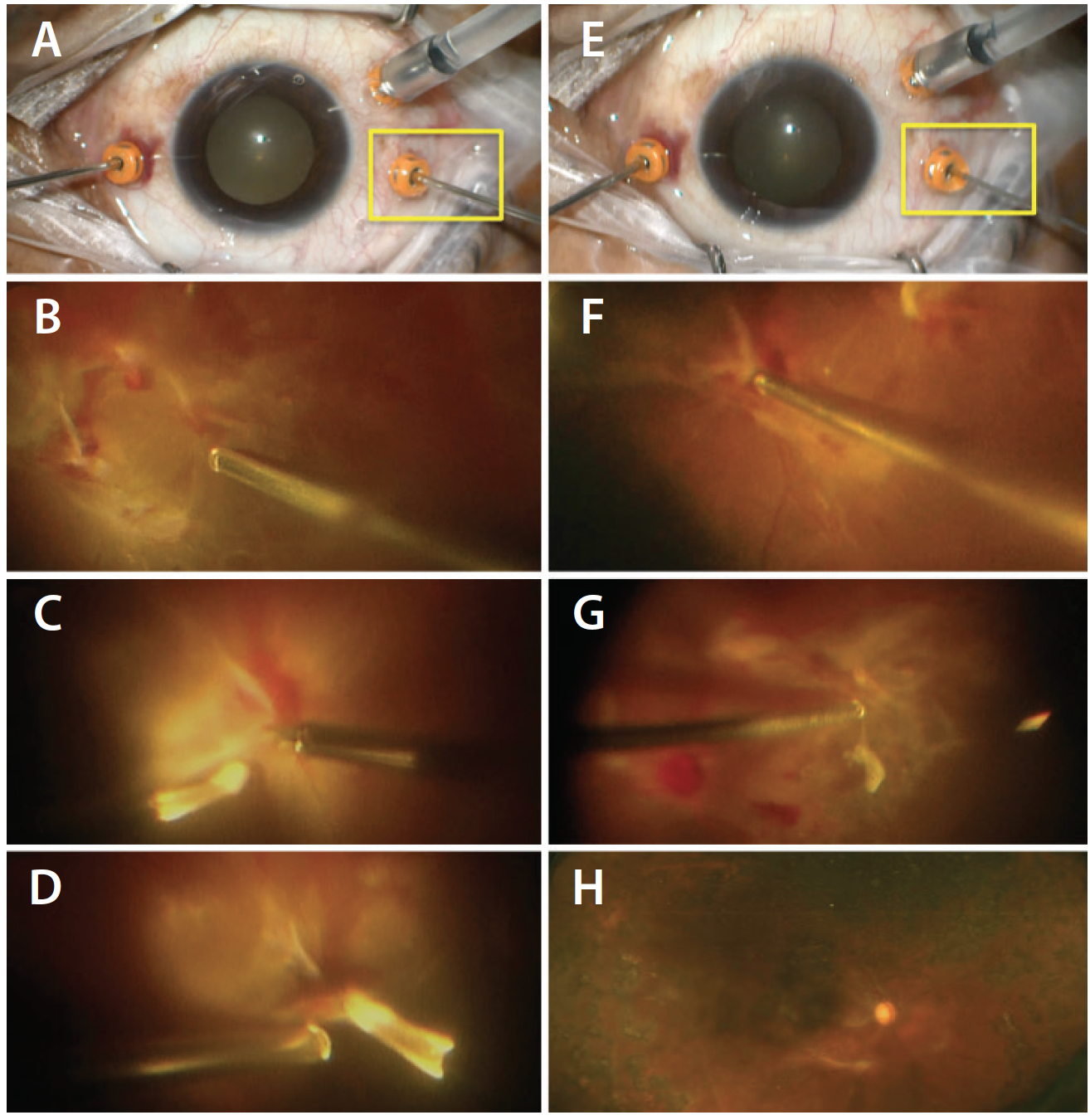
Figure. Hybrid vitrectomy using 27-gauge instrumentation in a 63-year-old woman with poorly controlled diabetes who presented with a chronic tractional/rhegmatogenous retinal detachment and vitreous hemorrhage with light perception vision. The case was initiated with standard 23-gauge vitrectomy (yellow frame) using valved cannulas (A). After debulking the core vitreous and hemorrhage and incising the peripheral posterior hyaloid, the underlying retinal detachment was identified, and segmentation was begun using a 23-gauge vitreous cutter (B). Tighter planes were opened up using a lighted pick and forceps (C). The planes were lifted with the pick, but the 23-gauge cutter was too large to enter some spaces (D). The 27-gauge vitreous cutter was inserted (yellow frame) through a 23-gauge valved cannula to initiate hybrid 27-gauge vitrectomy (E). The surgical plane that was difficult to access with the 23-gauge cutter was easily segmented across by the 27-gauge cutter alone (F). Additional low-lying taut planes were safely identified with the 23-gauge lighted pick and then entered and segmented across using the 27-gauge cutter (G). The patient’s retina was reattached, and her vision improved to count fingers (H).
MIXED-GAUGE VITRECTOMY
When 25- and 23-gauge vitrectomy systems became available, investigators demonstrated the utility of using sclerotomies of more than one gauge. These approaches typically use smaller-gauge cannulas for the infusion and the light pipe and a larger 20-gauge wound for the third sclerotomy to accommodate specific instruments or maneuvers. In a previous Retina Today article, Donald J. D’Amico, MD, referred to this type of technique as mixed-gauge vitrectomy.8 For the purposes of this article, we will follow suit (other terms, such as combined vitrectomy9 and hybrid vitrectomy5 have also been used in the literature to describe this approach).
Creating a fourth sclerotomy for larger-gauge instruments is also considered a mixed-gauge approach, and we still routinely use this to perform fragmatome lensectomy.10,11
A variety of pathologies can be addressed with these mixed-gauge techniques, including diabetic tractional retinal detachment (TRD),10 proliferative vitreoretinopathy,11 and retained lens fragments.12,13 Mixed-gauge techniques are useful when the surgeon wants to take advantage of the benefits of larger instruments.
The advent of valved cannulas now enables us to incorporate the benefits of smaller instruments. Before valved cannulas became available, smaller-gauge instruments, especially instruments that aspirate fluid, were not advised for use through larger sclerotomies because fluid egress along the sides of the smaller instruments would disrupt the closed system and potentially lead to dangerous complications.
Before the commercialization of 27-gauge instrumentation, Yamada and colleagues reported their use of 25-gauge instruments through 23-gauge cannulas.10 However, this hybrid vitrectomy approach did not provide groundbreaking benefits; the difference in performance between 23- and 25-gauge instruments is not as striking as that between those gauges and 27-gauge instruments. The 27-gauge vitreous cutter offers unique advantages as a multipurpose tool for tasks that 23- and 25-gauge cutters may not always accomplish.
In mixed-gauge vitrectomy with different sized sclerotomies, one is confined to using tools that fit the specific cannula or sclerotomy on the specific side of the eye. Now, however, truly integrated hybrid approaches can be performed, with 23-, 25-, and 27-gauge instruments used interchangeably through all cannulas.
WHERE HYBRID 27-GAUGE VITRECTOMY SHINES
The hybrid 27-gauge approach may have several advantages over single-gauge surgery for selected cases. In this approach, the 23- or 25-gauge vitreous cutter is used to start the case for efficient core vitreous removal. Next, 23- or 25-gauge instruments are utilized for anterior maneuvers such as peripheral membrane dissections and anterior segment surgery because these instruments are stiffer than 27-gauge instruments.
The 27-gauge vitreous cutter is then used for segmenting through tight spaces and delaminating tissues close to the retinal surface. Unlike in mixed-gauge vitrectomy, in which the larger vitreous cutter may outrun the smaller-gauge infusion, hybrid vitrectomy has favorable fluidics. The inflow: outflow ratio is not mismatched because the infusion is larger than the vitreous cutter.
If the 27-gauge cutter alone cannot accomplish the necessary dissections as a single instrument, then larger-gauge scissors, forceps, picks, etc., that are not available in 27-gauge can be used through any of the cannulas. Endoscopes can be used also. Hybrid bimanual dissection can be performed as well, for example by combing a 23- or 25-gauge lighted pick in one hand and a 27-gauge vitreous cutter in the other. See the Table below for suggestions on how hybrid 23-/27-gauge or 25-/27-gauge vitrectomy can be performed.
Personal Preferences
The hybrid technique is most valuable for tough diabetic TRDs, in our opinion. The senior author (YY) uses a 27-gauge single-gauge approach for most diabetic cases, but for patients with denser plaques he prefers the hybrid approach, which allows access for the 23-gauge lighted pick and forceps. The 23-gauge cutter is initially used for efficient debulking of the core vitreous and hemorrhage and for release of anteroposterior traction. The plaques can then be conquered either with the 23-gauge lighted pick and/or forceps or the 27-gauge vitreous cutter.

We find that the pick-forceps combination is useful for safe initial delamination when the plaques are very dense, whereas the 27-gauge cutter is more suitable for precise segmentation through tight surgical planes. The 27-gauge cutter can indeed function as an elegant pick for the majority of cases, though not always for the most adherent plaques, where the planes between broad fibrovascular pegs must first be safely opened mechanically.
We previously reported the utility of a 27-gauge cutter for posterior dissections in retinopathy of prematurity (ROP).2 With increasing rates of aggressive posterior ROP in micro-preemies, we are seeing more infants with relatively posterior retinal detachments. Stiff instruments are required for addressing the myriad tractional vectors in most ROP surgeries, but the 27-gauge vitreous cutter has been useful in unzipping posterior membranes in selected cases.2
Hybrid techniques may also have a role in the management of dislocated intraocular lenses (IOLs).2 The 27-gauge cutter can be used to remove capsular remnants or retained cortical material in IOL-capsular complexes without damaging the haptics, which can then be utilized for subsequent scleral fixation techniques. Rescuing an existing IOL is usually preferred over making a larger wound to insert a new lens, if there is a choice.
Cost Considerations
Cost-effective surgery is important in today’s health care climate. Many colleagues have asked whether the benefits of hybrid surgery are worth the costs of opening multiple vitrectomy packs. In actuality, one does not need to open two vitrectomy packs because 27-gauge cutters are available as individual instruments. Interestingly, this cost may be comparable to or even less than the aggregate of various forceps, scissors, and other ancillary instruments that surgeons may use in complex dissections. However, if a case can be performed with single-gauge vitrectomy and minimal instrumentation, then that of course would be the preferred method from a cost perspective.
Potential Drawbacks
The only drawback of hybrid 27-gauge vitrectomy is that, because it employs 23- or 25-gauge cannulas, one loses the benefit of 27-gauge sclerotomies. That is, 27-gauge wounds are truly self-sealing, with close to zero risk of postoperative hypotony due to unsealed wounds. Therefore, if the surgical goal can be accomplished with standard single-gauge 27-gauge vitrectomy (which is true in the majority of cases), then that is the technique that we recommend. Of course preference will vary from surgeon to surgeon, and there are many ways to tackle these cases.
EXPANDING OPTIONS
Hybrid 27-gauge vitrectomy can be thought of as an augmented 23- or 25-gauge approach to complex cases. It is also a surgeon-friendly technique when one is initially transitioning from 23- and 25-gauge to 27-gauge platforms. The larger-gauge trocar-cannulas can be placed before proceeding with 27-gauge surgery, and the setup for use of larger-gauge instrumentation is then ready as backup if necessary.
Hybrid 27-gauge vitrectomy is a new concept that has become possible due to advances in vitrectomy instrumentation. In vitreoretinal surgery, where no two cases are the same, we hope that this technique adds to the surgical options that vitreoretinal surgeons have in order to further improve outcomes for patients with advanced diseases.
1. Oshima Y, Wakabayashi T, Sato T, et al. A 27-gauge instrument system for transconjunctival sutureless microincision vitrectomy surgery. Ophthalmology. 2010;117(1):93-102.
2. Yonekawa Y, Thanos A, Abbey AM, et al. Hybrid 25- and 27-gauge vitrectomy for complex vitreoretinal surgyer. Ophthlamic Surg Lasers Imaging Retina. 2016;47(4):352-355.
3. Khan MA, Shahlaee M, Toussaint B, et al. Outcomes of 27 gauge microincision vitrectomy surgery for posterior segment disease. Am J Ophthalmol. 2016;161:36-43.
4. Scott MN, Weng CY. The evolution of pars plana vitrectomy to 27-G microincision vitrectomy surgery. Int Ophthalmol Clin. 2016;56(4):97-111.
5. Walter SD, Mahmoud TH. Hybrid-gauge and mixed-gauge microincisional vitrectomy surgery. Int Ophthalmol Clin. 2016;56(4):85-95.
6. Oellers P, Mahmoud TH. Surgery for proliferative diabetic retinopathy: new tips and tricks. J Ophthalmic Vis Res. 2016;11(1):93-99.
7. Antoniou GA, Sfyroeras GS, Karathanos C, et al. Hybrid endovascular and open treatment of severe multilevel lower extremity arterial disease. Eur J Vasc Endovasc Surg. 2009;38(5):616-622.
8. D’Amico DJ. Mixed-gauge vitrectomy. An evolving technology offers practical advantages. Retina Today. 2011;6(1):72-74.
9. Hubschman JP, Gonzales CR, Bourla DH, et al. Combined 25- and 23-gauge surgery: a new sutureless vitrectomy technique. Ophthalmic Surg Lasers Imaging. 2007;38(4):345-348.
10. Yamada K, Maeno T, Yamada M. Hybrid microincision vitrectomy surgery combined with 20-gauge silicone cannulas for use with 20-gauge horizontal scissors in diabetic tractional retinal detachment. Clin Ophthalmol. 2013;7:1559-1563.
11. Iwahashi-Shima C, Sato T, Bando, et al. Anatomic and functional outcomes of 25-gauge vitrectomy for repair of eyes with rhegmatogenous retinal detachment complicated by proliferative vitreoretinopathy. Clin Ophthalmol. 2013;7:2043-2049.
12. Baker PS, Spirn MJ, Chiang A, et al. 23-gauge transconjunctival pars plana vitrectomy for removal of retained lens fragments. Am J Ophthalmol. 2011;152(4):624-627.
13. Barthelmes D, Alexander S, Mitchell P, Chandra J. Hybrid 20/23-gauge pars plana vitrectomy for retained lens fragments after cataract surgery. Retina. 2012;32(9):1749-1755.
Thanos Papakostas, MD
• second-year vitreoretinal surgery fellow at the Massachusetts Eye and Ear Infirmary, Harvard Medical School, Boston, Mass.
• financial interest: none acknowledged
• thanosp@me.com
Yoshihiro Yonekawa, MD
• pediatric and adult vitreoretinal surgeon at the Massachusetts Eye and Ear Infirmary and Boston Children’s Hospital, Harvard Medical School, Boston, Mass.
• financial interest: none acknowledged
• yoshihiro_yonekawa@meei.harvard.edu


_1784132761.jpg?auto=compress,format&w=75)





