


The small, peaceful island nation of the Republic of Palau has a population of roughly 21,000 people who reside on some 350 coral and volcanic islands. It sits slightly north of the equator and about 550 miles southeast of the Philippines.

Figure 1. Drs. Handa (left) and Wieland (right) visit Palau once a year to volunteer their services.
Like other Pacific Islanders, Palauans have a genetic predisposition for diabetes.1 Combine that with a poor diet and you get a population with a 30% prevalence of diabetes. The Palauan government hospital, along with some US-trained physicians and medical officers, serve the community well; however, there are no ophthalmologists. Historically, patients needing ophthalmic care have had to fly to Manila, Tokyo, or Honolulu to seek eye care.
PALAU FAST FACTS
Capital: Ngerulmud
President: Thomas Remengesau Jr.
Currency: US Dollar
Official Languages: Palauan and English
Main Exports: Tuna and Clothing
HOW I GOT INVOLVED
In 1991, the government of Palau, via a US Public Health Service doctor, approached me and Daniel Schwartz, MD, of the University of California, San Francisco, about assisting in the delivery of ophthalmic care to Palauans. Dr. Schwartz and I agreed to help, and on our first visit we took an operating microscope and diode laser and performed 30 extracapsular cataract extractions and 35 laser treatments for diabetic retinopathy. After Dr. Schwartz suffered barotrauma while scuba diving, I asked James Handa, MD, of the Wilmer Eye Institute, to join me the second year (Figure 1). Since then, Dr. Handa and I have visited Palau once a year for 1 to 2 weeks, typically seeing 300 to 450 patients during each stay.
DEALING WITH DIABETIC EYE DISEASE
Because the use of anti-VEGF drugs, the gold standard of care for diabetic retinopathy,2 is not feasible in Palau, laser remains the primary mode of treatment (Figure 2). A portable diode laser lent to us by Iridex enables laser treatment in this isolated island nation. For the most part, we typically see patients with diabetes and cataract, but because there are no ophthalmologists in Palau we see a bit of everything. We screen patients with diabetes and treat them with focal laser and panretinal photocoagulation.
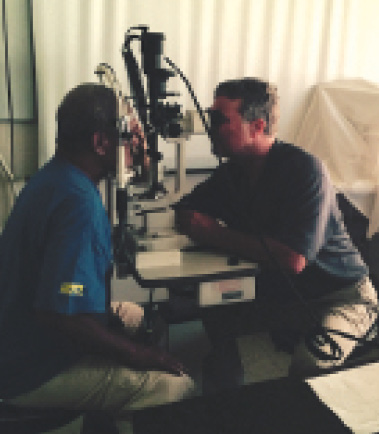
Figure 2. Dr. Wieland performs laser treatment on a patient with diabetic retinopathy.
Performing cataract surgery, screening, and treating patients ultimately proved to be more than we could handle. Dr. Handa and I recruited the Hawaiian Eye Foundation to help us with cataract surgery. Now, a visiting ophthalmologist performs phacoemulsification and follows patients with diabetes. This service saves the government more than $300,000 a year in ophthalmic care and allows the people of Palau to receive quality ophthalmic care in their home country. Dr. Handa and I have helped to build the infrastructure for outpatient ophthalmic care by delivering lectures to the local physicians and ancillary care providers. We have also helped to establish an “eye room” complete with slit lamps, autorefractors, and medications. In addition, we are trying to implement a telemedicine program to facilitate patient triage.
1. Kirtland KA, Cho P, Geiss LS. Diabetes among Asians and native Hawaiians or other Pacific Islanders–United States, 2011-2014. MMWR Morb Mortal Wkly Rep. 2015. 64(45):1261-1266.
2. Wells JA, Glassman, AR, Ayala AR, et al; Diabetic Retinopathy Clinical Research Network. Aflibercept, bevacizumab, or ranibizumab for diabetic macular edema. N Engl J Med. 2015;372(13):1193-1203.
Mark R. Wieland, MD
• vitreoretinal surgeon at Northern California Retina Vitreous Associates Medical Group
• financial interest: none acknowledged


_1784132761.jpg?auto=compress,format&w=75)





