



Macular hole repair has celebrated its 25th birthday, now well into adulthood. It often takes that quarter century for our children to mature, become educated, and eventually find employment, ready to embrace the challenges and opportunities of adulthood.
Macular hole surgery has matured too—from a simple vitrectomy with creation of a posterior vitreous detachment and gas bubble placement to now include internal limiting membrane (ILM) staining and peeling, and to require variable or no postoperative positioning. With a success rate of more than 90%, surgical repair of macular holes has matured into adulthood among vitreoretinal procedures.
AT A GLANCE
• With regard to size of ILM peel in macular hole repair, one study found that a 3-mm peel led to better functional and anatomic improvement than a 5-mm peel.
• Peeling the ILM over a larger surface area should be avoided.
• Although SF6 and C3F8 both worked as tamponades in another study, the shorter acting gas is preferred, as it results in fewer cataract and intraocular pressure issues.
Even young adults, however, may have rough edges and need fine tuning. For macular holes, some of the remaining rough edges include finding the optimal ILM stain, determining the optimal size of the peel, and deciding which type of gas to use as postoperative endotamponade.
Three recent articles from a group of authors at the Giridhar Eye Institute in Cochin, India, provide surgeons with guidance on these remaining issues, leading us yet closer to the ideal macular hole repair procedure, a successful adult ready to take on the world.
DOWN TO SIZE
First, Modi and associates examine the size of ILM peeling in macular hole repair.1 Does the axiom “bigger is better” apply to the ILM peel diameter, or would the better axiom be “good things come in small packages”? The authors prospectively studied a group of 50 eyes with macular hole. Eyes were randomly assigned to a small (3-mm diameter) or large (5-mm diameter) ILM peel group. The ILM was stained with brilliant blue dye, and all patients had SF6 gas fill and 5 days of facedown positioning.
Macular hole closure was higher in the 3-mm (80%) than in the 5-mm group (65%), although the difference between the groups was not statistically significant. Visual acuity improvement was also better in the smaller peel group; 4 lines versus 2 lines. Anatomic differences in nerve fiber layer thinning and ganglion layer thickness also favored the smaller peel group.
All things considered, the 3-mm peel group had better functional and anatomic improvement than the 5-mm peel group. In this case, then, bigger was not better.
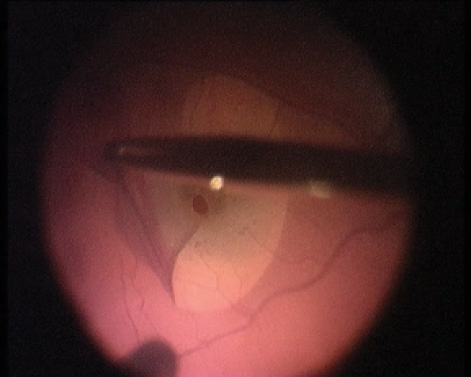
Figure. As many vitreoretinal surgeons know, sometimes less is more when it comes to the retina. Shown here is a 3-mm ILM peel performed with compounded brilliant blue dye.
The 3-mm ILM peel diameter (Figure) is a nice parameter for vitreoretinal surgeons, as it represents a peel radius of 1.5 mm, the diameter of the optic disc. This landmark is clearly visible to the surgeon during peeling, and it can provide the perfect guide for how much ILM to peel.
Experienced vitreoretinal surgeons know well that less is often better when fiddling with the retina. Each grab of the ILM represents an opportunity to damage or tear the retina. Longer surgery leads to surgeon fatigue, which may in turn lead to errors. Often a 3-mm ILM peel can be easily accomplished with a single circumferential peel around the macula. Over and done.
STRUCTURAL SUPPORT
Another paper by Modi and coworkers examined peel size in a different way. The authors studied spectral-domain optical coherence tomography (SD-OCT) after ILM peeling for macular holes.2 They presumably looked at the same 50 eyes as in the previously discussed study, and they found significant alterations in inner retinal architecture, especially in the ganglion cell layer, after ILM peeling. Their conclusion was that peeling the ILM over a larger surface area should be avoided, supporting the conclusion that less is better.
This reinforces the familiar medical maxim, “First do no harm.” Too much peeling may cross the boundary of effectiveness and venture into the area of potentially causing harm.
STAIN AND SEE
ILM staining also factors into this discussion. It is easier and safer to peel what you can see, rather than what you imagine seeing, hence the popularity of membrane staining to identify ILM and facilitate peeling. I reviewed staining options several years ago and found that each stain has advantages and disadvantages, including potential issues with toxicity and limited availability in the United States.3 My personal preference is compounded brilliant blue dye, which is the same stain used in the two studies mentioned above.
GAS AND GO
Finally, Modi et al addressed the issue of endotamponade.4 They compared macular hole surgery outcomes using sulfurhexafluoride (SF6) versus perfluoropropane (C3F8) gas in a larger and presumably different group of patients from the other two studies, including 177 eyes. The study was retrospective, rather than prospective, as the other two studies were, and therefore possibly not as sound as the other studies.
The researchers used brilliant blue dye and ILM peeling in all of their macular hole repair surgeries. The groups were distributed 37% SF6 and 63% C3F8. There was no statistically significant difference in preoperative characteristics between the two groups, an important consideration in retrospective reviews.
The macular hole closure rate was identical in the two groups, at 86%. There was no statistically significant difference in postoperative visual acuity between the two groups, although the C3F8 group was slightly favored in terms of better vision. Cataract progression was more frequent in the C3F8 group, as expected, but not statistically significantly different. Intraocular pressure elevation was statistically significantly higher in the C3F8 group.
All in all, both tamponades worked, with fewer cataract and intraocular pressure issues with SF6 than with C3F8. Thus the shorter acting gas would be preferred, especially given the inconveniences for patients associated with gas bubbles of long duration, including restricted travel via airplane or to the mountains.
WHAT HAVE WE LEARNED?
Modi and associates hit the trifecta with three articles in the same issue of Retina, a significant accomplishment in its own right. Granted, these are only three papers. Other studies may provide alternative or contradictory guidance. But these three papers are sound studies, published in a high-quality peer-reviewed journal, and all provide guidance regarding ideal macular hole repair.
Beyond the scope of this article are issues including the use of air as an endotamponade and whether facedown positioning is even needed. These can be topics of further discussion another day.
So what have we learned? Adding to the existing body of knowledge of optimal macular hole surgery, we can further refine the procedure beyond simply staining and peeling the ILM. A 3-mm peel is adequate. The optic nerve head can be used as a marker, extending the peel to one disc diameter from the fovea. We should use SF6 rather than C3F8.
We must understand that this is guidance, not dogma or standard of care. The best guidance is ultimately the wisdom and experience of the surgeon. But even well-seasoned surgeons continually seek to improve their outcomes. As macular hole surgery matures into a successful and predictable vitreoretinal procedure, the recommendations reviewed here will hopefully smooth a few more of the rough edges of this now adult procedure.
1. Modi A, Giridhar A, Gopalakrishnan M. Comparative analysis of outcomes with variable diameter internal limiting membrane peeling in surgery for idiopathic macular hole repair. Retina. 2017;37(2):265-273.
2. Modi A, Giridhar A, Gopalakrishnan M. Spectral domain optical coherence tomography-based microstructural analysis of retinal architecture post internal limiting membrane peeling for surgery of idiopathic macular hole repair. Retina. 2017;37(2):291-298.
3. Joondeph BC. Vitreoretinal staining solutions (Part 1 of 3). Retina Today. 2015;10(6):40-41.
4. Modi A, Giridhar A, Gopalakrishnan M. Sulfurhexafluoride (SF6) versus perfluoropropane (C3F8) gas as tamponade in macular hole surgery. Retina. 2017;37(2):283-290.
Section Editor Dean Eliott, MD
• Associate director, retina service, Massachusetts Eye and Ear, Boston, Mass.
Section Editor Ingrid U. Scott, MD, MPH
• Professor of ophthalmology and public health sciences, Penn State Eye Center, Penn State College of Medicine, Hershey, Pa.
Brian C. Joondeph, MD, MPS
• Partner at Colorado Retina Associates, Denver
• financial interest: none acknowledged
• @retinaldoctor; bjoondeph@retinacolorado.com


_1784132761.jpg?auto=compress,format&w=75)





