






The American Joint Committee on Cancer (AJCC) was founded in 1959 to complement the classification, formalized in the 1950s by the Union for International Cancer Control (UICC), that provided uniformity of cancer staging regarding tumor (T), node (N), and metastasis (M) status. In collaboration with the UICC, the AJCC has maintained this cancer staging system, which is used worldwide, publishing the first manual in 1977 and providing revisions every 6 to 8 years since then.1
AT A GLANCE
• A uniform cancer classification, particularly for rare cancers such as iris melanoma, is critical for understanding tumor biology, therapies, and long-term prognosis.
• The AJCC classification system, which incorporates tumor size and anatomic and histopathologic data into the determination of prognostic staging, is a valuable tool for classification of iris tumors and for “speaking the same language” in terms of specific tumor features.
This cancer staging system has been incorporated into at least 12 major ophthalmology journals, and it serves as an international reference for ocular oncology specialists and their patients.2 Regarding malignancies of the eye, the AJCC provides uniform classification for primary iris, ciliary body, and choroidal melanoma; retinoblastoma; conjunctival melanoma and carcinoma; ocular adnexal lymphoma; eyelid carcinoma; and orbital sarcoma.1
In January 2017, the AJCC updated its classification criteria in the 8th edition of the AJCC Cancer Staging Manual. This article reviews some of the features of this latest edition regarding uveal melanoma.
UVEAL MELANOMA
It is estimated that approximately 6,679 to 7,095 new cases of uveal melanoma occur worldwide each year,3 mostly in North America and Europe.4 Of these new cases of uveal melanoma, iris melanoma comprises approximately 4%.2,5,6 In one analysis of 8,033 consecutive cases of uveal melanoma, tumor location was found specifically in the choroid (n = 7,256, 90%), ciliary body (n = 492, 6%), and iris (n = 285, 4%).5 Regarding prognosis, iris melanoma fares better than ciliary body or choroidal melanoma, with a 25% 10-year rate of metastasis for choroidal melanoma, a 34% rate for ciliary body melanoma, and a 7% rate for iris melanoma.5
In an analysis of 317 consecutive patients with iris melanoma, the main factors found to be predictive for metastasis included extraocular extension and elevated intraocular pressure.6 In a previous report of 169 consecutive patients, Shields and colleagues found increased age at diagnosis, elevated intraocular pressure, angle invasion, extraocular extension, and previous surgical intervention before referral to be predictive for metastasis.7 The AJCC Ophthalmic Oncology Task Force categorized 160 cases of iris melanoma based on the AJCC 7th edition as follows: T1 (n = 78, 49%), T2 (n = 80, 50%), T3 (n = 0, 0%), and T4 (n = 2, 1%). With median follow-up of 3.6 years, five (3%) patients developed metastasis.2 There has not yet been evaluation of iris melanoma based on the AJCC 8th edition.
Herein, we focus on the AJCC 8th edition classification of iris melanoma by providing an interesting case of primary iris melanoma and by outlining key characteristics of the new classification system. The development of a uniform cancer classification, particularly for rare cancers such as iris melanoma, is critical for understanding tumor biology, therapies, and long-term prognosis.
CASE REPORT
A 39-year-old white female noted an asymptomatic spot on the iris of her right eye (OD) that developed gradually over a span of 2 years. Slow enlargement was observed, and she was referred for evaluation.
On examination, her visual acuity was 20/20 OD and 20/20 in the left eye (OS). Intraocular pressure was 11 mm Hg OD and 10 mm Hg OS. There was no ocular melanocytosis, and both irides were blue without heterochromia. The patient’s left eye was unremarkable.
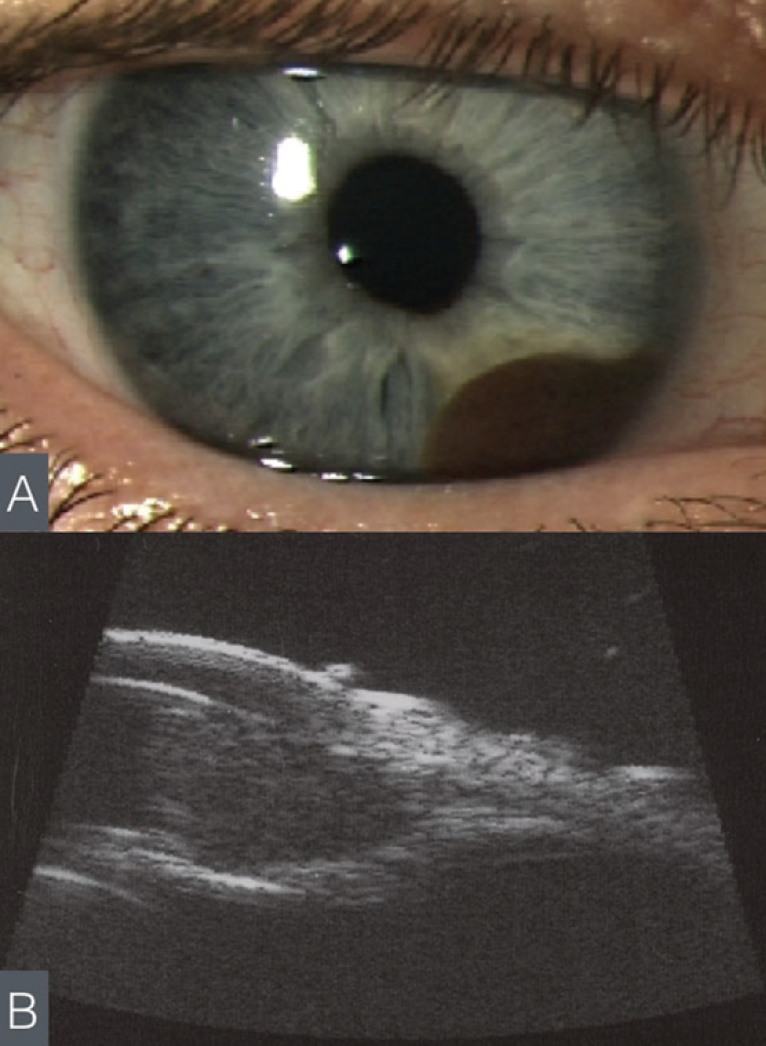
Figure. Slit-lamp photograph at presentation demonstrating pigmented inferonasal iris melanoma with ciliary body extension in the right eye (A). Ultrasound biomicroscopy depicting tumor thickness of 2.5 mm and adherence of mass to the corneal endothelium (B).
Anterior segment evaluation OD revealed a dome-shaped pigmented iris lesion involving the anterior chamber angle and peripheral iris between 4 o’clock and 6 o’clock. Intrinsic tumor vessels, mild corectopia with flattening of the pupillary contour, minimal ectropion, and trace pigment dusting were noted around the base of the mass. The tumor was adherent to the corneal endothelium for its entire extent, and no remote angle seeding was seen on gonioscopy. The tumor measured 6 mm x 4 mm in basal diameter and 2.5 mm in thickness by ultrasound biomicroscopy (Figure, B). Transillumination and ultrasound biomicroscopy showed minimal extension of the posterior margin of the mass into the pars plicata with no extrascleral component. These features were compatible with the diagnosis of iris melanoma.
After proper counseling of the patient, iridocyclectomy was performed. A deep scleral flap was created, the iridociliary mass was resected, and closure was achieved with flap replacement and tissue glue. Histopathology revealed infiltration of most of the iris and pars plicata with largely nonpigmented spindle B cells, consistent with primary iris melanoma with ciliary body involvement.
In accordance with the 8th edition of the AJCC Cancer Staging Manual, the tumor was classified as T2a N0 M0 and histologic grade G1 spindle cell melanoma type B. The patient has been followed for more than 10 years and has shown no evidence of metastasis.
DISCUSSION
Uveal melanoma staging according to the 8th edition of the AJCC Cancer Staging Manual classifies iris melanoma separately from posterior melanoma of the ciliary body and choroid. Iris melanoma is assessed based on several categories, including tumor (T), grade (G), node (N), and metastasis (M).
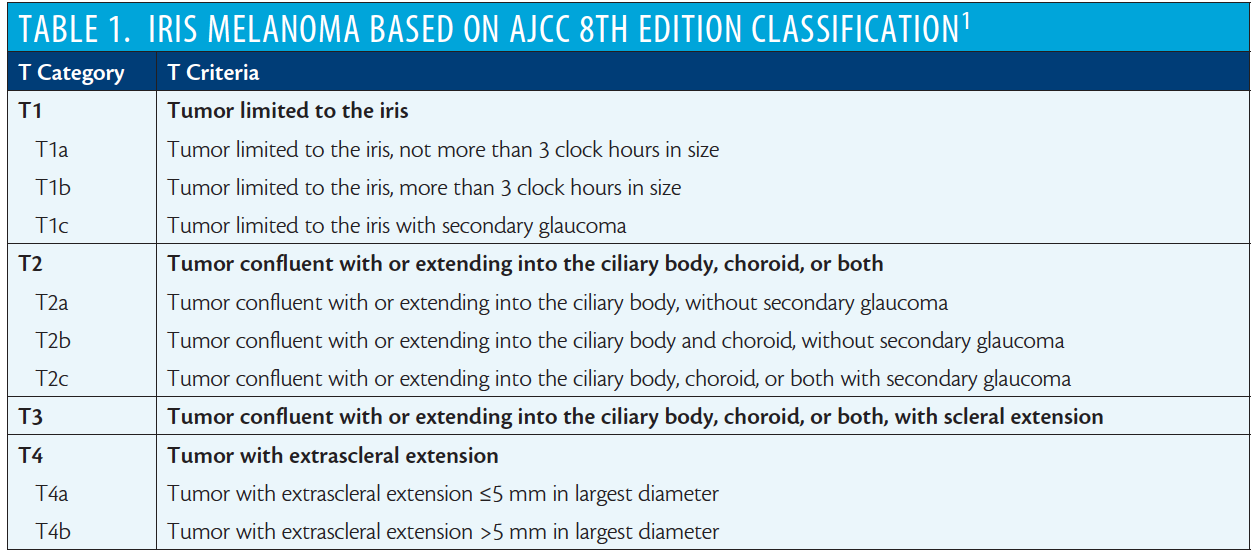
The T category is subdivided by anatomic extent of the iris tumor, with involvement limited to the iris (T1a-c) or involvement of the ciliary body (T2a), choroid (T2b,c), sclera (T3), and extrascleral tissues (T4a,b) (Table 1). Each increasing T category is anticipated to signify increasing risk for poor prognosis.
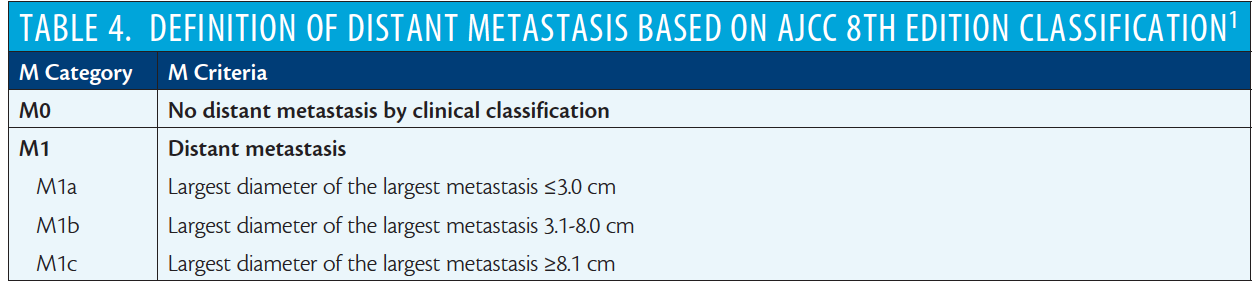
The G category is based on histopathologic findings, with spindle cell type (G1), mixed cell type (G2), and epithelioid cell type (G3) (Table 2). The N and M categories refer to localized or remote metastasis (Tables 3 and 4).


Although the AJCC recognizes the prognostic implications of chromosomal analysis and gene expression profiling, the current edition of the manual states that there is not yet a sufficient evidence basis for them to be included in the staging system.1
In 2015, the AJCC Ophthalmic Oncology Task Force provided a validation of the AJCC 7th edition classification of uveal melanoma, including iris melanoma. In that analysis of 160 cases of iris melanoma, tumor classification was T1 (n = 1, 0.6%), T1a (n = 33, 20.6%), T1b (n = 26, 16.3%), T1c (n = 18, 11.3%), T2 (n = 66, 41.3%), T2a (n = 14, 8.8%), T3 (n = 0, 0.0%), T4 (n = 1, 0.6%), and T4a (n = 1, 0.6%). Five of 160 patients developed metastasis, and all of these involved the ciliary body and/or choroid (T2), indicators of higher metastatic potential. Due to the small sample size, Kaplan-Meier estimates were not possible.2
WHAT’S NEW
Since its release in early 2017, there has not yet been analysis of iris melanoma based on the 8th edition of the AJCC Cancer Staging Manual. This edition provides the first update of iris melanoma staging since the 6th edition, published in 2003.9
Compared with the 6th and 7th editions, the 8th edition has undergone several updates. The T1 and T4 categories were basically unchanged. The most significant changes pertain to categories T2 and T3. Category T2 was expanded to include subcategories T2a (extension into the ciliary body only) and T2b (extension into ciliary body and choroid). Subcategory T2c now takes on the meaning that category T2a had when it was introduced in the 6th edition (T2 with secondary glaucoma), and category T3 has been condensed to involvement of the ciliary body, choroid, or both, with scleral extension (T3). Subcategory T3a (scleral extension and secondary glaucoma) has been completely removed due to the rarity of T3 tumors.1,9
TOWARD A UNIFORM CLASSIFICATION SYSTEM
Although genetic data, such as the presence of monosomy 3 and 8 q/p abnormalities on cytogenetics, can be used to estimate risk for metastasis, this information in combination with that in the 8th edition of the AJCC Cancer Staging Manual might provide the most accurate estimate of risk.1,8
The AJCC classification system incorporates tumor size and anatomic and histopathologic data into the determination of prognostic staging.1 This anatomic staging system continues to be a valuable tool for classification of iris tumors and to allow clinicians to “speak the same language” in terms of specific tumor features. We encourage all ocular oncologists to employ this method, so that data can be evaluated and shared in a more uniform manner.
1. Kivelä T, Simpson RE, Grossniklaus HE, et al. Uveal Melanoma. In: AJCC Cancer Staging Manual. 8th ed. New York, NY: Springer; 2017:805-817.
2. [no authors listed]. International validation of the American Joint Committee on Cancer’s 7th edition classification of uveal melanoma. AJCC Ophthalmic Oncology Task Force. JAMA Ophthalmol. 2015;133(4):376-383.
3. Kivelä T. The epidemiological challenge of the most frequent eye cancer: retinoblastoma, an issue of birth and death. Br J Ophthalmol. 2009;93(9):1129-1131.
4. Al-Jamal RT, Cassoux N, Desjardins L, et al. The pediatric choroidal and ciliary body melanoma study: a survey by the European ophthalmic oncology group. Ophthalmology. 2016;123(4):898-907.
5. Shields CL, Kaliki S, Furuta M, et al. Clinical spectrum and prognosis of uveal melanoma based on age at presentation in 8,033 cases. Retina. 2012;32(7):1363-1372.
6. Shields CL, Kaliki S, Shah SU, Luo W, Furuta M, Shields JA. Iris melanoma: features and prognosis in 317 children and adults. J AAPOS. 2012;16(1):6-10.
7. Shields CL, Shields JA, Materin M, Gershenbaum E, Singh AD, Smith A. Iris melanoma: risk factors for metastasis in 169 consecutive patients. Ophthalmology. 2001;108(1):172-178.
8. Kaliki S, Shields CL. Uveal melanoma: relatively rare but deadly cancer. Eye (Lond). 2017;31(2):241-257.
9. Malignant Melanoma of the Uvea. In: AJCC Cancer Staging Manual. 6th ed. New York, NY: Springer;2003:365-370.
Vladislav P. Bekerman, BS
• medical student at Drexel University College of Medicine and graduate student researcher at the Ocular Oncology Service, Wills Eye Hospital, Thomas Jefferson University in Philadelphia, Pa.
Maura Di Nicola, MD
• research fellow at the Ocular Oncology Service, Wills Eye Hospital, Thomas Jefferson University in Philadelphia, Pa.
Carol L. Shields, MD
• co-director of the Ocular Oncology Service, Wills Eye Hospital, Thomas Jefferson University in Philadelphia, Pa.
• member of the Retina Today editorial advisory board
• carolshields@gmail.com
Jerry A. Shields, MD
• director of the Ocular Oncology Service at the Ocular Oncology Service, Wills Eye Hospital, Thomas Jefferson University, in Philadelphia, Pa.
No conflicting relationship exists for any author.
Support provided by Eye Tumor Research Foundation, Philadelphia, Pa. (CLS). The funders had no role in the design and conduct of the study, in the collection, analysis and interpretation of the data, and in the preparation, review or approval of the manuscript. Carol L. Shields, MD, has had full access to all the data in the study and takes responsibility for the integrity of the data and the accuracy of the data analysis.


_1784132761.jpg?auto=compress,format&w=75)




