



As a group of millennials who grew up during the tech boom, the class of 2017 is well versed in modern technologies. What many of us may not fully appreciate, however, is that vitreoretinal surgery has seen an equally impressive leap forward since its primitive beginnings—and it is not much older than we are.
This year, in Chicago, at the 15th meeting of the Retina Fellows’ Forum, the 2017 retina fellows class had the privilege of hearing Gary Abrams, MD, the distinguished guest lecturer, narrate a piece of retina history in his talk, Pivotal Moments in Vitreoretinal Surgery. As one of the early giants in our field, Dr. Abrams helped advance retina to what it is today, all the while training fellows. To date, he has trained more than 70 vitreoretinal fellows. The following column is a brief summary of Dr. Abrams’ lecture.
HOW DID IT BEGIN?
Dr. Abrams started with a brief biography of Robert Machemer, MD, the undisputed father of vitreoretinal surgery. Dr. Machemer’s early work at the Bascom Palmer Eye Institute concerned retinal detachment (RD); it was at Bascom Palmer where he established vitreous traction as an important cause of RD. Around the same time, David Kasner, MD, a cataract surgeon, observed that eyes could tolerate vitreous removal without complication during intracapsular cataract extraction. This observation excited Dr. Machemer, who envisioned vitrectomy as a method to treat RD.
Dr. Machemer collaborated with Jean-Marie Parel, Ing. ETS-G, PhD, a French engineer he had recruited to Bascom Palmer, to develop the vitreous infusion suction cutter (VISC). This culminated in the first vitrectomy for a diabetic vitreous hemorrhage using an open-sky approach, performed at the Miami Veterans Affairs Hospital in 1970. The successful surgery restored the patient from count fingers to 20/50 visual acuity. From 1973 to 1976, Dr. Machemer published a remarkable series of seven articles in the American Journal of Ophthalmology. Thus was born the era of vitrectomy and vitreoretinal fellowships.
ON THE SHOULDERS OF GIANTS
After listening to Dr. Abrams speak, I could not help but feel immense admiration and gratitude for the work he and his colleagues accomplished. Without these early giants, none of us would have the opportunity to practice the profession we love and restore vision to our patients. In closing, Dr. Abrams left us with a quote from Isaac Newton that speaks an absolute truth: “As we progress further, it will be by standing on the shoulders of giants that preceded us.”
To Dr. Abrams and his fellow giants, the fellows of the class of 2017 say, “Thank you.”
Section Editor Murtaza Adam, MD
• second-year retina fellow at Wills Eye Hospital in Philadelphia, Pa.
• madam@midatlanticretina.com
Section Editor David Ehmann, MD
• second-year retina fellow at Wills Eye Hospital in Philadelphia, Pa.
• dehmann@midatlanticretina.com
Section Editor Sundeep K. Kasi, MD
• second-year retina fellow at Wills Eye Hospital in Philadelphia, Pa.
• skasi@midatlanticretina.com
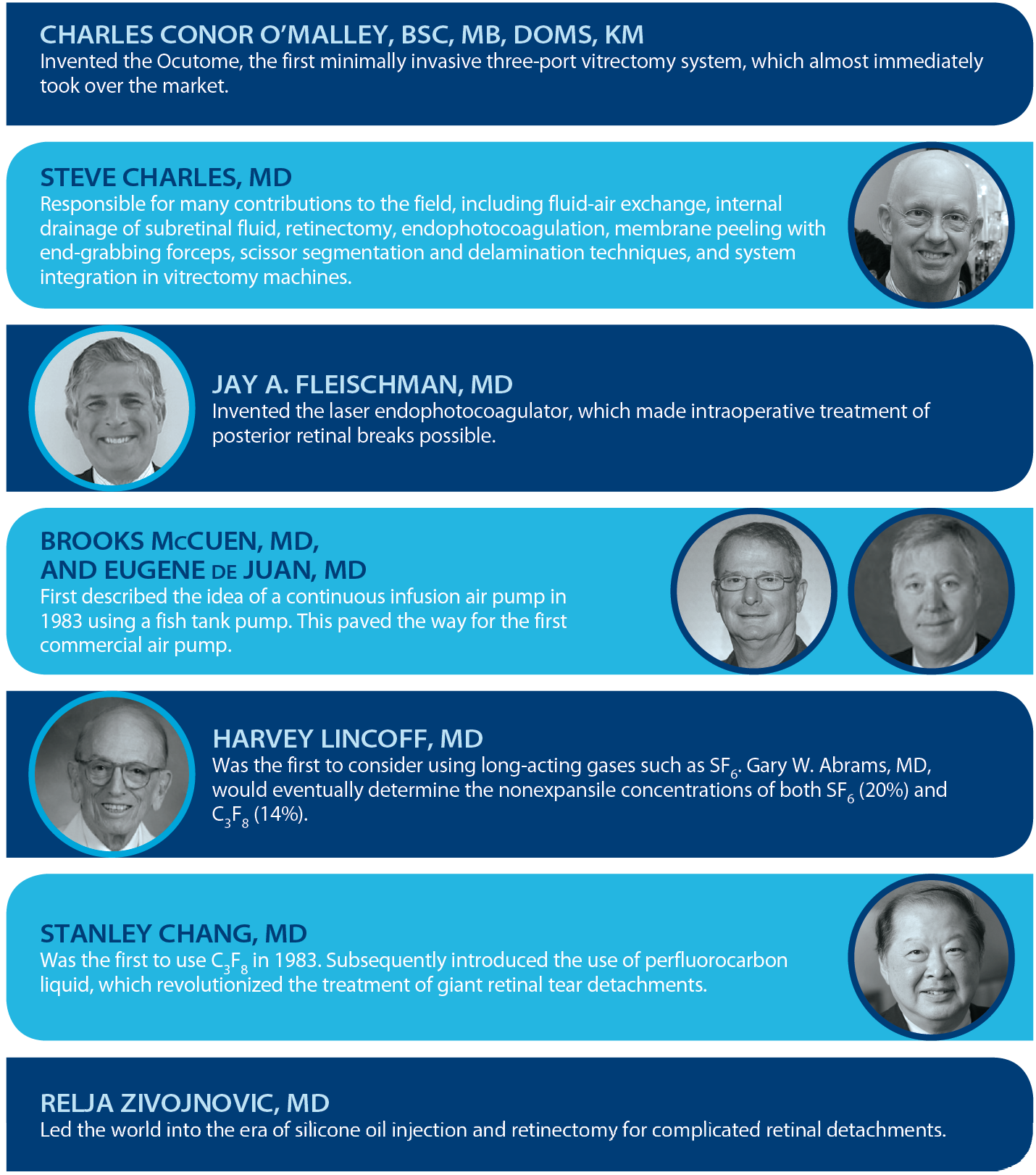
Indispensable Advances in Vitrectomy
Although time did not permit an exhaustive listing of all early contributors to the field, Dr. Abrams mentioned a few giants and their indispensable contributions that have shaped our ORs and instruments into what they are today.


_1784132761.jpg?auto=compress,format&w=75)





