


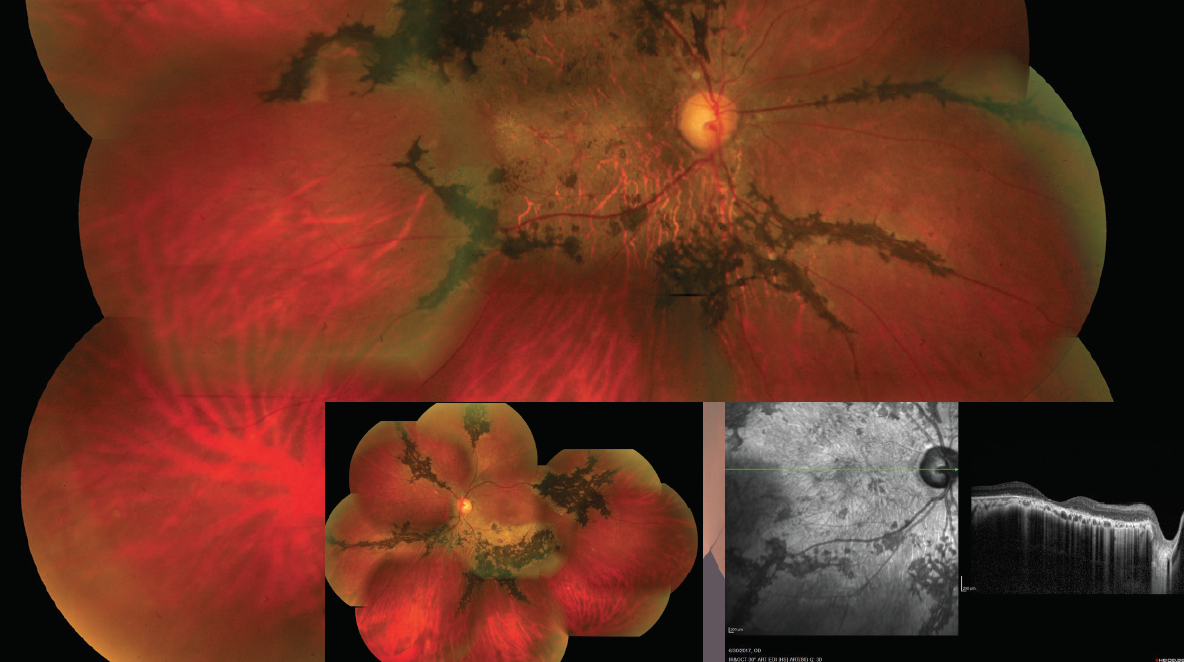
A 42-year-old woman presented to our practice with complaints of dimness in the near vision of her right eye (OD) lasting 6 months. The patient’s visual acuity at presentation was 20/200 OD and 20/120 in the left eye. Funduscopic examination revealed bilateral involvement. Retinal findings included bone-spicule pigmentation and atrophy of the choroid and retinal pigment epithelium (RPE) along the vascular arcade, with macular involvement OD (Main Figure and Inset, left).
Optical coherence tomography showed thin retinal layers, disrupted inner and outer segments of the photoreceptors and an irregular RPE layer (Inset, right). The patient was diagnosed with pigmented paravenous chorioretinal atrophy (PPCRA).
This rare disorder of unknown etiology was described as retinochoroiditis radiata by Hewitson-Brown in 1937.1 Its natural course is poorly understood. A diagnosis of PPCRA is made based on the peculiar retinal finding of pigment accumulation along the distribution of retinal veins during clinical examination. PPCRA is characterized by RPE degeneration, choriocapillaris atrophy, and pigmentation along the retinal veins. The retinal atrophy is characterized by loss of photoreceptor outer segments, outer nuclear layer, and inner nuclear layer. Many inflammatory and infectious causes have been associated with the disease, including sarcoidosis, Behçet disease, syphilis, measles, rubella, and tuberculosis; however, no known systemic diseases have been identified as the cause of the retinal findings.2,3
Recently, a mutation in gene CRB1 has been detected in patients with PPRCA.4 This gene is involved in various retinal dystrophies. PPCRA is an incidental finding, and the patient’s vision is rarely affected. The disease is more common in men than women. Most patients are asymptomatic at presentation or have mildly blurred vision. The exception is patients with macular involvement, for whom vision can be severely reduced on presentation. Color vision in these individuals is unaffected. Formal visual field testing may manifest scotomas along areas of densely involved retina. There are no specific findings on anterior and vitreous examination. PPRCA is a nonprogressive or slowly progressive disease. There is no treatment specific to PPRCA.
If you have an image or images you would like to share, email Dr. Nagpal.
Note: Photos should be 400 dpi or higher and at least 10 inches wide.
1. Hewitson-Brown T. Retinochoroiditis radiata. Br J OphthalmoI. 1937;21:645.
2. Huang HB, Zhang YX. Pigmented paravenous retinochoroidal atrophy (Review). Exp Ther Med. 2014;7(6):1439-1445.
3. Aoki S, Inoue T, Kusakabe M, et al. Unilateral pigmented paravenous retinochoroidal atrophy with retinitis pigmentosa in the contralateral eye. Am J Ophthalmol Case Rep. 2017;8:14-17.
4. McKay GJ, Clarke S, Davis JA, Simpson DA, Silvestri G. Pigmented paravenous chorioretinal atrophy is associated with a mutation within the crumbs homolog 1 (CRB1) gene. Invest Ophthalmol Vis Sci. 2005;46(1):322-328.
Jayesh Khandelwal, MS
• Vitreoretinal Fellow at the Retina Foundation in Ahmedabad, India
Section Editor Manish Nagpal, MS, DO, FRCS (Edin)
• Senior Consultant, Retina and Vitreous Services, at the Retina Foundation in Ahmedabad, India
• drmanishnagpal@yahoo.com


_1784132761.jpg?auto=compress,format&w=75)





