


A 48-year-old man presented with sudden loss of vision in his left eye (OS). He had a known history of choroideremia confirmed on genetic testing by a deletion in the CHM gene. His VA on presentation was 20/30 in his right eye (OD) and hand motions OS. Ocular examination showed extensive bilateral chorioretinal atrophy consistent with a diagnosis of choroideremia, with only small residual islands of retinal tissue remaining centrally (Main image, arrow). Fluorescein angiography was noncontributory, with a suggestion of slight hyperfluorescence at the junction of residual retina and atrophic choroid (inset left, arrow). Spectral-domain OCT showed subretinal hyperreflective exudative material between Bruch membrane and sclera (inset right, bottom, arrow), with extension into the outer retina and small outer retinal cystic spaces. This was consistent with type 1 choroidal neovascularization.
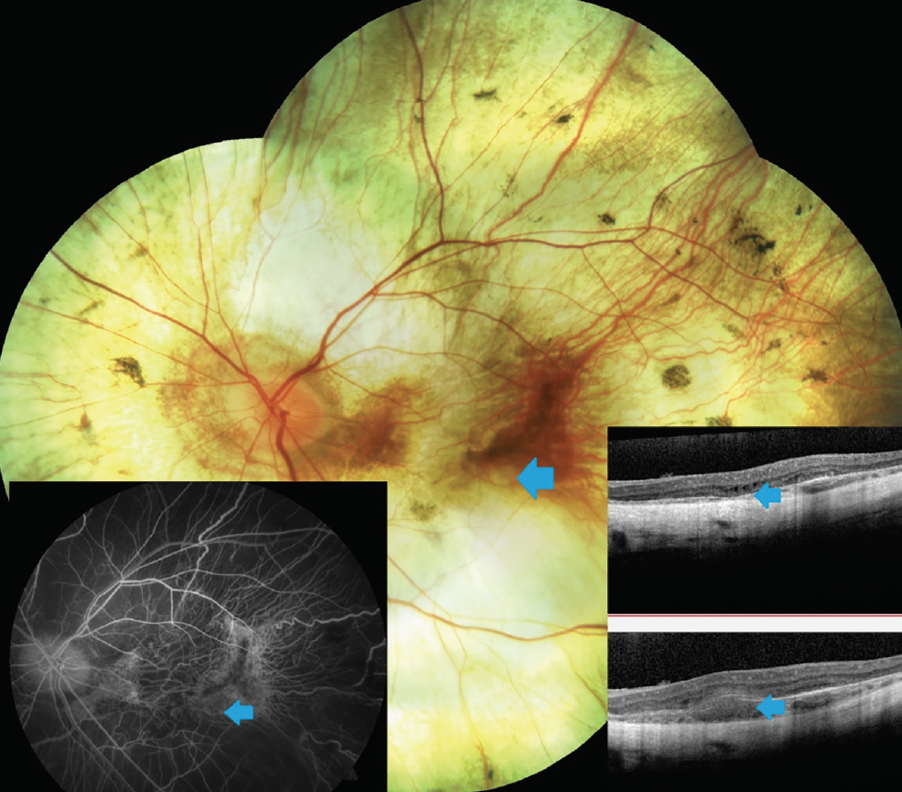
We began treatment with bevacizumab (Avastin, Genentech). One month after the first injection, the subretinal hyperreflective material had resolved, with a small amount of intraretinal fluid remaining (inset right, top, arrow). VA improved to 20/60 OS. After a further four monthly bevacizumab injections, the intraretinal fluid resolved with no recurrence on cessation of intravitreal therapy after 2 years of follow-up.
Choroideremia is a rare x-linked chorioretinal dystrophy affecting an estimated 1 in 100,000 men. Mutations in the CHM gene on chromosome Xq21.2 are responsible. Choroidal neovascularization is a rare complication that appears to respond well to anti-VEGF therapy. Unlike in age-related macular degeneration, continuing treatment does not appear to be necessary.


_1784132761.jpg?auto=compress,format&w=75)





