


An asymptomatic 12-year-old boy was referred to the retina service for assessment of presumed central serous chorioretinopathy in his left eye. A single well-circumscribed hypopigmented lesion without vitritis was noted in the inferotemporal macula (Image, A). There was no associated uveitis, and spectral domain OCT through the lesion demonstrated atrophy of the retinal pigment epithelium (RPE), an overlying neurosensory detachment, and ellipsoid zone attenuation (Image, B). A corresponding window defect without leakage was observed on fluorescein angiography (Image, C). Fundus autofluorescence demonstrated hypoautofluorescence with some inferior hyperautofluorescence (Image, D). B-scan ultrasonography did not reveal a significant elevation or hyperechoic signal.
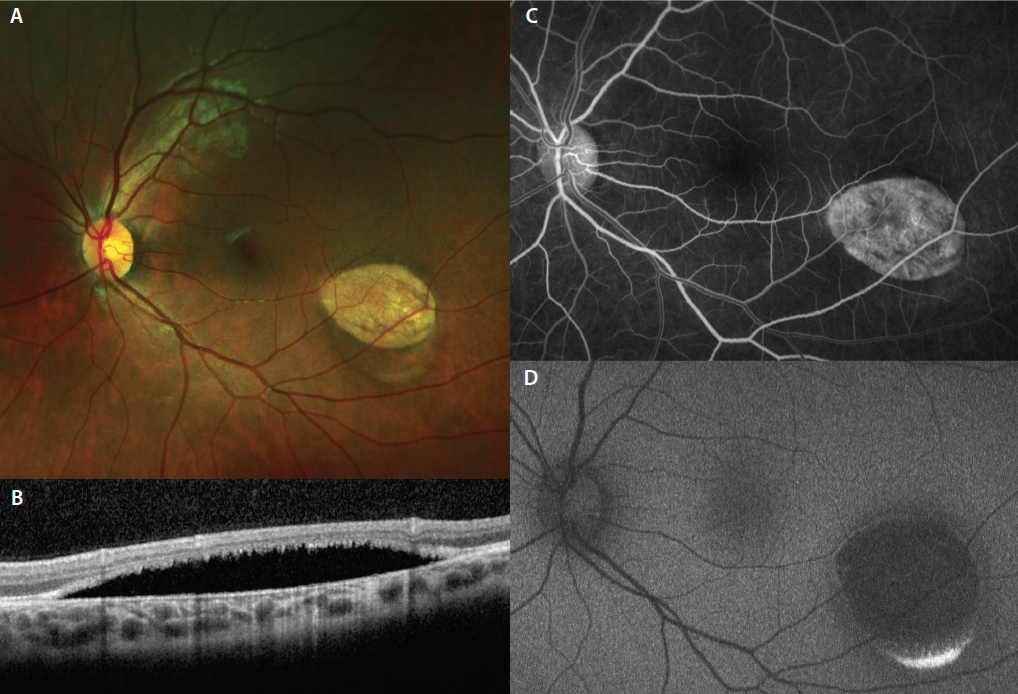
Torpedo maculopathy is a rare, unilateral, hypopigmented lesion of the RPE.1 This congenital lesion is located in the temporal macula and has a characteristic torpedo shape pointing toward the fovea. Its etiology is unknown, although there are several hypotheses, including a developmental defect of the nerve fiber layer, developmental defect at the horizontal raphe, abnormal choroidal development and vasculature, and a persistent developmental defect of the RPE at the fetal temporal bulge.2 Torpedo maculopathy is usually asymptomatic with normal VA. However, choroidal neovascularization, central serous chorioretinopathy, and a corresponding visual field scotoma have been reported.1,2
Wong et al proposed a classification system based on OCT appearance.3 Type 1 lesions show attenuation of outer retinal structures without outer retinal cavitation, whereas type 2 lesions show outer retinal cavitation with neurosensory detachment. These authors found that the average age of patients with type 1 and 2 lesions was 17 and 39 years, respectively, indicating that these two lesions represent different stages of disease progression. Shirley et al found that the average age of patients with type 1 and 2 lesions was 8 and 7 years, respectively, suggesting that these are two different phenotypic entities that can occur at a young age. Given our patient’s neurosensory detachment and young age, this case supports the latter of these two hypotheses.
1. Golchet P, Jampol L, Mathura J, Daily M. Torpedo maculopathy. Br J Ophthalmol. 2010;94:302-306.
2. Shirley K, O’Neill M, Gamble R, Ramsey A, McLoone E. Torpedo maculopathy: disease spectrum and associated choroidal neovascularisation in a paediatric population. Eye (Lond). 2018;32(8):1315-1320.
3. Wong E, Fraser-Bell S, Hunyor A, Chen F. Novel optical coherence tomography classification of torpedo maculopathy. Clin Exp Ophthalmol. 2014;43(4):342-348.
Section Editor Manish Nagpal, MS, DO, FRCS(Edin)
• Senior Consultant, Retina and Vitreous Services, Retina Foundation, Ahmedabad, India
• drmanishnagpal@yahoo.com
Jingyi Ma
• Medical Student, Faculty of Medicine and Dentistry, University of Alberta, Edmonton, Canada
• jma6@ualberta.ca
• Financial disclosure: None
Kelsey A. Roelofs, MD
• Ophthalmology Resident, Department of Ophthalmology and Visual Sciences, University of Alberta, Edmonton, Canada
• Financial disclosure: None
Parampal S. Grewal, MD
• Ophthalmology Resident, Department of Ophthalmology and Visual Sciences, University of Alberta, Edmonton, Canada
• Financial disclosure: None
David S. Ehmann, BSc, MD, FRCSC, ABO
• Vitreoretinal Surgeon, Department of Ophthalmology and Visual Sciences, University of Alberta, Edmonton, Canada
• dehmann@ualberta.ca
• Financial disclosure: None
To share an image, contact Dr. Nagpal at drmanishnagpal@yahoo.com.
Note: Images should be 400 dpi or higher and at least 10 inches wide.


_1784132761.jpg?auto=compress,format&w=75)





