


The ETDRS was a landmark prospective randomized study that enrolled approximately 3,700 patients from 1980 to 1985.1 The study investigators examined the impact of aspirin on diabetic retinopathy (DR), the role of focal laser in managing diabetic macular edema, and the value of panretinal photocoagulation in eyes without high-risk proliferative DR (PDR).
The results of the ETDRS, published in multiple reports in 1991 and years following, yielded insight into each of these issues that still guide clinical management of diabetic eye disease almost 30 years later. The most enduring and far-reaching consequence of the ETDRS, however, was the refinement of the quantitative Diabetic Retinopathy Severity Scale (DRSS).2 The development of the scale began in the 1960s with the Airlie House classification and was modified for the Diabetic Retinopathy Study in the 1970s and then again for the ETDRS.
CREATING THE DRSS
During the ETDRS, researchers set out to create a DRSS with the ability to predict development of PDR.3 Baseline characteristics of approximately 2,000 patients enrolled in the ETDRS were evaluated as potentially predictive variables, with progression to PDR the outcome of interest. Among the multitude of variables analyzed, some did not demonstrate a strong relationship with PDR development, including hard exudates, arteriolar sheathing, arteriovenous nicking, retinal venous loops, and venous narrowing.
Other characteristics were found to be more useful in predicting progression to PDR, including hemorrhages/microaneurysms, venous beading, and intraretinal microvascular abnormalities. Notably, these are the three characteristics engraved in our collective memory by the 4:2:1 rule, which defines DRSS level 53, or severe nonproliferative DR. Based on these observations, the previous DRSS was modified and solidified into what we now recognize as the ETDRS DRSS.3
This ETDRS DRSS turned out to be incredibly valuable for clinicians and drug developers. As the ETDRS authors noted in 1991, “For each one-level increase on the scale, the 1-year rate of progression to PDR approximately doubles, increasing from 4.1% for level 35 to 12.2% for level 43, 26% for level 47, and 51.5% for level 53.”3
Interestingly, and not often referenced, the ETDRS authors also reported that fluorescein angiographic pathologies, including capillary loss and severity of leakage, provided additional prognostic information beyond the scale built solely from photographic data.4 The importance of angiographic data in prognosticating DR progression was recently validated and highlighted in data from the RIDE and RISE studies, in which the presence of macular capillary nonperfusion at baseline was the only factor identified that was associated with progression to PDR among patients treated with ranibizumab (Lucentis, Genentech).5
The prognostic data provided by the ETDRS DRSS is used to guide management decisions and determine follow-up intervals. Also, due to its prognostic value, the DRSS has become instrumental in the development of therapeutics targeting DR treatment, as 2-or-more step DR severity improvement has proven to be an accepted endpoint for regulatory approval to gain market access within the United States.
THE ROLE OF ULTRA-WIDEFIELD IMAGING
The imaging used to create the ETDRS DRSS was based on stereoscopic 30° color fundus photographs of the seven standard fields (SSF) of the posterior pole (Figure 1). SSF imaging, which is still used in clinical research, captures approximately 34% of the retina’s surface. Does evaluation of the remaining 66% of the retina add value?
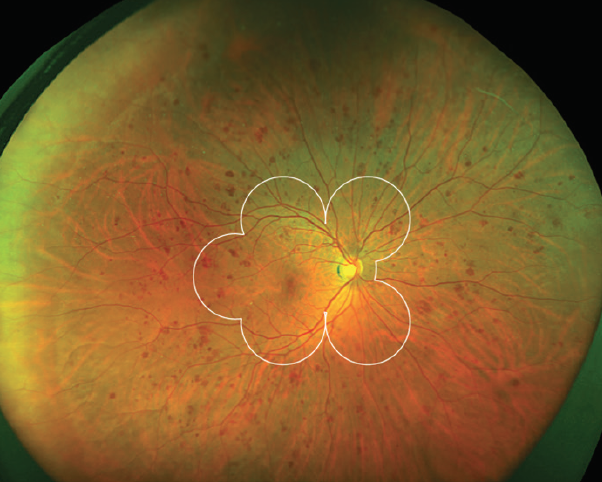
Figure 1. SSF imaging as approximated with the white contiguous circles centrally captures only about one-third of the retinal surface area. In comparison, UWF platforms can readily image 80% or more of the retinal surface area. Lesions identified to be predominantly within the retinal periphery compared to within the posterior pole have been reported to be associated with a faster rate of DR progression.
Development of a noncontact system using scanning laser ophthalmoscopy technology that can readily image more than 80% of the retina in a single view led to the dawn of the ultra-widefield (UWF) imaging era.
Studies employing UWF imaging have identified at least two clinically relevant findings in DR, one regarding severity at diagnosis and the other regarding detection of lesions.
Studies have reported that, in about 10% of eyes, use of UWF data to determine DR severity led to detection of a more severe DR level than was seen on SSF.6,7 Also, the presence of diabetic fundus lesions that are predominantly peripheral (ie, outside of the SSF) has been correlated with a greater risk of worsening DR severity and development of PDR.6
UWF fluorescein angiography may provide further prognostic utility beyond standard photography (Figure 2). The study outlined below was designed in part to help quantify that potential added prognostic value.
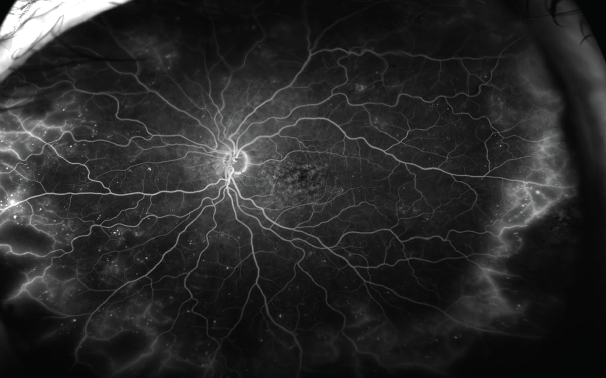
Figure 2. UWF fluorescein angiography can identify areas of retinal nonperfusion, as visualized here in the far periphery. Such findings may have prognostic value in the clinical management of patients with DR.
PROTOCOL AA
The DRCR Retina Network Protocol AA is a 4-year prospective study.8 This ongoing study’s primary objective is to assess whether evaluation of the retinal periphery via UWF imaging improves assessment and prediction of DR worsening compared with SSF imaging. Protocol AA includes both photographic and angiographic analyses. The main secondary objective is to explore whether the prevalence and severity of other systemic diabetic complications, including diabetic nephropathy and cardiovascular disease, are associated with severity and location of DR lesions.
Protocol AA has completed enrollment of approximately 385 patients with type 1 or type 2 diabetes mellitus with nonproliferative DR (DRSS levels 35-53), no history of panretinal photocoagulation, and no center-involving diabetic macular edema. Patients are scheduled to receive comprehensive examination and imaging at baseline, year 1, and year 4, and will receive less comprehensive imaging at years 2 and 3. The primary outcome is the relative risk of DR worsening of at least 2 steps over 4 years in the groups with and without any predominantly peripheral lesions on UWF images at baseline.
A baseline comparison of SSF and UWF photography has been published.9 Overall, comparison of the DRSS grades within the area of the SSF by ETDRS-style photography and within the area of UWF photography from 742 eyes revealed reasonable agreement: 48% had exact agreement in DR severity, and 88% were assessed within 1 step of agreement. The lack of absolute agreement may highlight that DR severity grading as an outcome is more dependent on image graders than are other endpoints used in clinical trials such as central retinal thickness, an important issue to note when designing and interpreting clinical trials.
Consistent with previous smaller series, 12.5% of eyes were found to have peripheral lesions that, when incorporated into the DRSS, led to a DR severity grade of at least 1 step more severe.9 Predominantly peripheral DR lesions were present in 41% of eyes.
These early results from Protocol AA suggest that consideration of peripheral pathology is important in the evaluation of patients with DR. Additional data will be forthcoming.
1. [No authors listed] Photocoagulation for diabetic macular edema. Early Treatment Diabetic Retinopathy Study report number 1. Early Treatment Diabetic Retinopathy Study Research Group. Arch Ophthalmol. 1985;103(12):1796-1806.
2. [No authors listed] Grading diabetic retinopathy from stereoscopic color fundus photographs--an extension of the modified Airlie House classification. ETDRS report number 10. Early Treatment Diabetic Retinopathy Study Research Group. Ophthalmology. 1991;98(5 Suppl):786-806.
3. [No authors listed] Fundus photographic risk factors for progression of diabetic retinopathy. ETDRS report number 12. Early Treatment Diabetic Retinopathy Study Research Group. Ophthalmology. 1991;98(5 Suppl):823-833.
4. [No authors listed] Fluorescein angiographic risk factors for progression of diabetic retinopathy. ETDRS report number 13. Early Treatment Diabetic Retinopathy Study Research Group. Ophthalmology. 1991;98(5 Suppl):834-840.
5. Ip MS, Domalpally A, Sun JK, et al. Long-term effects of therapy with ranibizumab on diabetic retinopathy severity and baseline risk factors for worsening retinopathy. Ophthalmology. 2015;122(2):367-374.
6. Silva PS, Cavallerano JD, Sun JK, et al. Peripheral lesions identified by mydriatic ultrawide field imaging: distribution and potential impact on diabetic retinopathy severity. Ophthalmology. 2013;120(12):2587-2595.
7. Kernt M, Pinter F, Hadi I, et al. [Diabetic retinopathy: comparison of the diagnostic features of ultra-widefield scanning laser ophthalmoscopy Optomap with ETDRS 7-field fundus photography]. Ophthalmologe. 2011;108(2):117-123.
8. Jaeb Center for Health Research. Protocol AA. Accessed August 13, 2019. https://public.jaeb.org/drcrnet/stdy/239.
9. Aiello LP, Odia I, Glassman AR, et al. Comparison of early treatment diabetic retinopathy study standard 7-field imaging with ultrawide-field imaging for determining severity of diabetic retinopathy. JAMA Ophthalmol. 2019;137(1):65-73.


_1784132761.jpg?auto=compress,format&w=75)




