


Identification of retinal neovascularization and intraretinal microvascular abnormalities (IRMA) is crucial in management of diabetic retinopathy, as these features, respectively, define proliferative diabetic retinopathy (PDR) and severe nonproliferative diabetic retinopathy (NPDR). Diagnosis of these features signifies that active treatment either is indicated or may soon be required. Retinal neovascularization denotes aberrant newly formed blood vessels on the surface of the retina that can extend into the vitreous cavity and lead to vitreous hemorrhage and retinal traction, whereas IRMA denotes abnormal vascular loops confined within the retina.
AT A GLANCE
- Identification of retinal neovascularization and intraretinal microvascular abnormalities (IRMA) is crucial in management of diabetic retinopathy as these features define high-risk diabetic retinopathy.
- Two features of OCTA imaging enhance its ability to characterize IRMA and retinal neovascularization: widefield OCTA and flow overlay.
- The ultimate goal is to produce high-resolution, artifact-free OCTA images of both the macula and the peripheral vasculature.
OCT angiography (OCTA) is a novel technology that produces images of retinal and choroidal vascular flow without dye injection. OCTA images are acquired by detection of the decorrelation signal generated between multiple successive OCT scans taken at high speed. Advantages of OCTA over fluorescein angiography (FA) include faster image acquisition time and noninvasive technique. Whereas FA provides dynamic images of dye leakage in the vasculature, OCTA produces static images of flow in the retinal circulation. A unique factor is that the OCTA images are 3D and can be manually segmented and co-registered with the accompanying structural OCT images.
VITAL FEATURES
Two features of OCTA imaging technologies enhance this modality's ability to characterize IRMA and retinal neovascularization: widefield OCTA and flow overlay.
Widefield OCTA
Initially, OCTA imaging provided only small fields of view in the range of 3-by-3-mm or 6-by-6-mm cubes centered on the foveola. Subsequent advances now allow imaging of larger areas of 8 by 8 mm, 12 by 12 mm, or 15 by 9 mm, depending on the manufacturer. In addition, some devices have software to produce montages of multiple images and create a widefield en face OCTA image extending beyond the arcades.
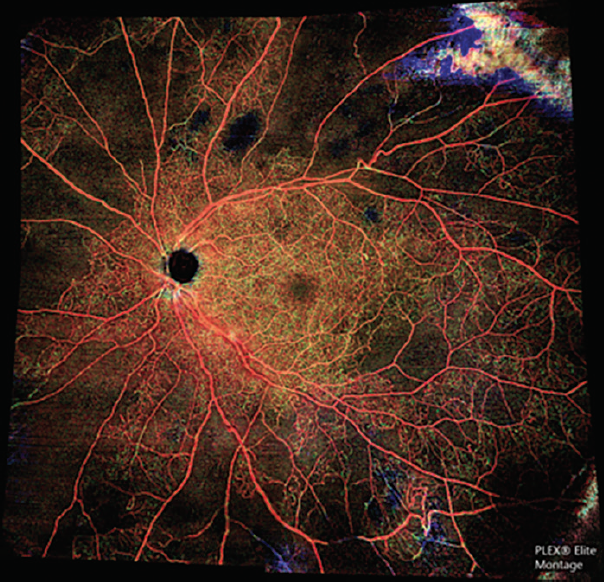
Figure 1. Depth-encoded widefield OCTA of full thickness retinal circulation, with differential colorization of the superficial and deep retinal vascular plexuses, in an eye with PDR. Regions of capillary nonperfusion are evident, and there are areas of image artifact in the far periphery.
Figure 1 shows a depth-encoded widefield OCTA of full thickness retinal circulation, with differential colorization of the superficial and deep retinal vascular plexuses. In this OCTA fundus image of a left eye with PDR, regions of capillary nonperfusion are evident, and there are some areas of image artifact in the far periphery. The ultimate goal is to produce high-resolution, artifact-free OCTA images of both the macula and the peripheral vasculature.
Flow Overlay
This important feature can assist in determining the depth of blood flow. This feature places the decorrelation signals that signify blood flow from the en face OCTA image onto the structural OCT scan.
CLINICAL STUDY
At the New England Eye Center, we studied the features of IRMA and retinal neovascularization in diabetic eyes using multimodal imaging, including en face OCTA, structural OCT with flow overlay, and FA. Preliminary findings were most recently presented at the MaculArt conference in Paris.1
Widefield OCTA imaging was performed with the Plex Elite 9000 (Carl Zeiss Meditec) using a mosaic of five 12-by-12-mm images. Flow overlay from the OCTA onto the structural OCT in retinal neovascularization demonstrated blood flow extending through the internal limiting membrane (ILM), in contrast with IRMA, in which blood flow on the flow overlay remained confined to the retina and internal to the ILM.
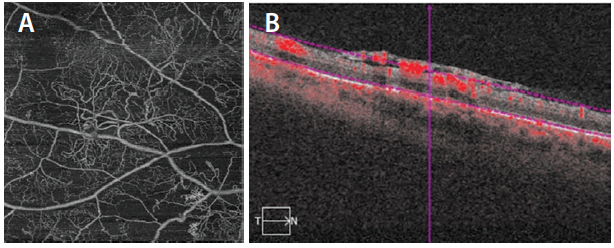
Figure 2. En face OCTA image of irregular retinal blood vessels (A); the co-registered OCT with flow overlay confirms that blood flow extends above the ILM, consistent with retinal neovascularization (B).
Figure 2A shows an en face OCTA image of irregular retinal blood vessels, and the co-registered OCT with flow overlay in Figure 2B confirms that blood flow extends above the ILM, consistent with retinal neovascularization.
MORE EFFICIENT
The use of OCTA technology may provide a more noninvasive, efficient, risk-free way to identify IRMA and retinal neovascularization than FA, with the potential for use in screening and directing high-risk eyes to more frequent follow-up examinations or active therapy.
Retina Today on the Road
This article is adapted from a lecture the author presented in February at the International Swept Source OCT and Angiography Conference in Fort Myers, Florida. Details about the 2020 meeting are forthcoming. Visit ISSOCT.com for details.
1. Baumal CR. OCT features of IRMA and retinal neovascularization. Paper presented at: MaculArt Conference; June 24, 2019; Paris, France.


_1784132761.jpg?auto=compress,format&w=75)





