


In January, the most significant revisions to the guidelines for evaluation and management (E/M) codes since 1997 will be implemented. In a previous article (“E/M Coding and Documentation Guidelines for 2021,” September 2020), I previewed these changes.
Are you ready? Along with educating your coding staff on these revisions, your retina practice should prepare an internal implementation checklist to ensure a smooth transition. Here are some ideas about what should be on your checklist.
ASSIGN A PROJECT LEADER
Identify a physician champion or staff member to lead the change. This individual can compile and track the necessary action steps for the transition. He or she will also act as the point person for any challenges, provide practice communication, and answer questions.
COMMUNICATE WITH YOUR VENDORS
Initiate discussions with your practice’s electronic health record (EHR) and practice management system vendors regarding software functionality that will be affected by the changes to the E/M guidelines. Review the necessary updates to EHR templates that document the history and examination components. For example, the review of systems may be modified for a medically relevant systemic review for retina-related consultations.
Confirm how the EHR system will document total physician time during the face-to-face encounter and additional activities performed the same day. Review any software functionality that may automatically track total time as an alternative to a manual process of tracking and entering the data.
For automated E/M coding software tools—programs that analyze documentation and determine the appropriate E/M codes—discuss with vendors the timeline for upgrades. Specifically review how these systems will accurately assess the medical decision-making or total time based on discrete data or narratives.
Finally, your software and hardware systems may need upgrades for coding compliance in 2021.
SUPERBILL
Remove CPT code 99201, New patient level 1, from your practice’s paper or electronic superbill, as this code will be eliminated in 2021. It may be necessary to inactivate 99201 from the procedure libraries and drop-down lists in your EHR and/or practice management systems.
TRAIN THE TEAM
Your practice should provide comprehensive training for all physicians and staff based on job roles. After you have conducted training on the revisions, you should review specific retina case studies commonly seen in the practice.
Consider conducting a session in which participants code a sample of recent encounters using both the current and the 2021 E/M guidelines. Discuss the differences in the guidelines and the impacts these will have on code selection. Make sure to document all practice training to comply with Department of Health and Human Services Office of Inspector General protocols for compliance plan education.
FOCUS ON MEDICALLY RELEVANT HISTORY AND EXAMINATION
A significant change in the 2021 E/M coding guidelines is the elimination of required history and examination elements and the effect this elimination will have on code selection. Instead, a medically relevant history and examination will now be required for all E/M codes for office encounters and other outpatient services. This change affects the elements of the history of present illness; the review of systems; and the assessment of orientation of time, place, person, and/or mood and affect. Much of the documentation related to the history and examination is relevant to the retina specialist.
It is vital for the practice to internally review the relevant history and examination for specific retina evaluations. The essential elements may vary, for instance, for a new versus established patient visit, and due to the reason for the encounter (eg, extended history of present illness, social history, extraocular motility). Outlining these expectations for the technicians will help to create an efficient workup and clinic flow.
IDENTIFY WHAT REMAINS THE SAME
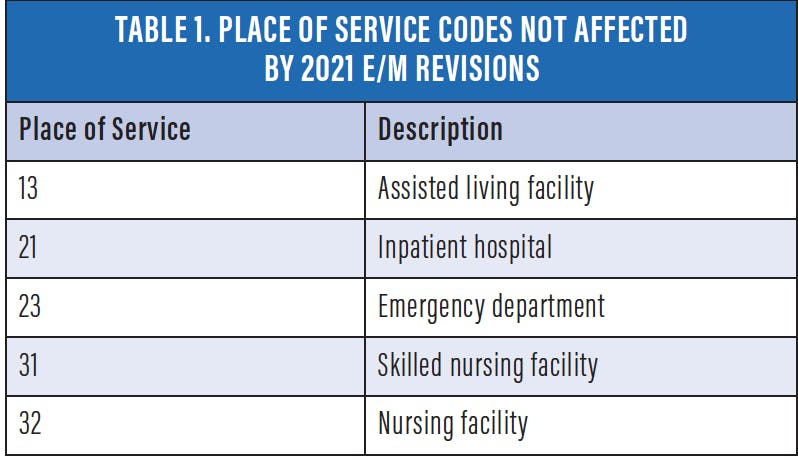
When the place of service for an encounter is other than the office or other outpatient service, the 2021 E/M documentation requirements will not change from current requirements. Table 1 outlines the place of service encounters that will not change with the 2021 E/M guidelines. The current history, examination, and medical decision-making requirements will remain for this family of E/M codes (eg, emergency department E/M codes 99281-99285).
Scenarios that affect retina practices could include inpatient retinopathy of prematurity consultations and emergency department consultations for endophthalmitis or trauma. These encounters will still be coded based on 1997 guidelines.
CONSIDER MIPS QUALITY MEASURES
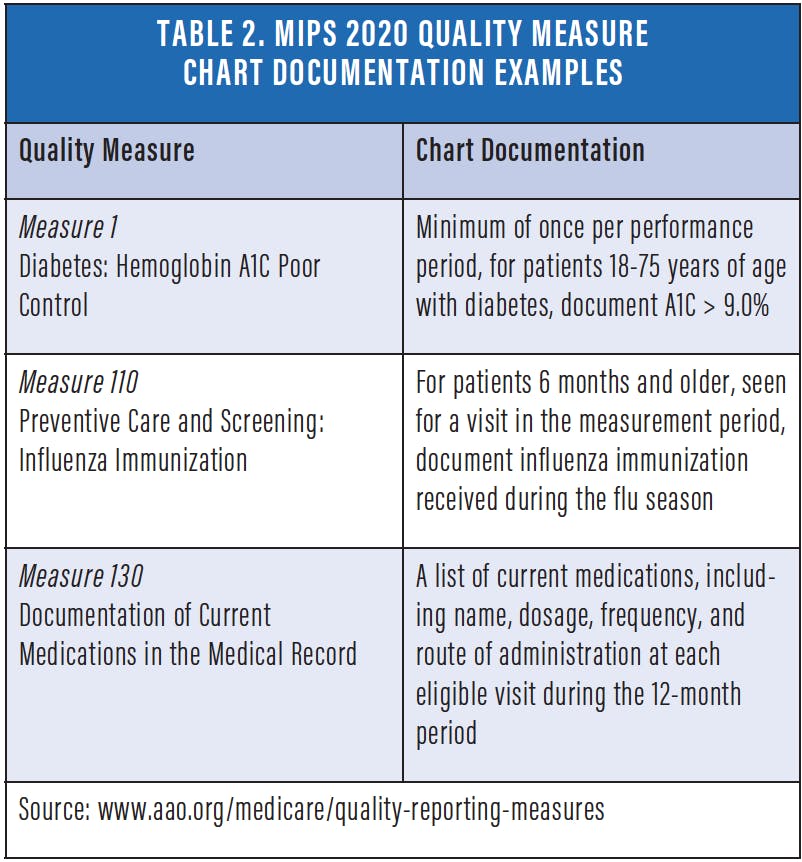
When documenting medically relevant history and examination, any required elements for Merit-Based Incentive Payment System (MIPS) quality measures should be included. Table 2 provides examples of quality measures and the necessary documentation according to the 2020 measure specifications. Before the 2021 E/M guidelines are implemented, your practice should do the following:
- Identify which 2021 quality measures the practice is reporting;
- Review the measures’ specifications and documentation requirements; and
- Communicate to physicians and staff the necessary history and examination elements for quality reporting and documentation.
UPDATE INTERNAL PROTOCOLS AND RESOURCES
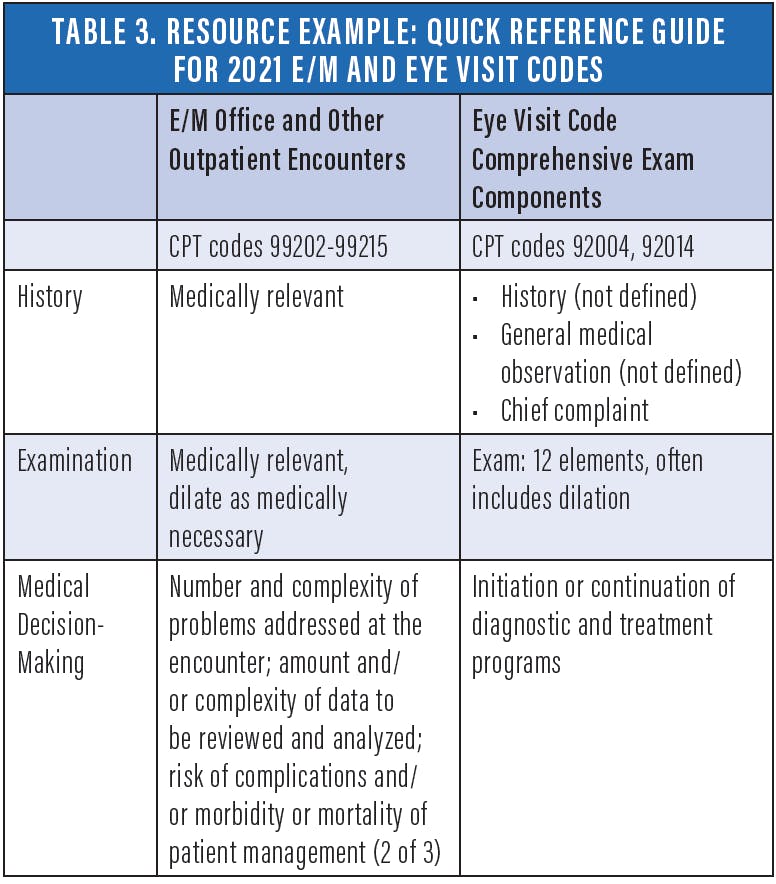
Any practice procedures and protocols related to E/M coding and documentation should be reviewed and updated as appropriate. Your practice should develop new internal training resources and quick reference guides to support end users. Examples of this can be found in Table 3.
MONITOR AND AUDIT
As the 2021 guidelines are implemented, it is essential for retina practices to monitor E/M coding, promptly resolve any payer denials, and perform internal chart audits. Continue to communicate with all practice stakeholders regarding any internal errors and corrective measures.
BE READY FOR 2021
For more information, consult these AAO resources:
- Visit Conquering New E/M Documentation Guidelines for Ophthalmology (bit.ly/1220RTBMCoding1).
- Consult the AAO’s dedicated webpage: aao.org/em.
- Use the AAO’s Ophthalmic Advisors Group to help identify private consulting services to assist with your transition to 2021 E/M guidelines and internal chart audits (bit.ly/1220RTBMCoding2).


