



Each year, the Aspen Retinal Detachment Society (ARDS) hears from a select group of highly distinguished speakers. In several of our past meetings, we have made sure to reserve time on the podium to discuss pediatric retinal care.
ARDS leadership knows that most retina conferences give little attention to pediatric retina care. The reasons are obvious: Pediatric retina is a sub-subspecialty of eye care, and dedicating valuable podium time on an otherwise filled agenda to a discipline that only a small subset of attendees may practice could be unwise.
Still, we know our attendees. ARDS participants’ hunger for learning deeply about a number of subjects is not limited to the topics that pertain most immediately to them and their practices. They’re polymaths. They know that rounding out their retina education gives them a more holistic sense of the space. And hey, you never know when those pediatric retina pearls will come in handy.
Be sure to keep an eye on MedConfs.com for the latest updates about ARDS 2021 and our focus on an in-person meeting.
—Timothy G. Murray, MD, MBA
BEST APPROACHES FOR PEDIATRIC RETINAL DETACHMENTS
Presentation by Philip J. Ferrone, MD
Summarized by Abdallah Mahrous, MD
At this year’s ARDS meeting, Philip J. Ferrone, MD, provided a rundown of surgical considerations for pediatric retinal detachments (RDs). He emphasized the important point that the anatomy of pediatric eyes is different from the anatomy of adult eyes, and he discussed the best approaches to use in a variety of presentations. This article summarizes portions of his presentation.
HISTORY and EXAMINATION TIPS
Dr. Ferrone reported that pediatric RDs have an incidence of 0.53 per 100,000, compared with an incidence of 12 per 100,000 in the adult population.1 Tractional RDs are even less common in children. RDs are sometimes challenging to diagnose in children, and they can present late or with other signs such as strabismus.
History is important, even in older children—details such as a baby’s birth weight, a history of prematurity, or a family history of eye disease or RD, and trauma are important to document. Pediatric examinations can be made more challenging due to lack of cooperation, difficulty with drop administration, and poor dilation.
For babies less than 1 year old, examination can be made easier by having the patient lie on a parent’s lap with the head by the knees and feet up to the parent’s chest, while the parent helps stabilize the baby by holding his or her head. For uncooperative children up to 8 years of age, you can ask the parent to bear-hug the child while an assistant holds the head and the physician attempts to pry the eyelids open and examine. If this approach fails, examination under anesthesia is often necessary.
Stickler detachments are often complicated, with a redetachment rate of 45% due to proliferative vitreoretinopathy (PVR). By contrast, non-Stickler RDs often behave more like adult RDs with more promising results.
SURGICAL APPROACHES
The standard Alcon kit for 25-gauge vitrectomy can often be used for common pediatric RDs. Use of the special Alcon short 25-gauge instrumentation can be helpful in cases such as microphthalmic eyes, or eyes with persistent fetal vasculature (PFV) with central retinal stalk lines, or peripheral retinal folds in retinopathy of prematurity (ROP). The short system has the advantage of providing a trocar with no cannula.
Pediatric eye anatomy varies from that of adults. The pars plana–pars plicata complex extends on average for 1.87 mm posterior to the limbus at 40 weeks; therefore, introducing the cannulas at 1 mm from the limbus is appropriate for a term baby. By 6 months, the pars plana–pars plicata complex extends for approximately 3 mm posterior to the limbus, so a trocar incision at 1.5 to 2.0 mm from the limbus is appropriate for that age.
The eye’s anatomy continues to change with the child’s growth. The axial length increases by approximately 1.5 mm during the first 12 weeks of life. The eye grows on average 2 mm over the first 2 years of life and then another 2 mm from 2 years to 5 years. Between 5 years and 15 years the eye typically grows another 3 mm. After 15 years of age, there is typically no significant growth.2 It is important to take this progression into account when scleral buckle surgery is considered and when you are placing sclerotomy wounds.
CASE-BY-CASE CONSIDERATIONS
Pediatric RDs should be approached on a case-by-case basis. Retinal dialysis should preferably be buckled using a low and broad approach, as opposed to a high and narrow one. Stickler detachments, as previously mentioned, are highly proliferative with high redetachment rates. Addressing these RDs often requires time and patience. They might require multiple surgeries, with relaxing retinectomies and silicone oil.
Familial exudative vitreoretinopathy (FEVR) may present with a normal appearing fundus, but fluorescein angiography can reveal large areas of peripheral nonperfusion that can be lasered. If not treated, these areas can lead to dense preretinal proliferation with high-ridged retinal folds. The folds must be carefully dissected, taking care not to create any retinal breaks, which would be very difficult to repair.
Mutations in KIF11 can cause microcephaly, microphthalmia, and congenital retinal folds. Fluorescein studies may show peripheral nonperfusion as well. Retinal folds can sometimes have stalks that connect to the lens. The preferred surgical approach in these eyes is to use the short 25-gauge instruments, cutting the stalk anteriorly to free up the retina and letting it settle back down to a more normal anatomy, then approaching the rest of the retinal folds.
Optic pit RDs can sometimes self-resolve if given time; however, in cases that require surgery it is recommended to remove the vitreous stalk that goes right into the optic pit, followed by application of light intraoperative laser around the pit.
In Coats disease, the pathognomonic telangiectatic vessels are often accompanied by RDs. In these eyes, it is better to drain the subretinal fluid externally and apply extensive laser to the telangiectatic vessels; this might not provide ideal results but will preserve any vision possible.
Colobomas can present with very challenging RDs. Silicone oil is preferred in these eyes, but even with oil there are often redetachments due to the complexity of the retinal layers in the coloboma. Platelet-rich plasma can be helpful in these cases.
CONCLUSION
Pediatric RDs are different from RDs in adults. Children’s eyes have a different anatomy that requires modification of surgical approaches. With the correct approach and patience, excellent visual and anatomic results are still possible.
Eyetube Meeting Coverage at Aspen Retinal Detachment Society
Each year, the Society invites Eyetube to cover selected talks from the year’s agenda.

Artificial Intelligence and Pediatric Retina
R.V. Paul Chan, MD, discusses how applying AI to pediatric patients aids in diagnosing conditions such as plus disease by characterizing and monitoring disease activity.

Best Approaches for Pediatric RD
Philip J. Ferrone, MD, discusses how to properly care for and diagnose pediatric patients. Dr. Ferrone discusses how fundus autofluorescence, OCT, and other in-office imaging modalities can be used to obtain the best and most accurate imaging results.

Subretinal Gene Therapy
Christina Weng, MD, MBA, gives insight into ongoing subretinal gene therapy pipeline candidates, specifically voretigene neparvovec for patients with a mutation of the RPE65 gene.
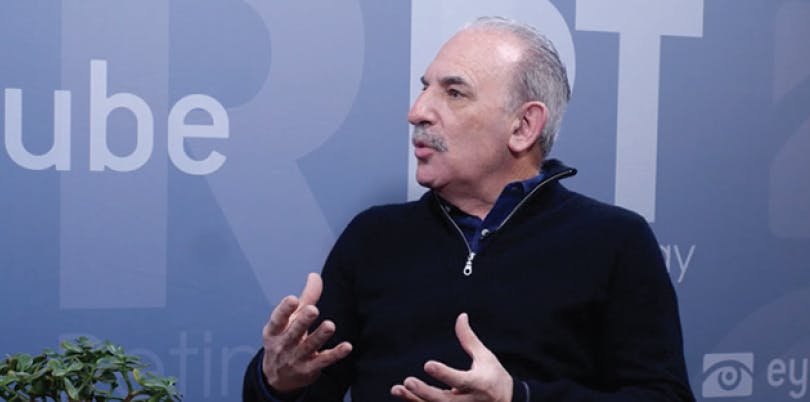
Neuroprotection for the Treatment of the Retina
Baruch Kuppermann, MD, PhD, discusses unmet needs in conditions such as retinal detachment, geographic atrophy, and dry AMD and what the right pathway may be for neural protection and enhancement.
Want to see the whole video collection? Click here.
1. Nuzzi R, Lavia C, Spinetta R. Paediatric retinal detachment: a review. Int J Ophthalmol. 2017;10(10):1592-1603.
2. Maldonado RS, Izatt JA, Sarin N, et al. Optimizing hand-held spectral domain optical coherence tomography imaging for neonates, infants, and children. Invest Ophthalmol Vis Sci. 2010;51(5):2678-85.


_1773249222.png?auto=compress,format&w=75)





