


Treatments for diabetic retinopathy (DR) and diabetic macular edema (DME) have made tremendous advances in recent decades, but modalities with better efficacy and longer durability are still needed. Many ongoing trials are aiming to validate new treatment options. These range from new drugs to advances in dosing or administration of established pharmaceuticals to entirely new modalities. In this article, we provide an overview of some phase 2 and 3 studies (Table) that, if successful, may revolutionize the treatment of DR and DME.
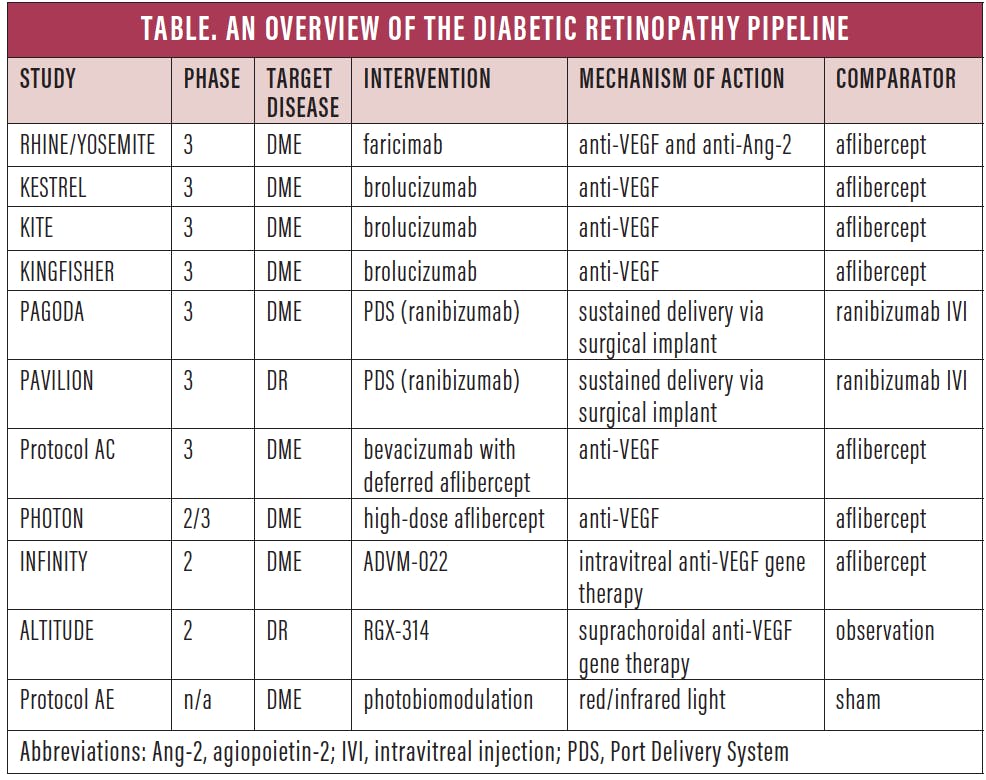
PHASE 3 STUDIES
Faricimab
RHINE (NCT03622593) and YOSEMITE (NCT03622580) are two phase 3 clinical trials designed to evaluate the efficacy of intravitreal injections of faricimab (Roche) for the treatment of DME in more than 900 participants each. Faricimab is a humanized immunoglobulin G antibody against two targets: VEGF-A and angiopoietin-2 (Ang-2). VEGF upregulates Ang-2, which further destabilizes retinal vasculature and increases inflammation.
AT A GLANCE
- Multiple trials are under way with the promise of advancing treatment for diabetic eye disease.
- In addition to novel therapeutics, some trials are assessing alternative treatment schedules, delivery systems, and dosages.
- Gene therapy and photobiomodulation are also being investigated.
Patients with type 1 or type 2 diabetes, abnormally increased central subfoveal thickness (CST), and VA of 20/40 to 20/320 at baseline are eligible for inclusion. The trials exclude patients who have high-risk proliferative DR (PDR) or have received anti-VEGF treatment within the preceding 3 months. The primary endpoint for both studies is change in BCVA from baseline to 1 year.
In two arms of each trial, participants receive injections of faricimab. Both experimental arms begin treatment with 6.0 mg injections dosed every 4 weeks for 20 weeks. Thereafter, one arm is treated every 8 weeks and a second experimental arm is treated every 12 weeks as long as the patient’s CST does not increase and require more frequent treatment. The comparison arm is 2.0 mg aflibercept (Eylea, Regeneron) dosed every 4 weeks for 16 weeks, then every 8 weeks thereafter. All study arms will be continued for 100 weeks.
Primary outcome data for RHINE and YOSEMITE are expected at the end of 2020.
Brolucizumab
Positive results in the HAWK and HARRIER trials in patients with AMD led to the FDA approval of brolucizumab-dbll (Beovu, Novartis) for that indication.
The safety and efficacy of brolucizumab for treatment of DME is now being investigated in three phase 3 trials (NCT03481634). The potential benefits of brolucizumab stem from the low molecular weight of the drug, allowing the injection of a much higher molar dose compared with currently available therapeutics.
KESTREL (NCT03481634) is a randomized, double-masked, noninferiority study including participants with type 1 or type 2 diabetes with VA of 20/32 to 20/320 and abnormally increased CST on OCT. Individuals who have previously undergone any treatment for DME or have proliferative disease are excluded. The experimental arms of the studies compare 3.0 mg and 6.0 mg doses of brolucizumab given every 6 weeks for five injections followed by maintenance injections every 8 or 12 weeks until the end of the study. The comparator for noninferiority is 2.0 mg aflibercept dosed every 4 weeks for five injections and then every 8 weeks as maintenance until completion of the study.
WATCH IT NOW
The PDS With Ranibizumab Enters Phase 3 Trials.
KESTREL reached full enrollment with 571 patients in March 2020. Study completion is expected in 2021.
Similarly, KITE (NCT03481660) is an international, randomized, noninferiority trial comparing brolucizumab with aflibercept for DME. This study includes patients with type 1 or type 2 diabetes with nonproliferative DR and previously untreated DME. Patients in one study arm will undergo treatment with 6.0 mg doses of brolucizumab given for five loading doses followed by maintenance therapy. The comparator is 2 mg aflibercept also administered for five loading doses followed by maintenance therapy. The primary outcome is change in BCVA from baseline to week 52.
KITE is still active and has completed enrollment with 361 patients. In September, Novartis announced that preliminary data show the trial met its primary noninferiority endpoint.
KINGFISHER (NCT03917472) is another phase 3 study assessing the effectiveness of brolucizumab in DME. This trial randomly assigns participants with DME to one of two treatment arms: 6.0 mg of brolucizumab every 4 weeks or 2 mg of aflibercept every 4 weeks. Patients with proliferative DR or prior medical or laser treatment for ocular disease are excluded. The primary outcome is change in BCVA from baseline to 12 months.
Data from the full enrollment of 521 patients in KINGFISHER are expected in 2021.
Ranibizumab via PDS
Two ongoing phase 3 studies are investigating the safety and efficacy of a new, higher concentration (100 mg/mL) of ranibizumab (Hoffman-La Roche) as delivered via the Port Delivery System (PDS) in DME (PAGODA) and DR (PAVILION). The PDS is an intraocular implant, surgically placed in the pars plana, that provides continuous delivery of a medication into the vitreous. The implant can be refilled as needed in an in-office procedure.
PAGODA (NCT04108156) is a noninferiority trial evaluating PDS with 100 mg/mL ranibizumab compared with intravitreal 0.5 mg ranibizumab (Lucentis, Genentech) injections in patients with DME. Participants have type 1 or type 2 diabetes, increased CST, and VA of between 20/32 and 20/320; patients with high-risk PDR are excluded. One arm of the study begins with four injections of ranibizumab, administered every 4 weeks. This treatment period is followed by insertion of the PDS, which is then refilled every 24 weeks with 100 mg/mL ranibizumab. A second study arm starts with 16 intravitreal injections of 0.5 mg ranibizumab, administered every 4 weeks, followed by insertion of the PDS. Change in BCVA from baseline to week 64 is the primary endpoint to demonstrate noninferiority, and assessments of the patient experience and quality of life are also included.
Recruitment for PAGODA is ongoing, progressing toward a target enrollment of 545 participants, and primary outcome data are expected in 2021.
PAVILION (NCT04503551) is designed to evaluate the PDS with ranibizumab 100 mg/mL versus intravitreal 0.5 mg ranibizumab injections in patients with moderately severe or severe nonproliferative DR. Importantly, patients with DME are excluded from this trial. The primary endpoint is the percentage of participants with an improvement of greater than 2 steps from baseline on the ETDRS Diabetic Retinopathy Severity Scale at 1 year. Participants will receive two intravitreal 0.5 mg ranibizumab injections before PDS insertion, and then the PDS will be refilled with 100 mg/mL ranibizumab every 36 weeks. A comparator arm will undergo regular examinations every 4 weeks until crossing over to receive the PDS implant.
PAVILION is actively recruiting, aiming for 160 patients.
Aflibercept
Building on the findings of its Protocol T, the Diabetic Retinopathy Clinical Research Network (DRCR.net) has initiated Protocol AC (NCT03321513), a phase 3 study to compare initial versus deferred treatment with aflibercept in DME, to look for differences in visual outcomes. In the experimental arm of the study, treatment is initiated with 1.25 mg bevacizumab (Avastin, Genentech) and then patients are changed to 2.0 mg aflibercept when CST meets the criteria for switching treatment. In the comparator arm, 2.0 mg aflibercept is administered from the beginning. The study will evaluate 260 patients with diabetes with increased CST and VA of 20/50 to 20/320; patients who have recently received treatments are excluded. The primary outcome is mean change in visual acuity at 2 years.
Protocol AC is fully enrolled, and completion and outcomes data are expected at the end of 2021.
PHOTON (NCT04429503) is a phase 2/3 randomized double-masked study designed to investigate the efficacy and safety of 8.0 mg aflibercept, referred to as high-dose (HD) aflibercept, compared with the current FDA-approved dose of 2.0 mg aflibercept. The target population is patients with DME, excluding patients with PDR or recent treatment for DME. In the two experimental arms of this trial, patients will receive HD aflibercept monthly for three injections and then either every 12 or every 16 weeks through the end of the study period. Patients in the control arm will receive five monthly doses of 2.0 mg aflibercept followed by injections every 8 weeks until the study concludes. The primary endpoint will be change in BCVA from baseline.
This study is ongoing and aims to recruit more than 600 patients. Estimated study completion is in 2023.
PHASE 2 STUDIES
ADVM-022
INFINITY (NCT04418427) is a randomized, double-masked trial investigating ADVM-022 (Adverum), a synthetic adeno-associated virus vector (AAV.7m8) carrying a coding sequence for aflibercept. This therapeutic candidate harnesses the technological advances of gene therapy, inducing cells in patients’ eyes, to produce the drug. ADVM-022 is administered in a single intravitreal injection. Phase 1 data showed improved visual acuity and CST with two doses of the vector, but only 21 patients were treated, and follow-up was limited.
INFINITY is actively recruiting, seeking a total of 33 patients. Eligible patients will be randomly assigned to receive one of two doses of ADVM-022 or aflibercept. The primary goal is to assess the durability of a single injection of ADVM-022 for DME. All patients will be followed for 48 weeks. Completion is expected in 2021.
RGX-314
ALTITUDE (NCT04567550) is a randomized controlled clnical trial investigating another viral vector developed for anti-VEGF gene therapy. RGX-314 (RegenxBio) uses an adeno-associated virus vector (AAV8) to deliver a gene encoding an anti-VEGF monoclonal antibody fragment. The vector is delivered into the suprachoroidal space rather than intravitreally. This study will include individuals with type 1 or type 2 diabetes with VA better than 20/40 and without DME. The primary endpoint is improvement in DR severity at week 48 versus observational controls.
ALTITUDE is recruiting toward a goal of 40 patients, and primary outcome data are anticipated in 2021.
Photobiomodulation
DRCR.net Protocol AE (NCT03866473) is assessing the effect of photobiomodulation compared with sham on CST in eyes with center-involved DME and good vision. In photobiomodulation, far red or near infrared light is used to decrease diabetes-induced retinal inflammation, likely by stimulation of mitochondrial cytochrome C oxidase. In the experimental arm of this study, patients will undergo two 90-second sessions each day using a device that delivers 670-nm wavelength light, while those in the control arm will receive sham treatment. The primary outcome is mean change in CST at 4 months.
Initially, Protocol AE was designed as a crossover trial, but COVID-19 forced changes to the protocol. This study is active and fully enrolled at 134 patients.
CONCLUSION
As the preceding list makes clear, several ongoing phase 2 and 3 trials have the potential to revolutionize the treatment of DR and DME. New molecules such as faricimab and brolucizumab are aiming at established and novel targets. Familiar pharmaceuticals are being investigated at higher doses, with alternative timings, and via different delivery methods. Viral vectors and novel phototherapeutics are being investigated. This broad range of scientific inquiry, with multiple therapeutics now in phase 3 trials, may lead to exciting improvements in the management of diabetic retinal disease in the not-too-distant future.


_1784132761.jpg?auto=compress,format&w=75)





