


When were you first interested in ophthalmology? When did you know you wanted to become a vitreoretinal surgeon?
I decided on ophthalmology my first week in medical school, and I worked all 4 years at Bascom Palmer Eye Institute. I decided on vitreoretinal surgery during my second year in medical school. The retina is a very complex and elegant structure, with a wide variety of diseases, techniques and technologies; it is a high-tech field perfect for my engineering background, and it is rich in opportunities for product development.
You pursued an engineering degree and are a mechanical and electrical engineer. What made you choose this path? How has it helped with your ophthalmology career?
I planned on using engineering to develop medical products even before starting medical school. I continued my education in engineering throughout medical school, internship, my residency at Bascom Palmer, and my fellowship at the National Eye Institute/National Institutes of Health, as well as my 45 years in practice. I now have more than 100 patents issued or pending and am the principal architect of the Alcon Accurus and Constellation Systems as well as Ocutome 8000 (CooperVision) and MVS (MidLabs) systems. I also invented endophotocoagulation in 1979.
You have developed many techniques and devices used by vitreoretinal surgeons worldwide and also have several patents in engineering. What keeps you motivated to continue to create and improve these fields?
It is about problem-solving for me. It is not about being an inventor per se, money, ego, challenges, or entrepreneurship. Prior to Accurus, we had many individual devices with their own foot pedals, power cords, and small displays. The Accurus system was about system integration, with a single reconfigurable display that is multifunction configurable. I invented linear aspiration to enable foot pedal control of vacuum levels. I pushed for higher and higher cutting rates to reduce pulsatile vitreoretinal traction. I helped develop faster response time fluidics to reduce the incidence of iatrogenic retinal breaks.
How do you maintain a healthy work-life balance?
I have three awesome daughters, work 7 days a week, live alone in an apartment, and have taken no vacation in 25 years, no hobbies, games, movies, fishing, or golf. I lift weights intensely and do that 3 to 4 days per week. I also help domestic violence victims. I have an Airline Transport Pilot rating, six jet type ratings, and have flown corporate jets for business purposes for 30 years. I have no plans to retire.
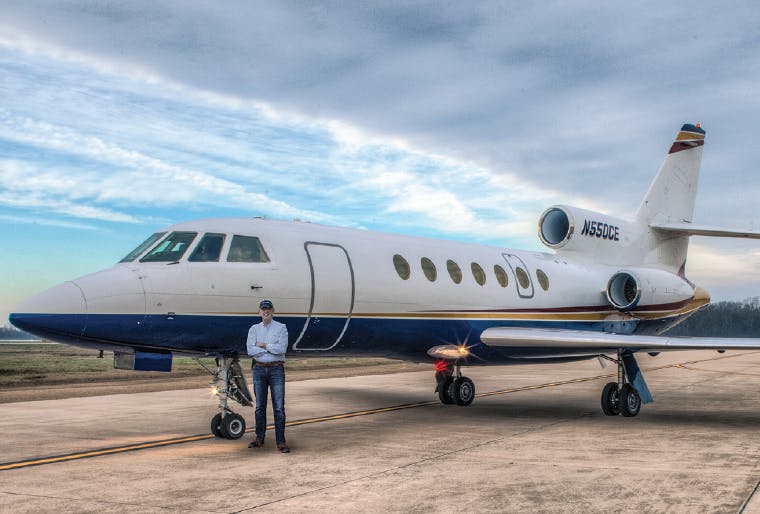
Figure. Dr. Charles owned and flew a Falcon 50 corporate plane to research and development meetings and medical meetings. He is type-rated in the 3,400 mile range, 480 knot airspeed aircraft.
What has been the most memorable moment of your career?
When I received the AAO’s Laureate Recognition Award in 2018 for my work in vitreoretinal surgery. The AAO presents this award to individuals who “have made exceptional contributions to the advancement of eye care, leading to the prevention of blindness and restoration of sight worldwide.”1
1. 2018 Laureate Recognition Awardee: Steven Charles, MD. 2018 Laureate. www.aao.org/about/awards/laureate/steven-charles. Published 2018. Accessed March 3, 2021.

_1784132761.jpg?auto=compress,format&w=75)





