


AT A GLANCE
- The number of required annual screenings for AMD, glaucoma, and diabetic retinopathy easily tops 100 million, with a prohibitive yearly cost of $23 billion.
- A new deep-learning and telemedicine-based screening tool for AMD detection showed an accuracy of 96.29% on referable AMD and 86% for predicting disease progression within 1 to 2 years.5
- The AI-based tools are developed by iHealthScreen, and the current study—led by R. Theodore Smith, MD, PhD—focuses on the prospective trial and offers a portfolio of visual sensory function tests that provide additional information and, potentially, higher accuracy in the screening.
Despite the widely understood importance of visual health, diagnostic eye care continues to fail a large segment of our population, especially the medically underserved. This often results in catastrophic consequences, such as preventable blindness from AMD, glaucoma, or diabetic retinopathy (DR).
Even with the AAO’s recommendation for timely and ongoing vision examinations for patients with type 1 and type 2 diabetes,1 half of all diabetics do not get the eye examinations necessary to diagnose DR. Left untreated, DR can lead to irreversible blindness.
Likewise, AMD remains the leading cause of blindness in the developed world, followed closely by glaucoma. Both conditions are underdiagnosed in their early stages, with diagnosis often occurring only after irreparable vision loss has already occurred. Vision loss often leads to a downward spiral in overall health: depression, loss of independence and mobility, nursing home care, falls, fractures, bleeds, and, ultimately, death.
AMD INNOVATIONS
Obstacles to early diagnosis can include financial barriers, difficulty accessing care, and a lack of motivation. One proposed solution to overcome these barriers is the adoption of telemedicine.
R. Theodore Smith, MD, PhD, Director of Biomolecular Retinal Imaging at the New York Eye and Ear Infirmary of Mount Sinai and a professor of ophthalmology and neuroscience at the Icahn School of Medicine at Mount Sinai, strongly believes that telemedicine is the answer.
With telemedicine, “Physicians would be able to inform patients if they are at risk for a problem before they even leave the office and, if so, encourage them to get specialized care,” he explained. “It could represent a major step for public health by alerting patients to problems that too often today lead to advanced disease and even blindness.”2
The development and implementation of a screening tool for early detection of AMD is now of greater importance than ever, as the Age-Related Eye Disease Study has shown that specific antioxidants and vitamin supplements can reduce the risk of progression from intermediate to late-stage AMD. If telemedicine screening can bring about increased use of these supplements by AMD patients, it has the potential to meaningfully decrease AMD progression and associated visual loss.
Considering this urgent need, Alauddin Bhuiyan, PhD, and his team at iHealthScreen developed artificial intelligence (AI)-based AMD screening and prediction tools. Now, Dr. Bhuiyan and Dr. Smith are working on a prospective trial funded by the National Institutes of Health (NIH).
“This technology could be particularly useful in identifying someone who has slipped across the boundary to intermediate or higher-risk AMD and is thus more statistically likely to progress,” Dr. Smith said. “By alerting patients and their physicians to the potential dangers ahead, we believe this approach could play a very important public health role.”2
The tools for this approach are already available and are more affordable than conventional screening and office-based care methods. However, a significant cost worth considering is that of the skilled ophthalmologist integral to telemedicine image evaluation and diagnosis.3 The number of annual screenings required (AMD for all patients aged 50 or above, glaucoma for all patients over age 40, DR for all diabetics) easily tops 100 million, with a prohibitive yearly cost of $23 billion.
The missing link between affordability and need may be AI. Dr. Smith and Dr. Bhuiyan, the founder and CEO of iHealthScreen and an associate professor at Icahn School of Medicine at Mount Sinai, have led the way for several years in building AI systems with deep learning (DL) algorithms capable of making retinal diagnoses (AMD, DR, and glaucoma) using retinal photographs.
“We were able to train these convolutional neural networks on hundreds of thousands of photographs to be able to recognize features that determined if they fell into the broad categories of early, intermediate, or advanced AMD,” Dr. Smith explained. “And that’s the beauty of AI: it can define patterns and make inferences from gigantic data sets that humans could never wrap their minds around.”2
Sharmina Alauddin, MBBS, DO, FCPS, presented results with the screening tool for AMD detection at the 2020 AAO Annual Meeting.4 Prospectively vetted in the clinic setting with inexpensive automated cameras operated by trained staff, the tool uses AMD-specific algorithms to classify patients into early, intermediate, or advanced AMD. A machine learning technique is used to predict progression to late-stage AMD (Figures 1 and 2). The system’s accuracy for predicting disease progression within 1 to 2 years is 86%, higher than any other tool currently available.5
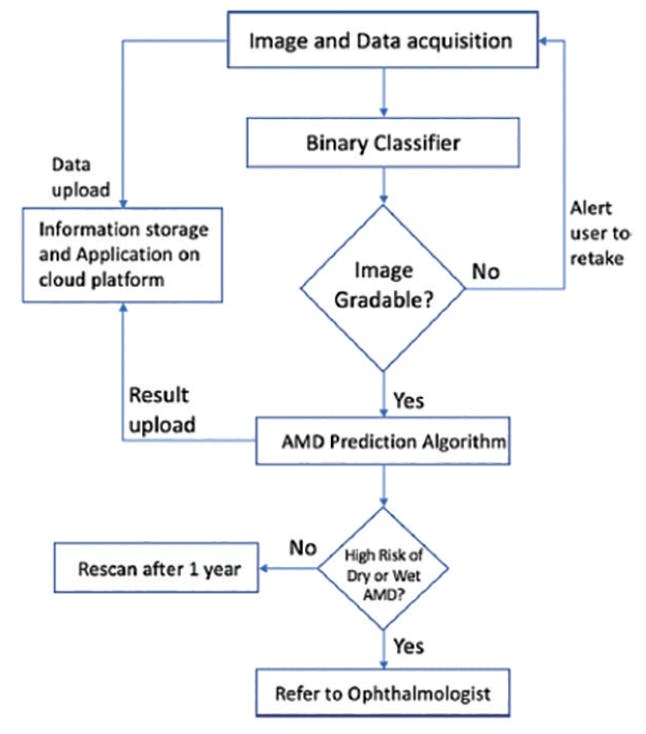
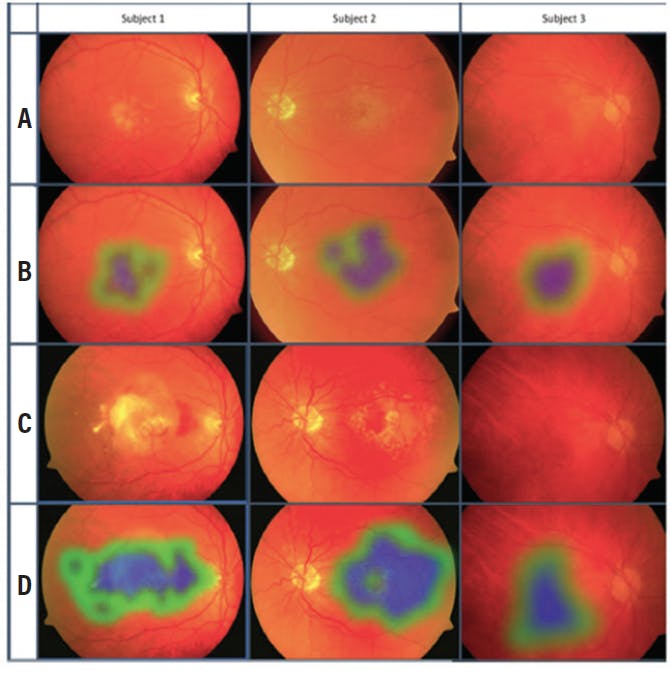
Figure 2. Fundus photos of three patients at baseline (A) and the corresponding heat maps (B) of early AMD signs detected by the classifier. Blue and green colors indicate strong and weaker signs of AMD, respectively. Follow-up photos show conversion to late AMD (C). Follow-up heat maps show larger areas and worse signs signifying late AMD (D).
TARGETING DR
The algorithms for DR screening are also promising, with the ability to grade the severity of DR on a five-point scale (no, mild, moderate, severe, and proliferative DR) based on the presence and extent of microaneurysms, exudates, hemorrhages, and other abnormalities detectable in fundus photographs. When measured prospectively in the clinic against human expert screening, the AI system achieved a sensitivity of 94.7% and a specificity of 100% for referral-level DR (moderate or worse), which is adequate for FDA approval of a screening system.6 Larger scale trials are planned to further test the five-point DR algorithm on the path to FDA approval. The federal government, noting the progress being made in AI-based retinal screening, has developed a code for automated retinal diagnosis that will pay $35, not $230,3 paving the way for a potentially affordable solution.
TARGETING GLAUCOMA
Our group also performed a study for screening glaucoma suspects. Because glaucomatous vision loss may be preceded by an enlargement of the cup-to-disc ratio (CDR), we propose to develop and validate an AI-based CDR grading system that may aid in effective glaucoma suspect screening. The results were presented at ARVO 2020.7 We tested the system using a dataset constructed from various studies and achieved an accuracy of 89.67%.7 For external validation, we used the Retinal Fundus Image Database for Glaucoma Analysis dataset, which has 638 gradable quality images, and achieved an accuracy of 83.54%.7
FUTURE PLANS
AI is not a panacea. The algorithms can miss vision-threatening disease when left on their own—a concern clinicians and regulators alike must address before any AI system is cleared for independent use. Our team is planning a complementary fail-safe: simple, functional vision testing of what the eye actually sees. If a patient fails these tests, regardless of what the AI thinks, something is wrong and the patient must be referred to a specialist. If the BCVA is 20/200 (legally blind), referral is clearly required. Our screening system, therefore, includes a portfolio of visual sensory function tests that are not AI, easily administered on an iPad, creating a safety net for AI errors.
This proposal, then, is a full-fledged assault on the three major blinding eye diseases in primary care settings, particularly in underserved communities, with retinal photography, AI, and functional tests.
Machine learning with combined structural and functional data will optimize identification of disease and prediction of outcomes. Our study will be carried out in six clinics by clinic staff under physician supervision: a primary medical clinic for the underserved; a diabetes clinic, a geriatric clinic, and two retina clinics. In total, 2,800 individuals will be enrolled over 5 years, with patient outcomes followed over 3 years, with cohorts chosen to appropriately sample the general population and with enrichment of AMD, DR, and glaucoma patients to focus on these highly prevalent diseases.
The long-term goal is large-scale screening for blinding eye diseases in primary care settings, using telemedicine and AI with nonmydriatic retinal photos unified with functional testing. This will provide cost savings over telemedicine alone and will help to address health care disparities in disadvantaged populations, providing both early detection and efficacious treatment of blinding diseases.
1. American Academy of Ophthalmology. Screening for diabetic retinopathy. AAO Quality of Care Secretariat, Hoskins Center for Quality Eye Care. 2014. www.aao.org/clinical-statement/screening-diabetic-retinopathy. Accessed March 8, 2021.
2. First Eye Hospital In America Turns 200. New York Eye and Ear Infirmary of Mount Sinai. Department of Ophthalmology. Fall 2020. www.nyee.edu/files/NYEE/Patient-Care/Eye%20Services/NYEE_Ophthalmology_Chair_Report_2020.pdf. Accessed March 8, 2021.
3. Charters L. Teleretinal screening: effective, less costly option for DR. Ophthalmology Times. 2020;45(17):26.
4. Alauddin SB, Otero-Marquez O, Gildengorn R, et al. An automated artificial intelligence (AI) based telemedicine platform for screening patients with referable age-related macular degeneration (AMD): a prospective trial. Paper presented at: 2020 AAO annual meeting.
5. Bhuiyan A, Ting DSW, Govindaiah A, Souied EH, Smith RT. Artificial intelligence to stratify severity of age-related macular degeneration (AMD) and predict risk of progression to late AMD. Transl Vis Sci Technol. 2020;9(2):25.
6. Bhuiyan A, Govindaiah A, Deobhakta A, et al. Development and validation of an automated diabetic retinopathy screening tool for primary care setting. Diabetes Care. 2020;43(10):e147-e148.
7. Bhuiyan A, Govindaiah A, Smith T. An artificial intelligence based screening tool to identify glaucoma suspects from color fundus imaging. Invest Ophthalmol Vis Sci. 2020;61(9):PB009.

_1784132761.jpg?auto=compress,format&w=75)





