


Cystoid macular edema (CME) is a common manifestation of many retinal diseases.1 Often, the underlying etiology, such as diabetic retinopathy, macular degeneration, or retinal vein occlusion, is obvious based on clinical examination. Recent cataract surgery or active uveitis are other common causes of CME and are readily apparent based on history or examination.
Occasionally, CME may manifest without an obvious cause or underlying condition, perhaps noted on a routine and otherwise unremarkable eye examination. We recently encountered a case of CME with a surprising—although not unheard of—etiology, reminding us to look beyond the obvious and keep elusive etiologies in mind when the usual CME culprits don’t apply.
CASE REPORT
A 55-year-old man with recently diagnosed glaucoma presented with blurred central vision, redness, and ocular irritation in his left eye. He had been prescribed several different drop regimens to control his IOP, the most recent being latanoprost 0.005% once daily, which he had been using for several weeks unilaterally in the left eye.
His ocular history included repair of a pseudophakic macula-on retinal detachment in his left eye 5 years ago, with resulting VA of 20/20 OS and a mild, non-clinically significant epiretinal membrane.
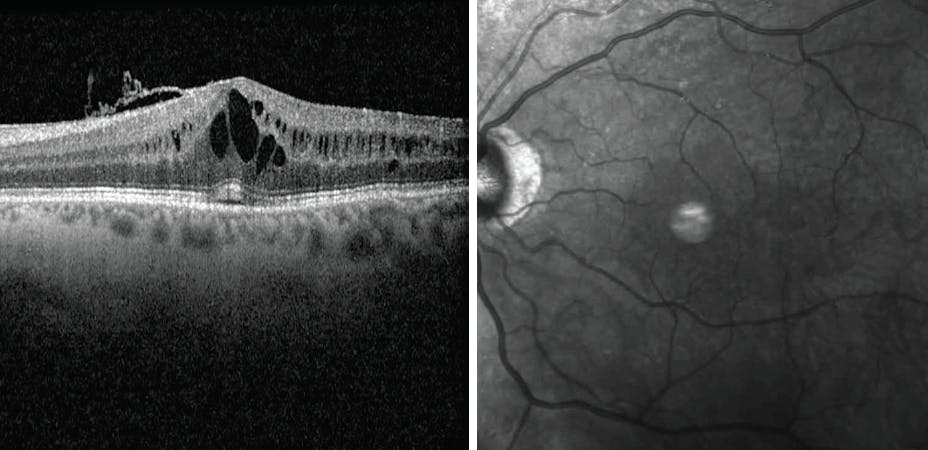
On examination, VA was 20/30 OS, with normal IOP and CME noted on OCT (Figure 1). There were no signs of macular degeneration, retinal vascular disease, or uveitis, only the previously noted mild epiretinal membrane. In addition, the timing of the vision decrease, the unilateral CME, and onset of prostaglandin use in the same eye (not bilaterally) was suggestive of a causal relationship.
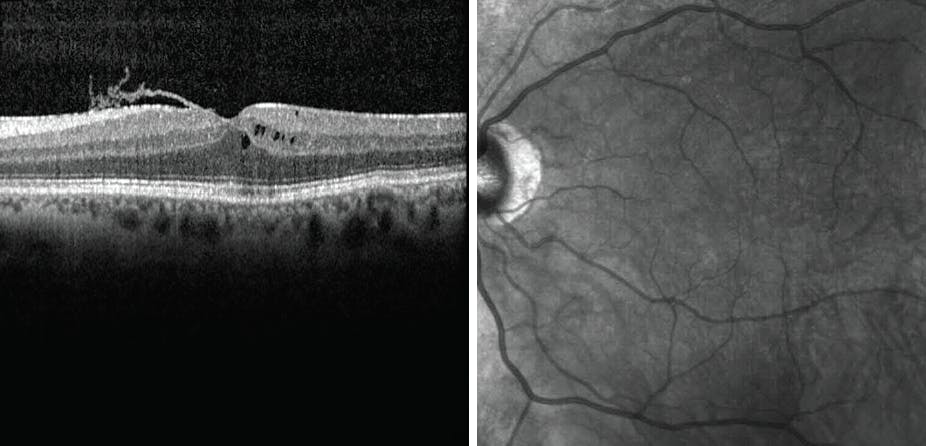
We recommended discontinuation of latanoprost. The patient saw a glaucoma specialist who substituted brimonidine 0.15% twice daily. One month later, his VA had improved to 20/20 OS with almost complete resolution of symptoms and CME on OCT (Figure 2).
DISCUSSION
Prostaglandin analogues are often used to reduce IOP in patients with ocular hypertension or glaucoma. These drops are often used as first-line therapy due to their convenient once-daily dosing. Common side effects include conjunctival hyperemia, corneal punctate epithelial erosions, and increased iris pigmentation.2
A lesser-known side effect of this class of drug is CME, reported with latanoprost and other commercially available prostaglandin analogues.3,4 Preservative-free prostaglandin analogues can produce this same side effect, ruling out the preservative as the cause of the CME rather than the prostaglandin itself. The CME is reversable after discontinuation of the drug.5
Interestingly, prostaglandin analogues can be administered distant from the eye and still cause CME. For example, one group of researchers reported a case of CME several days after intracorporeal injection of a prostaglandin E1 for erectile dysfunction.6
Although prostaglandin analogues are known to cause inflammation, CME is an uncommon side effect.7 The reason for this remains unknown, but genetic factors or underlying ocular diseases may increase a patient’s susceptibility. In addition, other confounding ocular pathologies could make a patient more susceptible to CME, such as epiretinal membrane and macular degeneration. Other risk factors for prostaglandin-induced CME are ocular surgery and damage to the blood-retina barrier, as is the case with uveitis.6 A patient with a healthy blood-retina barrier is less likely to be affected by prostaglandin-induced CME.
Both ocular and systemic use of prostaglandin analogues should remain on the physician’s list of possible causes of CME, particularly when a case presents with no other obvious etiology or when standard treatment is ineffective.
Fortunately, treatment is straightforward, as eliminating the causative drop and replacing it with one of many other IOP-lowering drops can lead to complete resolution of CME. This also holds true with discontinuation of systemic prostaglandin use.6
1. Rotsos TG, Moschos MM. Cystoid macular edema. Clin Ophthalmol. 2008;2(4):919-930.
2. Watson P, Stjernschantz J, Latanoprost Study Group. A six-month, randomized, double-masked study comparing latanoprost with timolol in open-angle glaucoma and ocular hypertension. Ophthalmology. 1996;103(1):126-137.
3. Heier JS, Steinert RF, Frederick AR. Cystoid macular edema associated with latanoprost use. Arch Ophthalmol. 1998;116(5):680-682.
4. Agange N, Mosaed S. Prostaglandin-induced cystoid macular edema following routine cataract extraction. J Ophthalmol. 2010;2010:690707.
5. Makri OE, Tsapardoni FN, Plotas P, Ifantis N, Xanthopoulou PT, Georgakopoulos CD. Cystoid macular edema associated with preservative-free latanoprost after uncomplicated cataract surgery: case report and review of the literature. BMC Res Notes. 2017;10:127.
6. Asahi M, Chou C, Gallemore R. Acute macular edema following intracorporeal prostaglandin injection for erectile dysfunction. Int Med Case Rep J. 2015;8:141-144.
7. Ricciotti E, FitzGerald GA. Prostaglandins and inflammation. Arterioscler Thromb Vasc Biol. 2011;31(5):986-1000.


_1773249222.png?auto=compress,format&w=75)





