


AT A GLANCE
- Early 3D visualization systems met with early adaptation issues, such as inconsistent color and visual performance and questions of latency.
- A recent training survey found that 42% of North American training institutions had access to an Ngenuity 3D visualization system (Alcon), but nearly half of them never used the system and none used it 100% of the time.
- Optimizing surgeon-controlled parameters including monitor viewing distance, camera aperture, and microscope magnification can improve the system’s performance.
The introduction of 3D visualization systems for vitreoretinal surgery a number of years ago was met with significant enthusiasm and excitement. Surgeons were enticed by the potential advantages these types of systems offered, including enhanced ergonomics, better visual performance, a better teaching platform for educational institutions, greater engagement among the OR surgical staff, overlay of surgical metrics on the display, and the ability to alter the image of the surgical environment (color, contrast, etc.) and to use lower light levels during surgery (reducing the risks of phototoxicity). Overall, it brought a sense of the future with all of its potential.
After a few years on the market, however, the momentum stalled. Many surgeons’ initial clinical experiences ended in disappointment because of a number of issues: perceived poor visual performance—either poor resolution, or a sense of too little or too much depth of field (DOF) or “swimming inside the eye”; increased latency, particularly with external work; inconsistent color performance; difficulty with ergonomics because the screen is on the side of the bed; difficulty with the sizing of the large display and control unit in smaller ORs; splitting of the image, particularly on the edges of the display; and high cost that made acquisition a challenge.
A survey of retina fellows during the 2020 Retina Fellows Forum found that 42% of training institutions had access to an Ngenuity 3D visualization system (Alcon), yet nearly half of those institutions never used the system and none of them used it 100% of the time. Only 50% of the responding fellows stated that they would use the system routinely if given a choice on graduation.
Because of this underperformance in clinical reality, I set out with my students to perform a number of studies to determine how to maximize the performance of the Ngenuity system.
PARAMETER SHOWDOWN
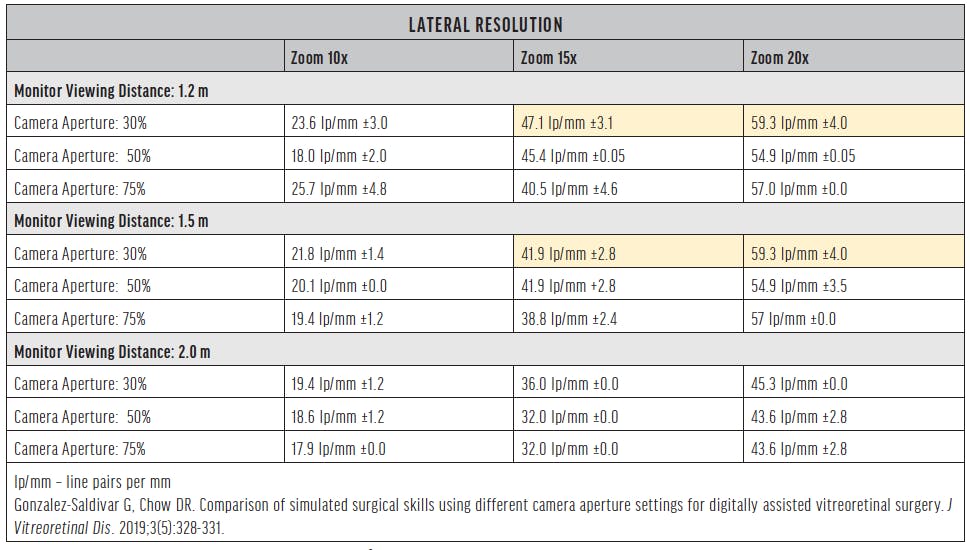
Our first study aimed to determine the effect of surgeon-controlled parameters (eg, monitor viewing distance, camera aperture, and microscope magnification) on the lateral resolution of the display. Our data showed that the most important factor in maximizing lateral resolution was maximizing the magnification of the microscope, followed by keeping the display at 1.2 m or, at most, 1.5 m from the surgeon.1 The camera aperture, when varied between 30% and 75%, had little effect on lateral resolution.
Interestingly, when the display was tested at 2 m (which 54% of fellowships used in 2019 and 17% in 2020, according to the fellow’s survey) there was a significant drop in resolution by about 25%, which explains some of the resolution complaints in clinical reality (Figure 1). Our advice from this data is that when the surgeon needs the best resolution during peeling of the internal limiting membrane (ILM), he or she should increase magnification on the microscope and make sure the display is 1.2 m distant.
Our next study evaluated the Ngenuity system’s DOF with various parameters. The results showed that maximal DOF was obtained at the lowest microscope magnification and with the camera aperture at 30% (Figure 2).1 A small clinical validation with a surgical wet-lab task with exaggerated 3D requirements in a group of masked test subjects showed better task completion times and accuracy with the camera aperture at 30% than at 75%.2
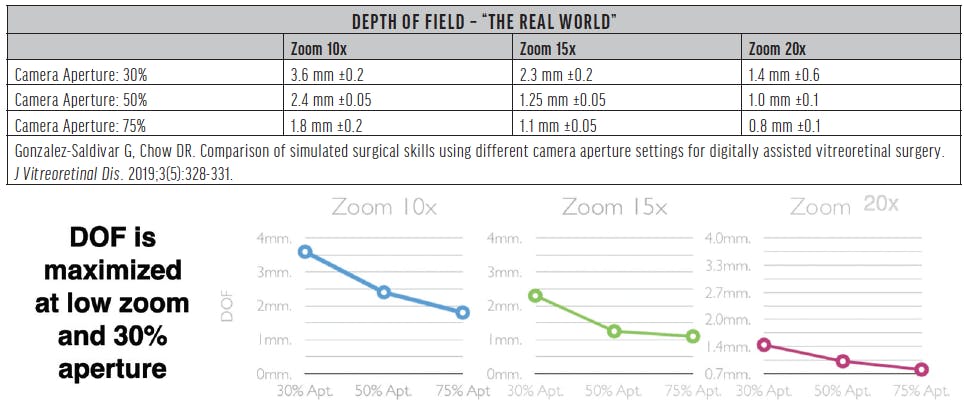
To maximize DOF at any magnification, the surgeon should keep the aperture at 30%. (Interestingly, the survey data in 2020 found that 47% of responding fellows were unaware that the 3D Ngenuity camera had an adjustable aperture.) However, if the surgeon finds the increased DOF of the Ngenuity uncomfortable compared with the conventional microscope, he or she should open the aperture to 50% to collapse the DOF.
The final visual parameter we assessed was depth resolution, which is a 3D system parameter that measures the finest axial depth possible. Our data, pending publication and presented at Euretina 2020, showed that the most important variable to maximize depth resolution was keeping the camera aperture at 30%, followed by maintaining the viewing distance at 1.2 m—the same settings that also maximize lateral resolution.
To peel an ILM, depth resolution is crucial, and the combination of a viewing distance of 1.2 m, a camera aperture of 30%, and maximized microscope magnification will provide the surgeon with the best visual performance with respect to lateral resolution, DOF, and depth resolution.
OVERCOMING DELAYS
Latency, particularly when performing external work, is a frequent complaint from surgeons, but not something I have experienced when using the Ngenuity system.
During the 2020 American Society of Retina Specialists conference, we presented results of our study exploring a titratable latency display on the Ngenuity. Test participants were evaluated objectively and subjectively while performing external suturing tasks or ILM peeling at four latencies: 50 ms (the lowest possible), 70 ms (the current latency of the Ngenuity system), 90 ms (the latency on the TrueVision 3D system, the precursor of the Ngenuity platform), and 122 ms. At 70 ms latency, only 4% of test subjects detected latency for external suturing and 0% for ILM peeling. Objective data revealed no differences in performance at any of the tested latencies, and subjective data suggested that the test subjects found external suturing at 122 ms more difficult, with a 60% drop in usability reported. Overall, our data confirmed to us that there are no clinical performance implications at the current Ngenuity latency of 70 ms.
COLOR IS KEY
Our most recent research explored the color performance of the Ngenuity’s camera and display. Ancedotal clinical experience has suggested variability in the color performance of the Ngenuity platform (Figure 3). We hypothesized that the white-balance process was contributing to this inconsistency. However, our data revealed consistent color performance when the white-balance process was altered in several ways. The only significant deviation in color performance occurred when white balance was performed using the surgeon’s gloved hand.
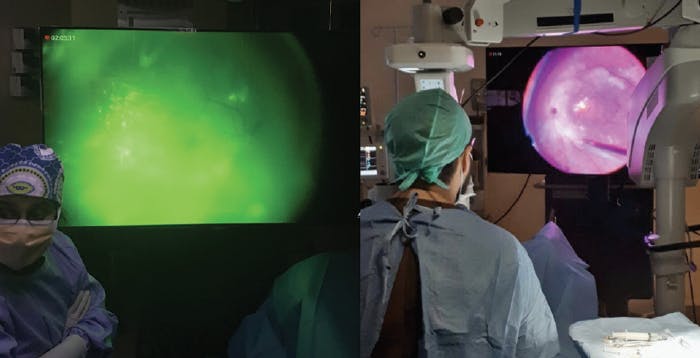
Figure 3. Some surgeons note inconsistency in color performance when using a 3D vitreoretinal surgery platform.
We also noted that the color performance remained stable over an extended period of time following white balance, suggesting that this process does not need to be performed daily, or likely even weekly. We also noted that color performance was better maintained by white-balancing with the laser filter in place rather than adding the filter intraoperatively. Further studies on the color performance of the platform are onging.
DIM THE LIGHTS
Since the Ngenuity platform’s release, many surgeons have reported operating at much lower light pipe levels (some lower than 5%) using the system. Our current work is evaluating the effect of surgeon-controlled parameters (monitor viewing distance, camera aperture, magnification, light pipe power, and use of digital gain on the display) on the display brightness to determine the subjective threshold that surgeons are content with when performing surgery.
NEW OPTIONS
Last year, a second 3D vitreoretinal surgery platform, Artevo (Carl Zeiss Meditec), came to market. Our institution is one of the few centers in the world to have both currently available 3D systems. In my early clinical experience using the Artevo, I have noted many subtle differences between the two. We are now performing the same series of studies just described on the Artevo to determine the ideal settings to maximize visual performance on that device. We look forward to presenting these data later this year.
Now that I have been using 3D visualization systems to perform vitreoretinal surgery for several years, I can say without hesitation that I have no intention of going back to a conventional microscope. Our studies have helped me to maximize my visualization with the Ngenuity platform and will shortly allow me to do the same for the Artevo system. I look forward to many wonderful new technologies in development that will take digital 3D visualization systems to the next level.
1. Gonzalez-Saldivar G, Chow DR. Optimizing visual performance with digtally assisted vitreoretinal surgery. Ophthalmic Surg Lasers Imaging Retina. 2020;51(4):S15-21.
2. Gonzalez-Saldivar G, Chow DR. Comparison of simulated surgical skills using different camera aperture settings for digitally assisted vitreoretinal surgery. J Vitreoretinal Dis. 2019;3(5):328-331.

_1784132761.jpg?auto=compress,format&w=75)




