





AT A GLANCE
- OCT angiography (OCTA) provides depth-resolved imaging of the retinal vasculature in both normal and pathologic states.
- OCTA is a valuable resource to detect macular neovascularization in a wide range of conditions, including AMD, myopia, presumed ocular histoplasmosis syndrome, multifocal choroiditis, panuveitis, pseudoxanthoma elasticum, and placoid diseases.
- Several types of artifacts have been described during acquisition of OCTA images, the most significant being motion, shadow, projection, and pseudoflow artifact.
OCT angiography (OCTA) is a safe, noninvasive imaging modality that provides depth-resolved imaging of the retinal and choroidal vasculature. With the use of dense volumetric OCT scans, OCTA can detect change (ie, decorrelation) in the OCT signal over very short time periods based on red blood cell motion. The surrounding static tissue remains unchanged on OCT during these short intervals, and the decorrelation information can then be projected in a 2D en face image segmented through the layers of the retina and choroid.1,2
The depth-resolved capabilities of OCTA facilitate identification and isolation of the retinal vasculature in both normal and pathologic states that are poorly differentiated by fluorescein angiography (FA).
The normal retinal vasculature is composed of four parallel capillary plexuses divided into two major circulations. The superficial vascular complex (SVC) includes the nerve fiber layer capillary plexus and the superficial retinal capillary plexus (SCP) located between the nerve fiber layer and the inner plexiform layer. The deep vascular complex (DVC) comprises the intermediate retinal capillary plexus and the deep retinal capillary plexus (DCP) located in the inner and outer borders of the inner nuclear layer (INL), respectively.3
THE VASCULATURE DISRUPTED
The DVC is difficult to capture with FA, which is primarily helpful to evaluate the SVC.3,4 In contrast, OCTA can localize the exact layer of ischemia in patients with acute retinal vein and artery occlusions. Specifically, patients with mild forms of retinal vein occlusion can initially present with localized INL hyperreflectivity on OCT (ie, paracentral acute middle maculopathy [PAMM]) with corresponding DCP flow deficit on OCTA.5,6 This initially develops in the region of the veins and is referred to as perivenular PAMM with en face OCT.
In more severe cases, PAMM can become more diffuse, and the ischemia can extend into the inner retina closer to the arteriole pole, a mechanism recently described as the ischemic cascade.4,7 These findings illustrate the new insights that en face OCT and OCTA have provided into both pathologic and normal retinal vascular states.
OCTA also provides a greater understanding of the choroid in retinal disease because of its ability to better capture the presence of choroidal ischemia and identify macular neovascularization (MNV).
In placoid spectrum diseases—such as acute posterior multifocal placoid pigment epitheliopathy and persistent placoid maculopathy—OCTA can effectively illustrate inner choroidal ischemia and can help physicians monitor for progression and response to treatment.8
OCTA is also an effective tool to quantitate choroidal ischemia in dry AMD. Choriocapillaris (CC) flow deficits can be identified in patients with early and intermediate dry AMD, indicating that CC ischemia is an important driving force in the development and progression of the disease.9-13
In neovascular disorders, OCTA can detect MNV in a wide range of conditions, including AMD, myopia, multifocal choroiditis, panuveitis, presumed ocular histoplasmosis syndrome, pseudoxanthoma elasticum, and placoid diseases.2,8,14-21
In patients with AMD, OCTA can identify morphologic differences that indicate the maturity of the neovascularization. These morphologic features have been associated with growth of the neovascular lesion, but reliable OCTA markers or predictors of disease activity and response to therapy are lacking.22 OCTA is also a critical modality to help identify nonexudative MNV and rule out neovascularization in eyes with intermediate AMD and fluid (Figure 1).23
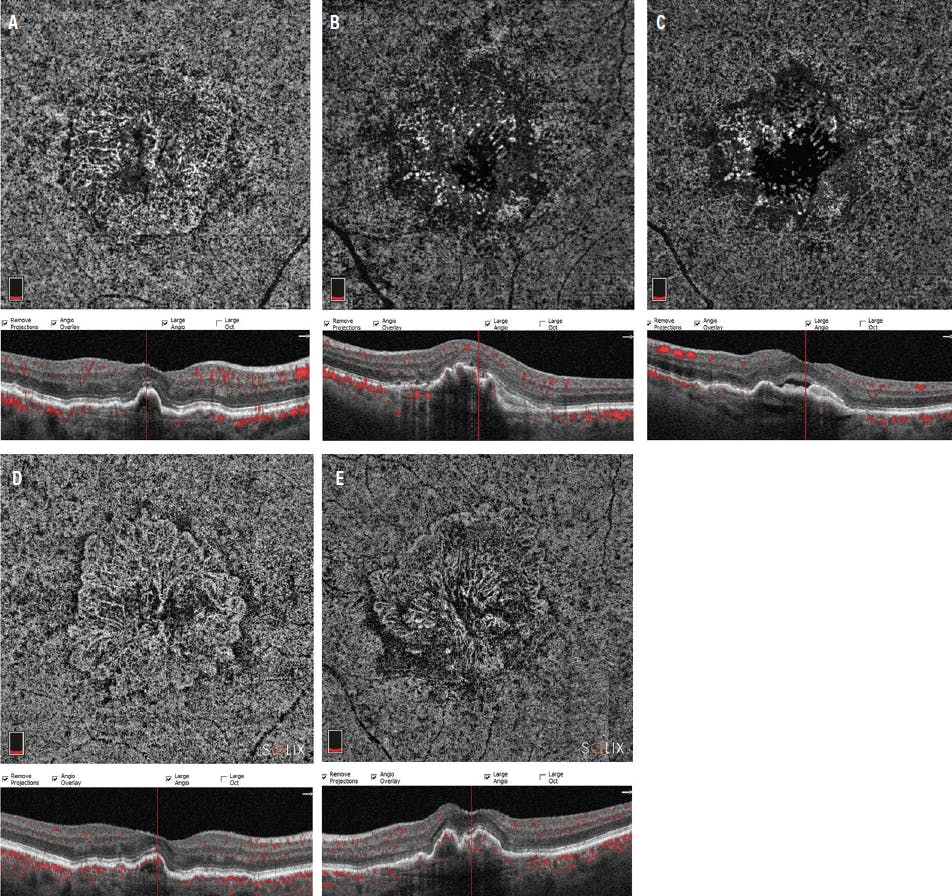
Figure 1. En face OCTA of this patient’s right eye segmented at the level of the CC shows nonexudative MNV, which is mature as distinct vessels can be identified and no fluid is present on OCT (A). The left eye CC OCTA scan through different locations of the pigment epithelial detachment shows exudative immature MNV and associated subretinal fluid with the registered OCT B-scan (B and C).
In the right eye, fluid is still absent 4 years later, but the nonexudative MNV is more mature and has grown larger in area (D). The left eye received several intravitreal injections of aflibercept (Eylea, Regeneron) over the 4-year period, and the MNV shows growth in area, and the vessels display a more mature morphology (E). The central area of the MNV shows characteristics of mature MNV while the fringe region shows evidence of more immature MNV.
IMAGING HURDLES
In addition to the limitations typically encountered with other imaging modalities, such as the need for minimal pupil size, patient cooperation, clear media, and stable fixation, OCTA has unique challenges. For one, the device depends on a threshold level to detect blood flow. To reduce unwanted noise, the manufacturer sets a threshold level of motion detection. If the threshold is set too high, true blood flow signals may be missed; conversely, a low threshold level can cause false-positive flow signals. Thus, OCTA may be less sensitive than FA in detecting microaneurysms and polyps (ie, polypoidal choroidal vasculopathy) because the slow flow can be below OCTA’s threshold detection level.2,24,25
Another challenge is the presence of segmentation errors. These errors occur more frequently in eyes with pathologies in which the normal retinal architecture is disrupted, requiring manual correction.26
Several types of artifacts have been described in the acquisition of OCTA images, the most significant being motion, shadow, projection, and pseudoflow artifact.2,15,24 Any form of eye movement, including head movement, breathing, blinking, or even minimal fixation changes and micro-motion due to blood flow pulsation, can result in motion artifacts. These movements can cause discrepancies in the consecutive scans that manifest as vertical or horizontal lines on en face images (Figure 2).
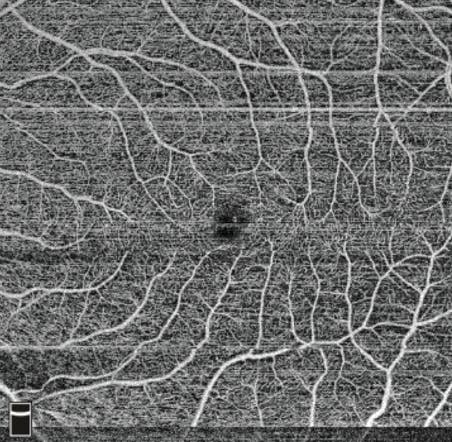
Figure 2. This 6x6 mm en face OCT angiogram of the left eye shows evidence of motion artifact. Note the horizontal lines that are present due to eye movement.
A shadow artifact is caused by attenuation of the signal due to light absorption or scattering. It can be caused by any obstacle anterior to the retina such as posterior vitreous detachment, vitreous hemorrhage, or vitritis. Even hyperreflective retinal material such as hard exudate or drusen can obstruct the retinal and choroidal layers.2,24
Projection artifact refers to a reflection of superficial blood flow in a deeper layer, generating a false positive flow signal on the en face image.2,24,25
Pseudoflow artifact is false-positive flow detected within hyperreflective structures such as hard exudate, drusen, or intraretinal retinal pigment epithelial cells.2,24,27 False-positive detection of MNV due to the presence of pseudoflow is a common pitfall, and care should be taken when evaluating OCTA to avoid misinterpretation based on artifacts.
Various techniques have been developed to decrease artifacts, including eye-tracking strategy and motion correction and projection removal algorithms, with partial success (Figure 3).2,24,26,27
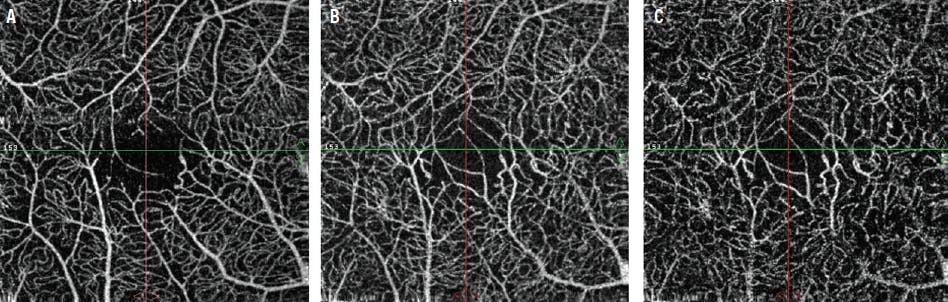
Figure 3. En face OCT angiogram at the level of the SCP (A). En face OCTA scan of the DCP shows projection artifact from the SCP (B). After application of a projection removal algorithm, the superficial vessels are removed, providing a cleaner representation of the DCP (C).
FINAL TAKEAWAY
OCTA provides important insights into the retinal and choroidal vasculature with depth-resolved capability, and uses an approach that is noninvasive, facile, and reproducible. This modality has generated significant knowledge not only regarding the normal anatomy of the retinal microvasculature but also as pertains to pathologic states, such as retinal vascular occlusions, choroidal ischemia, and MNV.
OCTA can facilitate the depth-resolved detection of ischemia in both the retinal and choroidal circulations and is an indispensable tool to capture MNV, providing more accurate identification and diagnosis and more effective disease monitoring than is possible with conventional systems such as dye-based angiography.
However, as with all imaging modalities, OCTA comes with limitations, the understanding of which is essential to maximize its application for the evaluation and management of retinal disease.
1. Ferrara D, Waheed NK, Duker JS. Investigating the choriocapillaris and choroidal vasculature with new optical coherence tomography technologies. Prog Retin Eye Res. 2016;52:130-155.
2. Kashani AH, Chen CL, Gahm JK, et al. Optical coherence tomography angiography: A comprehensive review of current methods and clinical applications. Prog Retin Eye Res. 2017;60:66-100.
3. Campbell J, Zhang M, Hwang T, et al. Detailed vascular anatomy of the human retina by projection-resolved optical coherence tomography angiography. Sci Rep. 2017:42201.
4. Spaide RF, Klancnik JM Jr, Cooney MJ. Retinal vascular layers imaged by fluorescein angiography and optical coherence tomography angiography. JAMA Ophthalmol. 2015;133(1):45-50.
5. Nemiroff J, Kuehlewein L, Rahimy E, et al. Assessing deep retinal capillary ischemia in paracentral acute middle maculopathy by optical coherence tomography angiography. Am J Ophthalmol. 2016;162:121-132.e1.
6. Falavarjani KG, Sarraf D. Optical coherence tomography angiography of the retina and choroid; current applications and future directions. J Curr Ophthalmol. 2017;29(1):1-4.
7. Bakhoum MF, Freund KB, Dolz-Marco R, et al. Paracentral acute middle maculopathy and the ischemic cascade associated with retinal vascular occlusion. Am J Ophthalmol. 2018;195:143-153.
8. Klufas MA, Phasukkijwatana N, Iafe NA, et al. optical coherence tomography angiography reveals choriocapillaris flow reduction in placoid chorioretinitis. Ophthalmol Retina. 2017;1(1):77-91.
9. Waheed NK, Moult EM, Fujimoto JG, Rosenfeld PJ. Optical coherence tomography angiography of dry age-related macular degeneration. Dev Ophthalmol. 2016;56:91-100.
10. Cicinelli MV, Rabiolo A, Marchese A, et al. Choroid morphometric analysis in non-neovascular age-related macular degeneration by means of optical coherence tomography angiography. Br J Ophthalmol. 2017;101(9):1193-1200.
11. Sohrab M, Wu K, Fawzi AA. A pilot study of morphometric analysis of choroidal vasculature in vivo, using en face optical coherence tomography. PLoS One. 2012;7(11):e48631.
12. Borrelli E, Uji A, Sarraf D, Sadda SR. Alterations in the choriocapillaris in intermediate age-related macular degeneration. Invest Ophthalmol Vis Sci. 2017;58(11):4792-4798.
13. Carnevali A, Cicinelli MV, Capuano V, et al. Optical coherence tomography angiography: a useful tool for diagnosis of treatment-naïve quiescent choroidal neovascularization. Am J Ophthalmol. 2016;169:189-198.
14. Inoue M, Jung JJ, Balaratnasingam C, et al; COFT-1 Study Group. A comparison between optical coherence tomography angiography and fluorescein angiography for the imaging of type 1 neovascularization. Invest Ophthalmol Vis Sci. 2016;57(9):OCT314-323.
15. Sarraf D, Sadda S. Pearls and Pitfalls of Optical Coherence Tomography Angiography Image Interpretation. JAMA Ophthalmol. 2020;138(2):126-127.
16. Faridi A, Jia Y, Gao SS, et al. Sensitivity and specificity of OCT angiography to detect choroidal neovascularization. Ophthalmol Retina. 2017;1(4):294-303.
17. Roisman L, Zhang Q, Wang RK, et al. Optical coherence tomography angiography of asymptomatic neovascularization in intermediate age-related macular degeneration. Ophthalmology. 2016;123(6):1309-1319.
18. Bruyère E, Miere A, Cohen SY, et al. Neovascularization secondary to high myopia imaged by optical coherence tomography angiography. Retina. 2017;37(11):2095-2101.
19. Dolz-Marco R, Sarraf D, Giovinazzo V, Freund KB. Optical coherence tomography angiography shows inner choroidal ischemia in acute posterior multifocal placoid pigment epitheliopathy. Retin Cases Brief Rep. 2017;11(Suppl 1):S136-S143.
20. Chapron T, Mimoun G, Miere A, et al. Optical coherence tomography angiography features of choroidal neovascularization secondary to angioid streaks. Eye (Lond). 2019;33(3):385-391.
21. Liu TYA, Zhang AY, Wenick A. Evolution of choroidal neovascularization due to presumed ocular histoplasmosis syndrome on multimodal imaging including optical coherence tomography angiography. Case Rep Ophthalmol Med. 2018;2018:4098419.
22. Xu D, Dávila JP, Rahimi M, et al. Long-term progression of type 1 neovascularization in age-related macular degeneration using optical coherence tomography angiography. Am J Ophthalmol. 2018;187:10-20.
23. Hilely A, Au A, Freund KB, et al. Non-neovascular age-related macular degeneration with subretinal fluid [published online ahead of print, 12 Sep 2020]. Br J Ophthalmol.
24. Spaide RF, Fujimoto JG, Waheed NK. Image artifacts in optical coherence tomography angiography. Retina. 2015;35(11):2163-2180.
25. Couturier A, Mané V, Bonnin S, et al. Capillary plexus anomalies in diabetic retinopathy on optical coherence tomography angiography. Retina. 2015;35(11):2384-2391.
26. Camino A, Zhang M, Gao SS, et al. Evaluation of artifact reduction in optical coherence tomography angiography with real-time tracking and motion correction technology. Biomed Opt Express. 2016;7(10):3905-3915.
27. Hou KK, Au A, Kashani AH, Freund KB, Sadda SR, Sarraf D. Pseudoflow with OCT angiography in eyes with hard exudates and macular drusen. Trans Vis Sci Tech. 2019;8(3):50.

_1784132761.jpg?auto=compress,format&w=75)





