


AT A GLANCE
- The potential clinical utility of peripheral OCT is significant.
- At the 2021 Macula Society Meeting, data were presented from a study that examined the relationship between peripheral OCT obtained with the Silverstone (Optos) and clinical decision-making.
- A majority (69%) of eyes in the study presented with periphery-only pathology; among that group, data from peripheral OCT aided clinical decision-making in 84% of eyes.
For years, obtaining peripheral OCT images has been challenging. For example, the steered image capture of peripheral OCT images relied on variables such as patients’ ability to guide their gaze toward a target to capture pathology. Patient cooperation, technician skill, and extended capture time made the tool impractical for many physicians, although the data garnered from the high-quality images were often useful. Assembling montages from contiguous OCT scans similarly faces challenges related to capture time and technical training.
Either method of capturing peripheral OCT—steered image capture or montage—could take, in our experience, as long as 30 minutes. Thus, retina specialists had to weigh the benefits of the peripheral OCT data against the costs of obtaining them.
A new OCT device, the Silverstone (Optos), resolves many of these concerns. This multimodal platform integrates ultra-widefield (UWF) fundus imaging, swept-source OCT (SS-OCT), fundus autofluorescence (FAF), fluorescein angiography, and indocyanine green angiography.
Peripheral OCT capture on this platform takes a few minutes and requires neither image steering nor montaging. The screen-based interface allows technicians to quickly capture 23-mm line scans in the central retina or smaller line or volume scans in the peripheral retina.
Because quantitative data regarding the platform’s real-world uses are limited, we conducted a study examining the utility of UWF and peripheral OCT in clinical practice to better understand whether clinical integration of this device would benefit physicians and patients.
DESIGN AND RESULTS
In this single-center, prospective, observational, consecutive case series, presented at the 2021 Macula Society Meeting, we imaged 91 patients (125 eyes) with any of 38 retinal pathologies (eg, retinal detachment, retinoschisis, retinal vein occlusion, retinitis pigmentosa) with disease in the posterior pole, midperiphery, or far periphery.1
UWF color, FAF, and peripheral SS-OCT imaging was captured on the Silverstone by two experienced retinal photographers. The photographers captured 6-mm line scans and 6-mm volume scans, as well as a 6-mm HD volume scan and 23-mm extended line OCT as needed. Patients also underwent clinical examination with a Volk digital widefield lens.
The main outcome measures were accessibility of peripheral pathology and the relationship between peripheral OCT images and clinical decision-making.
The average age of study participants was 54 (range, 21–92) years. Of the 125 eyes imaged, 86 (69%) had pathology present only in the periphery. Among those, the addition of peripheral OCT impacted clinical decision-making in 72 (84%) eyes (Figure 1).
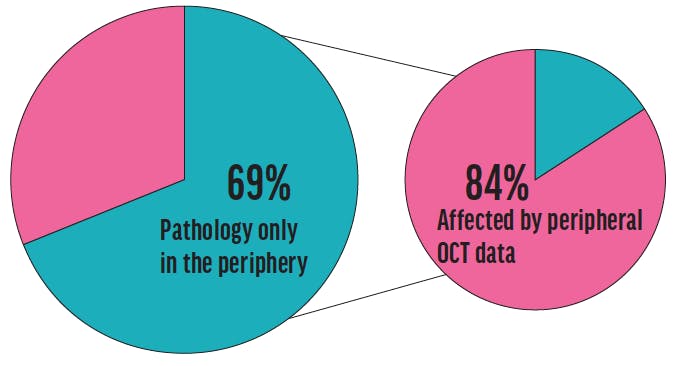
Figure 1. Among 125 eyes imaged in the study, 69% presented with pathology only in the periphery. Of those eyes, peripheral OCT data changed clinical decision-making in 84%.
These results confirmed that peripheral OCT data are clinically valuable and can guide patient care, particularly in cases involving periphery-only pathology. Of course, SS-OCT imaging of the posterior pole continues to be a mainstay of retina care. It should also be noted that peripheral OCT does not serve as a replacement for a clinical examination; rather, it allows for a more robust examination and may provide preoperative data for surgical pathologies.
SURGICAL CASES
We identified several instances in which peripheral OCT informed clinical decision-making in patients with pathologies that had a surgical indication, such as macular hole and retinal detachment. The following case presentations illustrate the real-world utility of peripheral OCT imaging.
Case No. 1
A 45-year-old White woman was referred to our clinic for a macular hole. She presented with BCVA of 20/200 OD. Imaging confirmed the presence of a macular hole, and peripheral OCT imaging captured a retinal hole in the far periphery (Figure 2). The retinal hole was treated with laser retinopexy before macular hole surgery was initiated.
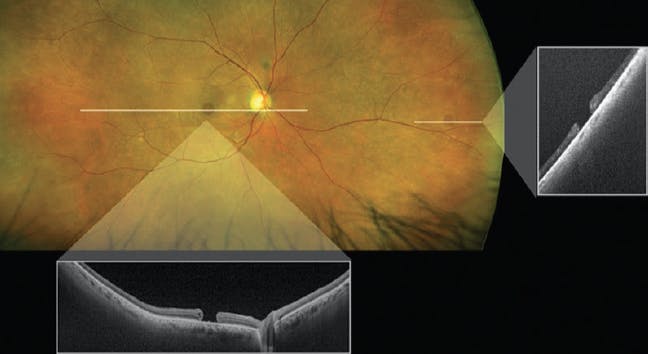
Figure 2. Peripheral OCT detected a retinal hole in the periphery. Early detection of the retinal hole led to its treatment before macular hole surgery.
The patient’s retinal hole might have been detected without peripheral OCT if a modality such as UWF imaging had been used. However, without OCT, the surgeon would not have known the presence or degree of traction and fluid related to the retinal hole. In this case, there was neither fluid nor traction. These data were used in planning surgery.
Case No. 2
A 57-year-old White woman was referred for a retinal detachment with BCVA of 20/200 in the left eye. Peripheral OCT revealed no other retinal breaks or tears, and pneumatic retinopexy was performed. During the follow-up period, peripheral OCT allowed us to track the resolution of subretinal fluid and monitor healing (Figure 3).
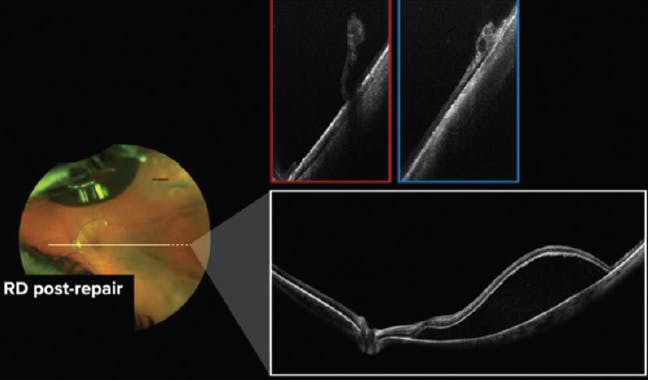
Figure 3. Peripheral OCT allowed visualization of subretinal fluid during follow-up of a patient who underwent pneumatic retinopexy for a retinal detachment.
In our experience, retinal tears addressed by pneumatic retinopexy may not resolve in the presence of undetected retinal tears or holes. In this case, the surgeon was able to execute treatment with the confidence that no other pathology was present and observe the patient during follow-up using peripheral OCT.
Case No. 3
A 41-year-old White man was referred to our clinic for suspicion of a retinal detachment. He presented with BCVA of 20/20 OD. UWF imaging demonstrated unusual pigmentation in the periphery. Further imaging with peripheral OCT revealed age-related retinoschisis (Figure 4). No retinal holes or detachments were detected. Because the pathology was not threatening to the fovea and the patient was asymptomatic, we elected observation over treatment.
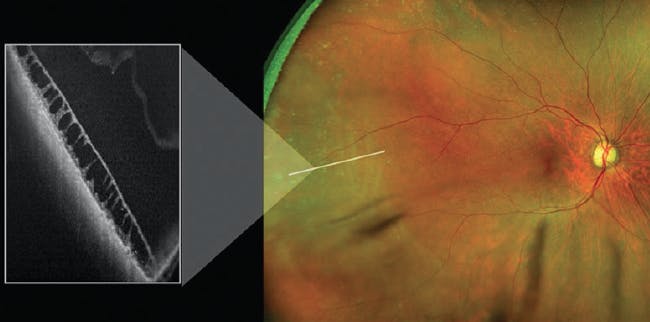
Figure 4. Age-related retinoschisis was detected on peripheral OCT in an asymptomatic patient who was referred for a possible retinal detachment.
Without peripheral OCT data in this case, the clinician would be faced with a more challenging and less certain diagnosis that might have required clinical examination with scleral depression or further follow-up. With peripheral OCT, an accurate diagnosis was made quickly and an observation plan was established.
Other OCT Options
Practices looking into devices capable of peripheral OCT imaging can also consider the Heidelberg Spectralis OCT 2 with a 55° lens1 and the Canon Xephilio OCT-A1, which gained FDA clearance in 2019.2
1. Cereda MG, Corvi F, Cozzi M, Pellegrini M, Staurenghi G. Optical coherence tomography 2: diagnostic tool to study peripheral vitreoretinal pathologies. Retina. 2019;39(2):415-421.
2. Canon Xephilio OCT-A1 Device Receives FDA 510(k) Clearance. https://eyewire.news/articles/canon-xephilio-oct-a1-device-receives-fda-510k-clearance. Accessed March 9, 2021.
COLLECTING MORE DATA
Use of this new tool for peripheral OCT has expanded our understanding of various retinal conditions. Clinicians particularly benefited from peripheral OCT data when addressing pathologies that required surgery (eg, retinal detachment, macular hole), as surgical planning and postoperative follow-up were more robust.
Further, there were some instances in which UWF imaging combined with peripheral OCT yielded data suitable for an accurate diagnosis, such as in Case No. 3 here, in which peripheral discoloration on UWF color imaging required further exploration with OCT imaging.
As with all new technology, there is room for improvement, particularly for the addition of steered imaging and enhanced vitreous detail. Of course, all devices have a cost, which must be taken into consideration for each practice.
The addition of a peripheral OCT device, especially as the technology improves, may be useful for busy retina clinics, particularly if the device is easy to use with fast data capture.
1. Choudhry N. Feasibility and clinical utility of peripheral OCT imaging using a novel integrated SLO ultra-widefield imaging full-field swept-source OCT device. Paper presented at: Macula Society Meeting; February 6-7, 2021.

_1784132761.jpg?auto=compress,format&w=75)





