




Trauma to the anterior segment may or may not be associated with posterior segment injury or complication. Patients who have had trauma limited to the anterior segment undergo initial wound repair (group A). If the resultant corneal scar is dense, full thickness, and precluding vision, penetrating keratoplasty (PKP) is done with or without lensectomy and limited anterior vitrectomy, depending on the extent of the injury. However, patients with associated posterior segment injury or complication (group B)—such as retinal detachment, nonresolving vitreous hemorrhage, intraocular foreign body, or endophthalmitis—will require a combination procedure including pars plana vitrectomy (PPV) and PKP.1
The question of whether or not to perform PPV arises only for patients in group A who do not have posterior segment pathology. Patients in group B—who have both corneal and retinal damage requiring combined surgery—would be expected to have a poorer prognosis than those in group A due to the involvement of both segments.
However, in a series of cases at our tertiary care eye institute, we have observed that graft survival and clarity are paradoxically better in group B patients undergoing combined surgery, provided that other parameters such as glaucoma, infection, and inflammation are controlled. Here, we discuss the mechanisms by which PPV may act as a favorable prognostic factor in terms of graft survival.2
Trauma Details
The Ocular Trauma Classification Group developed a classification system, based on the Birmingham Eye Trauma Terminology, that classified injured eyes by zones affected by the trauma: (1) cornea and limbus, (2) limbus to 5 mm posterior into the sclera, and (3) > 5 mm into the sclera.3
Although it is now several decades old, this classification system is still useful for categorizing the severity of corneoscleral injuries. Generally, scars from the repair of zone 1 injuries do not require corneal transplantation, whereas higher grades of trauma, after primary repair healing, will require corneal transplantation (Figure 1) along with additional procedures such as lensectomy and anterior vitrectomy if the posterior segment is not involved.
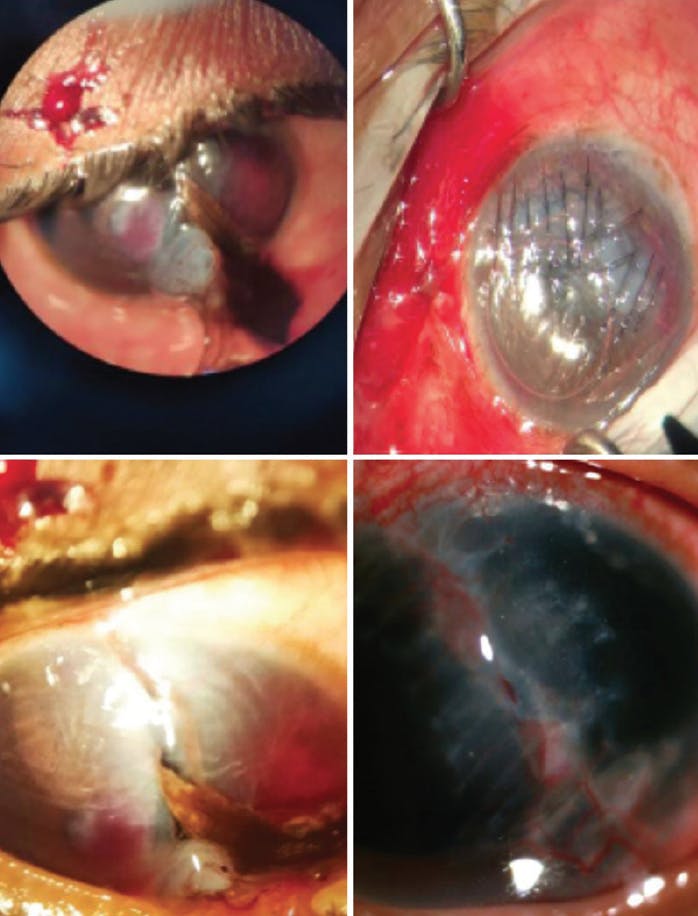
Figure 1. Composite picture showing two eyes with severe corneal injury, at left, and the corresponding distorted anterior segment after initial repair, at right.
Although the initial trauma in group A is limited, reasons for corneal graft failure in these eyes still exist:
- Excessive inflammation and hemorrhage after trauma can lead to an exaggerated fibrovascular response in the vitreous cavity; formation of retrocorneal, ciliary body, and pars plana membranes; and elevated IOP.
- Retinal detachment can occur due to traction from incomplete posterior vitreous detachment and membrane formation. Limited anterior vitrectomy alone may be inadequate for complete removal of the vitreous from the anterior segment and the wound, leading to increased risk of traction and infection.
Even in eyes in which trauma is limited to the anterior segment, inflammation may involve the vitreous cavity. Further, blood in the vitreous is a potent stimulus for a fibrovascular response, especially in young patients. These factors may lead to retrocorneal membrane formation and graft rejection and failure. Hence, eyes in group A may show initial favorable graft clarity followed by long-term graft failure.
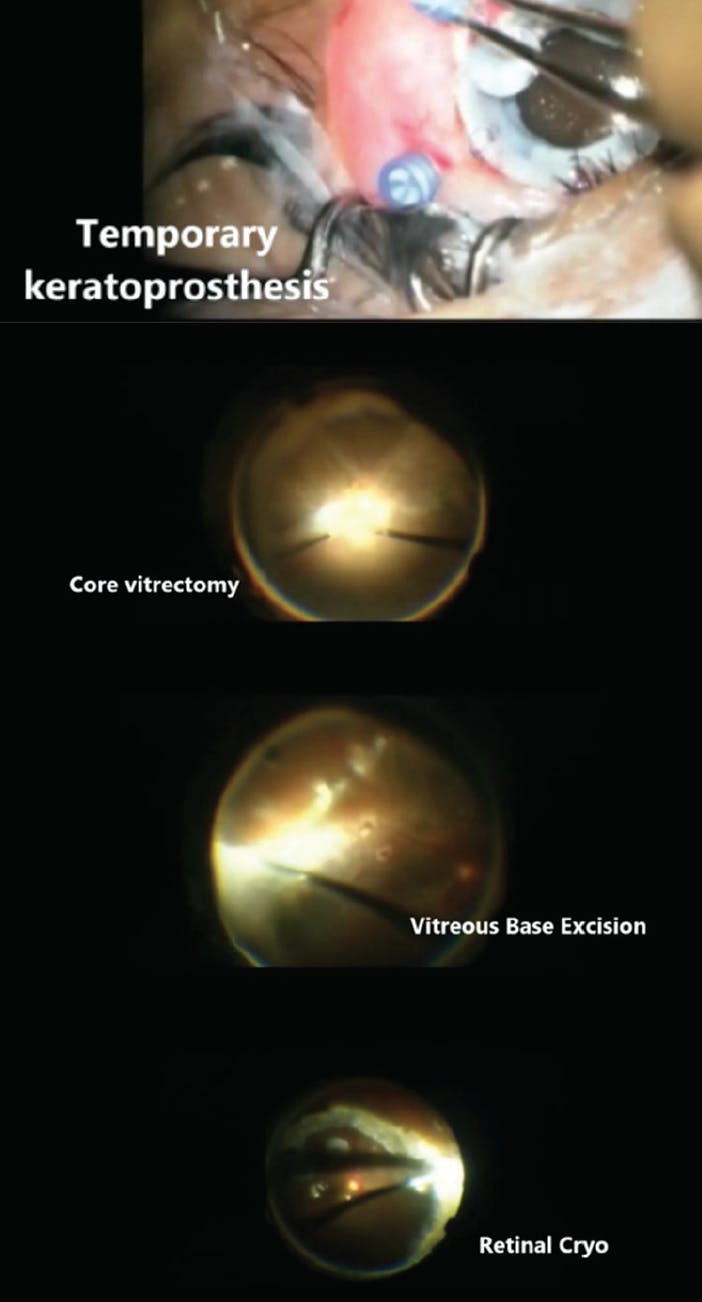
PPV in conjunction with PKP may reduce the risk of corneal graft failure, decreasing inflammation by clearing cytokines, inflammatory cells, fibrin, hemorrhage, and degenerated cells from the eye. Further, vitreous base excision reduces the risk of fibrovascular proliferation by clearing membranes and vitreous from the wound. In addition, induction of a complete posterior vitreous detachment and placement of a scleral buckle can reduce traction on the retina, decreasing the risk of retinal detachment.
Takeaways
Although PPV has its own possible complications, in appropriate cases the cleanup achieved through PPV may help to reduce membrane formation and facilitate graft survival (Figure 2). In our experience, graft prognosis was better in patients who underwent combined PKP with PPV than in patients who underwent PKP with anterior vitrectomy only.
Some patients require PKP for dense corneal scarring after primary trauma repair. With considerable anterior segment injury or nonresolving hemorrhage, concomitant PPV, even in the absence of posterior segment indications, may improve the chances of corneal graft survival.
1. Miller RC, Leiderman YI. Indications and outcomes of combined pars plana vitrectomy and penetrating keratoplasty. Invest Ophthalmol Vis Sci. 2014;55:2348.
2. Watson RM, Dawood S, Cao D, Mieler WF, Leiderman YI. Outcomes of pars plana vitrectomy in combination with penetrating keratoplasty. J Vitreoretinal Dis. 2017;1(2):116-121.
3. Kuhn F, Morris R, Witherspoon CD, et al. A standardized classification of ocular trauma. Graefe’s Arch Clin Exp Ophthalmol. 1996;234:399-403.

_1784132761.jpg?auto=compress,format&w=75)




