


AT A GLANCE
- Surgeons first used intraoperative OCT (iOCT), with time-domain technology, to visualize anterior segment structures during lamellar keratoplasty and trabeculectomy procedures.
- The DISCOVER trial supported the clinical utility of iOCT, with 29.2% of posterior segment surgeries reportedly affected by information supplied by iOCT.
- Ongoing advances such as iOCT-compatible instruments, software systems for tissue analysis, and volumetric real-time iOCT may improve this tool’s clinical utility.
OCT has become vital in the diagnosis and monitoring of myriad ophthalmic conditions.1 The value OCT provides in the pre- and postoperative management of ophthalmic surgical conditions, such as epiretinal membranes and macular holes, led investigators to evaluate the possible role of OCT in the OR itself. In 2005, surgeons first used intraoperative OCT (iOCT), with time-domain technology, to visualize anterior segment structures during lamellar keratoplasty and trabeculectomy procedures.2 The development of various iOCT technologies followed, ranging from handheld OCT devices to microscope-integrated systems.
The clinical utility of iOCT to date spans anterior and posterior segment applications, and prospective studies suggest that this tool may have the potential to be a future cornerstone of ophthalmic surgery.
iOCT OPTIONS
Portable
The first handheld spectral-domain OCT (SD-OCT) probe was developed by Cynthia Ann Toth, MD, and Joseph A. Izatt, PhD, at Duke University. The device was first described in clinical use during vitreoretinal surgeries in 2009. Using the handheld probe, Toth et al obtained retinal images during macular surgeries involving epiretinal membranes, full thickness macular holes, and vitreomacular traction.3 The surgeons were able to see operative tissue configurations difficult to detect using traditional en face microscopic views.3
Other studies corroborated the advantages of portable SD-OCT, including its use in vitreoretinal indications such as retinal detachment (RD) and proliferative diabetic retinopathy (PDR) surgeries and pediatric retinal examinations.4-7
FDA-cleared portable OCT systems include the EnVisu handheld OCT probe (Leica Microsystems) and the stand-mounted iVue system (Optovue). Limitations of handheld probes include the need to devote operating time to the process of obtaining images, as well as motion artifacts, challenges in image stabilization, a steep learning curve for image acquisition, and lack of real-time imaging.
Microscope-Mounted
Mounting a device on the microscope can improve the stability of the scan axis and reproducibility of images and allow foot-pedal control. The first commercially available device offering this function was the Bioptigen EnVisu (Leica Microsystems).8,9 Microscope stabilization dramatically improved image acquisition time, image stabilization, usability across surgeons, and overall efficiency. This broad accessibility enabled the first multisurgeon large scale prospective study of iOCT, PIONEER.8 However, like the handheld devices, microscope-mounted devices did not provide real-time imaging of the instrument-tissue interface.8
Microscope-Integrated
In this approach, OCT and microscope optical pathways are integrated, allowing real-time visualization of instrument-tissue interactions with a heads-up external viewing display. Susanne Binder, MD, and Dr. Toth both independently developed early prototypes with this approach. Dr. Toth’s team developed an integrated iOCT system using the Bioptigen engine, whereas Dr. Binder’s team used the Carl Zeiss Meditec Cirrus engine.
Multiple commercial microscope-integrated iOCT systems are now FDA-cleared and available in many global markets. The Rescan 700 (Carl Zeiss Meditec) is integrated with that company’s Lumera 700 microscope platform. The device provides Z tracking and focus controls designed to enhance image quality and stability.10,11 Haag-Streit’s system uses a mounted side port to incorporate the OPMedT OCT system. Finally, the EnFocus system (Leica Microsystems) uses the Leica surgical microscope with extended-range scanning and high-resolution images from the Bioptigen engine.11
CLINICAL STUDIES
Two large prospective iOCT trials, PIONEER and DISCOVER, have examined the feasibility, utility, and safety of iOCT across multiple ophthalmic surgeries.
PIONEER evaluated the utility of OCT images derived from a microscope-mounted system in anterior and posterior segment surgeries. OCT images were collected from 98% of the 531 enrolled eyes (256 posterior segment indications) using disease- and procedure-specific imaging protocols with surgeon feedback on the value of the images. The study found that iOCT imaging provided valuable additional information in 43% of membrane peel cases.8
DISCOVER evaluated microscope-integrated iOCT using three OCT prototypes, including the Rescan 700, EnFocus, and a research prototype developed at Cleveland Clinic’s Cole Eye Institute. Over a 3-year period, 820 individuals were enrolled for either anterior or posterior segment procedures. The DISCOVER trial further supported the clinical utility of iOCT, with 29.2% of posterior segment surgeries reportedly affected by iOCT information.12-15
Several studies have since corroborated the clinical efficacy of iOCT. Pfau et al demonstrated a benefit of iOCT in 74.1% of 32 posterior segment and combined cases.10 Moreover, the addition of iOCT images led to changes in surgical approaches in 41.9% of cases, particularly in surgeries involving membrane peeling and tamponade choice.10
Binder et al found that iOCT confirmed procedure completion, depicted macular retinal changes, and helped to identify subclinical pathology that ultimately affected surgical management.16 Following the success of their initial study, the same group compared the efficacy of iOCT for crucial vitreoretinal surgical steps, including visualizing membranes with retinal dyes. The authors found that iOCT images allowed membrane peeling without the use of dyes and helped surgeons detect iatrogenic macular hole formation during vitreomacular traction procedures.17
In a recent study led by Drs. Toth and Izatt, the authors reported that real-time iOCT images during vitrectomy for complications of PDR improved dissection of surgical planes and enhanced retinal traction relief by highlighting the need for additional peeling.18
VITREORETINAL APPLICATIONS
Macular Surgery
The use of iOCT has been described extensively in macular disease, particularly in vitreoretinal interface disorders, in which the technology provides surgeons with exceptional visualization of the epiretinal membrane and tissue planes throughout the procedure. One study reported that iOCT-guided membrane peeling was possible without the use of surgical staining agents in 40% of cases.17 Prospective studies of membrane peeling procedures found that iOCT identified occult residual membranes in 12% of cases—and confirmed complete membrane peeling contrary to surgeon impression in 9% of cases.8
The DISCOVER trial also demonstrated a disconnect between surgeon impression and surgical anatomy. In 40% of cases in which the surgeon felt that residual membranes were present, iOCT revealed complete membrane removal (Figure 1).15 Additionally, iOCT has allowed surgeons to characterize subclinical structural changes in procedures such as macular hole closure, providing insights into retinal anatomic configurations that may ultimately influence clinical outcomes.19,20
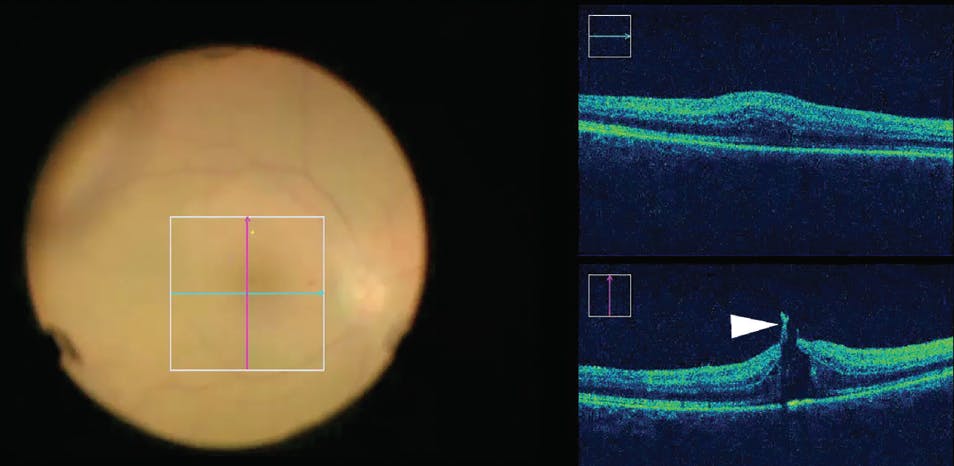
Figure 1. iOCT during macular hole surgery. Following internal limiting membrane peeling, iOCT confirms complete removal of epiretinal membrane and internal limiting membrane. Partially bridging retinal tissue is noted at the hole edge (arrowhead).
Retinal Detachment
iOCT can enhance visualization of surgical steps during RD repair, including retina or retinal pigment epithelium apposition after perfluorocarbon tamponade and after air-fluid exchange. Specifically, iOCT can assist in locating retinal breaks or occult membranes and differentiating retinal schisis versus detachment. In the DISCOVER study, the feedback provided by iOCT altered the RD surgical procedure in 18% of cases.15
Proliferative Diabetic Retinopathy
In posterior segment surgery involving PDR, iOCT can help surgeons identify difficult-to-visualize surgical planes and facilitate differentiation of RD versus PDR fibrovascular membranes. Static and continuous feedback from iOCT can alter PDR surgery by identifying occult retinal breaks and membrane dissection planes and differenting between tractional and rhegmatogenous RD.15,18
Emerging Therapeutics
iOCT can act as a surgical guidance system for subretinal injections, gene delivery, and retinal prosthesis placement.21-23 For example, surgeons used iOCT feedback regarding the array-tissue interface and prosthetic retinal tack placement when performing Argus II implants (Second Sight Medical Products).22
During gene therapy delivery into the subretinal space, iOCT can help identify the location and volume of viral vector injection. In an ongoing phase 2 clinical trial of choroideremia gene therapy, iOCT helped to improve the clinical safety through direct monitoring of foveal stretching and hole formation.23
ONGOING ADVANCES
iOCT-compatible Instruments
iOCT images of tissue-instrument interactions are hindered by the properties of most standard vitreoretinal instruments. Metallic surgical instruments with large profiles (eg, forceps and scissors) result in shadowing of the underlying retinal structures, and light scattering limits the visualization of instrument tip maneuvers with iOCT. The development of iOCT-compatible devices may provide better visualization of instrument tips and surgical manipulation of tissue.24
Software Systems for Tissue Analysis
iOCT devices require improved analytical software to enable surgeons to perceive minute tissue alterations intraoperatively. For example, in a study examining the use of volumentric analysis algorithms during macular hole surgery, OCT devices proffered automated analysis of macular hole structural dimensions that correlated with clinical stages and visual outcomes.25 In addition, iOCT can detail macular hole covariates, which have been shown to be predictive of successful macular hole closure, in ways that are not obtainable preoperatively.26
Volumetric analysis using iOCT may also help to determine accurate subretinal therapeutic drug delivery and prevent retinal toxicity. iOCT-derived algorithms measuring bleb volumes after subretinal therapeutic delivery have shown validity and reproducibility, as well as illuminating a stark contrast between intended and actual subretinal drug volumes.27,28
Volumetric Real-Time iOCT
Research is under way on the development of microscope-integrated intraoperative swept-source OCT. A research prototype at Duke University can produce real-time volumetric 4D imaging with up to 10 volumes per second while maintaining micron-scale resolution. The images are relayed to microscope oculars using a stereoscopic heads-up device. This platform provides surgical guidance, helping surgeons to visualize retinal pathology and iatrogenic tissue damage in ways not readily visible with current 2D images.29,30
CONCLUSIONS
iOCT can provide a better understanding of tissue architectural changes in the OR, thus assisting with surgical maneuvers and guiding the surgeon’s decision-making (Figure 2). Researchers are working to enhance certain aspects of iOCT performance, such as instrument integration, software analysis, clinical utility, and image quality. Additional prospective randomized controlled trials would help elucidate the ultimate benefit of this technology for patient outcomes.
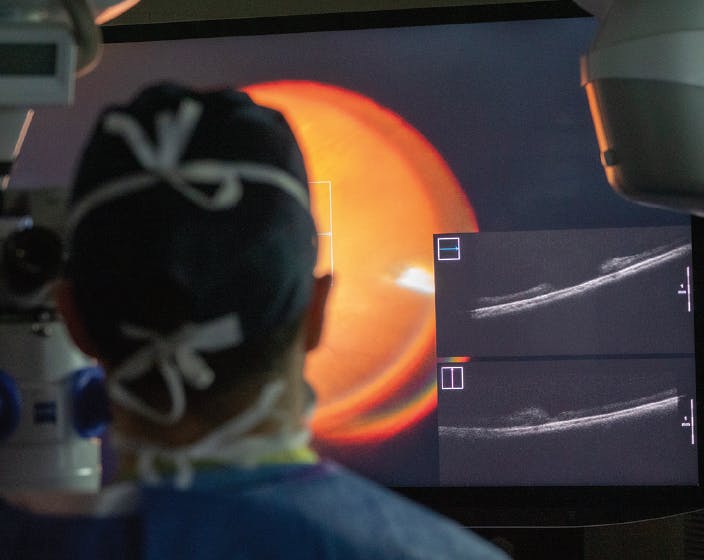
Figure 2. With a 3D immersive system with iOCT integration, the iOCT overlay demonstrates a flat full-thickness retinal hole.
1. Huang D, Swanson EA, Lin CP, et al. Optical coherence tomography. Science. 1991;254(5035):1178-1181.
2. Geerling G, Müller M, Winter C, et al. Intraoperative 2-dimensional optical coherence tomography as a new tool for anterior segment surgery. Arch Ophthalmol. 2005;123(2):253-257.
3. Dayani PN, Maldonado R, Farsiu S, Toth CA. Intraoperative use of handheld spectral domain optical coherence tomography imaging in macular surgery. Retina. 2009;29(10):1457-1468.
4. Lee LB, Srivastava SK. Intraoperative spectral-domain optical coherence tomography during complex retinal detachment repair. Ophthalmic Surg Lasers Imaging. 2011;42 Online:e71-e74. .
5. Chavala SH, Farsiu S, Maldonado R, Wallace DK, Freedman SF, Toth CA. Insights into advanced retinopathy of prematurity using handheld spectral domain optical coherence tomography imaging. Ophthalmology. 2009;116(12):2448-2456.
6. Muni RH, Kohly RP, Charonis AC, Lee TC. Retinoschisis detected with handheld spectral-domain optical coherence tomography in neonates with advanced retinopathy of prematurity. Arch Ophthalmol. 2010;128(1):57-62.
7. Branchini LA, Gurley K, Duker JS, Reichel E. Use of handheld intraoperative spectral-domain optical coherence tomography in a variety of vitreoretinal diseases. Ophthalmic Surg Lasers Imaging Retina. 2016;47(1):49-54.
8. Ehlers JP, Dupps WJ, Kaiser PK, et al. The Prospective Intraoperative and Perioperative Ophthalmic ImagiNg with Optical CoherEncE TomogRaphy (PIONEER) Study: 2-year results. Am J Ophthalmol. 2014;158(5):999-1007.
9. Ray R, Barañano DE, Fortun JA, et al. Intraoperative microscope-mounted spectral domain optical coherence tomography for evaluation of retinal anatomy during macular surgery. Ophthalmology. 2011;118(11):2212-2217.
10. Pfau M, Michels S, Binder S, Becker MD. Clinical experience with the first commercially available intraoperative optical coherence tomography system. Ophthalmic Surg Lasers Imaging Retina. 2015;46(10):1001-1008.
11. Ehlers JP. Intraoperative optical coherence tomography: past, present, and future. Eye (Lond). 2016;30(2):193-201.
12. Ehlers JP, Kaiser PK, Srivastava SK. Intraoperative optical coherence tomography using the RESCAN 700: preliminary results from the DISCOVER study. Br J Ophthalmol. 2014;98(10):1329-1332.
13. Ehlers JP, Goshe J, Dupps WJ, et al. Determination of feasibility and utility of microscope-integrated optical coherence tomography during ophthalmic surgery: the DISCOVER Study RESCAN Results. JAMA Ophthalmol. 2015;133(10):1124-1132.
14. Runkle A, Srivastava SK, Ehlers JP. Microscope-integrated OCT feasibility and utility with the EnFocus system in the DISCOVER study. Ophthalmic Surg Lasers Imaging Retina. 2017;48(3):216-222.
15. Ehlers JP, Modi YS, Pecen PE, et al. The DISCOVER study 3-year results: feasibility and usefulness of microscope-integrated intraoperative OCT during ophthalmic surgery. Ophthalmology. 2018;125(7):1014-1027.
16. Binder S, Falkner-Radler CI, Hauger C, Matz H, Glittenberg C. Feasibility of intrasurgical spectral-domain optical coherence tomography. Retina. 2011;31(7):1332-1336.
17. Falkner-Radler CI, Glittenberg C, Gabriel M, Binder S. Intrasurgical microscope-integrated spectral domain optical coherence tomography-assisted membrane peeling. Retina. 2015;35(10):2100-2106.
18. Gabr H, Chen X, Zevallos-Carrasco OM, et al.Visualization from intraoperative swept-source microscope-integrated optical coherence tomography in vitrectomy for complications of proliferative diabetic retinopathy. Retina. 2018;38(Suppl 1):S110-S120.
19. Ehlers JP, Xu D, Kaiser PK, Singh RP, Srivastava SK. Intrasurgical dynamics of macular hole surgery: an assessment of surgery-induced ultrastructural alterations with intraoperative optical coherence tomography. Retina. 2014;34(2):213-221.
20. Ehlers JP, Itoh Y, Xu LT, Kaiser PK, Singh RP, Srivastava SK. Factors associated with persistent subfoveal fluid and complete macular hole closure in the PIONEER study. Invest Ophthalmol Vis Sci. 2014;56(2):1141-1146.
21. Ehlers JP, Petkovsek DS, Yuan A, Singh RP, Srivastava SK. Intrasurgical assessment of subretinal tPA injection for submacular hemorrhage in the PIONEER study utilizing intraoperative OCT. Ophthalmic Surg Lasers Imaging Retina. 2015;46(3):327-332.
22. Rachitskaya AV, Yuan A, Marino MJ, Reese J, Ehlers JP. Intraoperative OCT imaging of the Argus II retinal prosthesis system. Ophthalmic Surg Lasers Imaging Retina. 2016;47(11):999-1003.
23. Lam BL, Davis JL, Gregori NZ, et al. Choroideremia gene therapy phase 2 clinical trial: 24-month results. Am J Ophthalmol. 2019;197:65-73.
24. Ehlers JP, Uchida A, Srivastava SK. Intraoperative optical coherence tomography-compatible surgical instruments for real-time image-guided ophthalmic surgery. Br J Ophthalmol. 2017;101(10):1306-1308.
25. Xu D, Yuan A, Kaiser PK, et al. A novel segmentation algorithm for volumetric analysis of macular hole boundaries identified with optical coherence tomography. Invest Ophthalmol Vis Sci. 2013;54(1):163-169.
26. Ehlers JP, Uchida A, Srivastava SK, Hu M. Predictive model for macular hole closure speed: insights from intraoperative optical coherence tomography. Transl Vis Sci Technol. 2019;8(1):18.
27. Hsu ST, Gabr H, Viehland C, et al. Volumetric measurement of subretinal blebs using microscope-integrated optical coherence tomography. Transl Vis Sci Technol. 2018;7(2):19.
28. Song Z, Xu L, Wang J, et al. Lightweight learning-based automatic segmentation of subretinal blebs on microscope-integrated optical coherence tomography images. Am J Ophthalmol. 2021;221:154-168.
29. Carrasco-Zevallos OM, Keller B, Viehland C, et al. Optical coherence tomography for retinal surgery: perioperative analysis to real-time four-dimensional image-guided surgery. Invest Ophthalmol Vis Sci. 2016;57(9):OCT37-OCT50.
30. Carrasco-Zevallos OM, Keller B, Viehland C, et al. Live volumetric (4D) visualization and guidance of in vivo human ophthalmic surgery with intraoperative optical coherence tomography. Sci Rep. 2016;6:31689.

_1784132761.jpg?auto=compress,format&w=75)





