


AT A GLANCE
- The miniaturization of laser technology has led to development of an untethered, head-mounted, laser indirect ophthalmoscope.
- The Norlase Lion, housed on the Keeler LED indirect ophthalmoscope, is battery-powered and uses a tablet–based controller with voice activation.
- The laser system does not use a fiber-optic cable, eliminating a major regular maintenance cost.
Vitreoretinal surgeons have always been at the forefront of biologic and technologic innovation in a constant drive to improve care and outcomes for our patients. Anti-VEGF agents, OCT, ultrawide-field imaging, and small-gauge vitrectomy platforms are a few of the innovative technologies we have embraced. In the next few years more novel medications will come to market, the OR will shift from analog to digital, and telehealth will bring care closer to the patient’s home.
Unfortunately, our office laser technologies haven’t always kept pace with this flurry of advances. Now, the Norlase Lion is helping to bring laser indirect ophthalmoscopes (LIOs) into the 21st century. We were fortunate to get our hands on one of the first Lion devices, and we have been putting it through its paces in the clinic and the OR over the past few months. Here’s what we have learned.
WHAT’S NEW
On most modern LIOs, the headset connects to the external laser and power source through a long fiber. These external devices are heavy, must be housed on a table or cart, and are not easily moved. Additionally, the laser and power source must be plugged into an electrical outlet.
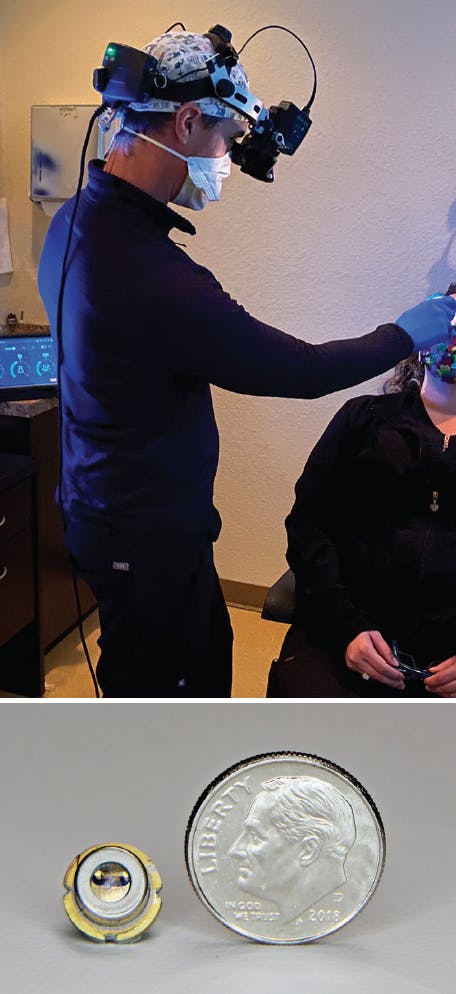
The critical innovation that sets the Lion apart from other current models is the miniaturization of the laser source. Its green laser source is half the size of a dime and is housed within the indirect ophthalmoscope headset itself (Figure 1). This allows the surgeon to be untethered from the external laser and power source. The Lion also incorporates a rechargeable battery source, so that it is not tied to an electrical outlet. The entire setup weighs less than 2 pounds.
Instead of a tabletop control unit, the Lion uses an Android tablet with a clean and intuitive interface (Figure 2). Setup is rapid, with a quick turn of a key on the headset and one-touch Bluetooth pairing with the tablet.
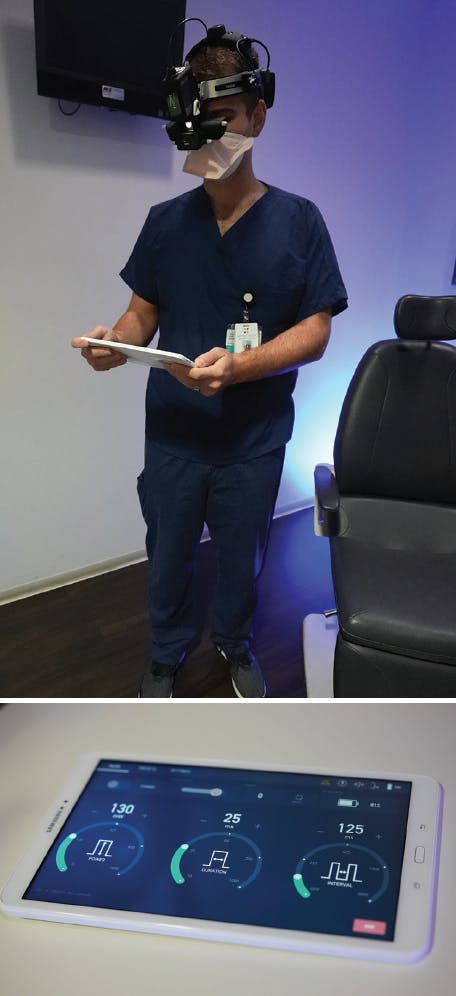
The Lion is voice-controlled, allowing the surgeon to change parameters (power, duration, interval) the same way we change the volume on our smartphones and speakers: Just say, “Hey Norlase … .”
CLINICAL PERSPECTIVE
The portability and flexibility of this LIO have been key features that have benefited our practice efficiency. We can move the device around in clinic and transport it easily among satellite offices.
After just a few months of use, the Lion has helped us decrease the time from diagnosis to laser treatment because we can bring the laser into any treatment room whenever we need it. There is no wait for the laser to heat up or for a laser room to become available.
For example, I (Dr. Houston) recently evaluated a patient and diagnosed a retinal tear. When I left that room to do an injection, a staff member brought in the laser and turned it on. After I performed the injection, I walked back into the first patient’s room and completed the laser within 5 minutes of the initial evaluation and diagnosis.
In our practice setting, where the surgeons travel to multiple office locations each week, the lightweight, portable unit is a significant benefit. The entire setup, including the headset with integrated laser, footpedal, and control tablet, packs into a small suitcase. For surgeons who perform missions or other outreach trips, the carry-on sized case would make the Lion an excellent option for traveling to remote areas.
Other LIO Options
Norlase isn’t the only manufacturer to capitalize on the many innovations in LIO technologies. Here are some other companies offering feature-rich LIO systems:
The Smart LIO (Lumenis), also mounted on a modified Keeler indirect ophthalmoscope, offers a lightweight design with wireless capabilities. This multiwavelength system is compatible with all of the company’s photocoagulators and multi-application platforms.1
Iridex offers both single-mirror (LIO Plus) and double-mirror (LIO Premiere) options, each of which provide excellent peripheral visualization and treatment flexibility, according to the company. The LIO Premiere also touts a rechargeable battery system, eliminating the need for a power cord.2
Alcon’s LIO, featuring Purepoint laser technology, boasts a wireless system with a rechargeable battery, independent control of illumination and laser, and a 16’ fiber-optic cable for improved freedom of movement.3
Topcon’s Pascal LIO provides increased access to the far periphery of the retina, according to the company, within a headset that provides 2 hours of battery life.4
The Visulas Trion (Carl Zeiss Meditec) can pair with the company’s LIO to provide excellent aiming beam contrast against the retinal background within a lightweight yet durable frame, according to the company.5
1. Lumenis. Lumenis Smart LIO. lumenis.com/medical/eye-care-products/lios. Accessed December 14, 2020.
2. Iridex. Iridex Laser Indirect Ophthalmoscopes. www.iridex.com/Products/RetinaDeliveryDevices/LIO.aspx. Accessed December 14, 2020.
3. The Alcon LIO featuring Purepoint laser technology. eyetube.net/portals/alcon-vitreoretinal/docs/US-PPT-17-E-0381%20-%20LIO%20Sales%20Aid%20LoRes%20FINAL.pdf. Accessed December 14, 2020.
4. Topcon Healthcare. Pascal Synthesis Photocoagulator [product borscure]. topconhealthcare.com/us/wp-content/uploads/sites/8/2020/07/PASCALSynthesis_brochure_E_201603.pdf. Accessed December 14, 2020.
5. Zeiss. VISULAS Trion. www.zeiss.com/meditec/us/products/ophthalmology-optometry/retina/therapy/therapeutic-lasers/visulas-trion.html#options---accessories. Accessed December 14, 2020.
COST AND MAINTENANCE
From a cost and maintenance perspective, a major drawback of traditional laser systems is the fiber-optic cable that connects the LIO headset with the laser and power source. We use several different units and models in our offices, and we are replacing or repairing fiber-optic cables at least once a year, to the tune of several thousand dollars. The Lion does not use a fiber-optic cable, thereby eliminating this major regular maintenance cost.
Regarding other maintenance issues, we don’t have a long history of use with the Lion, and only time will tell how the system holds up.
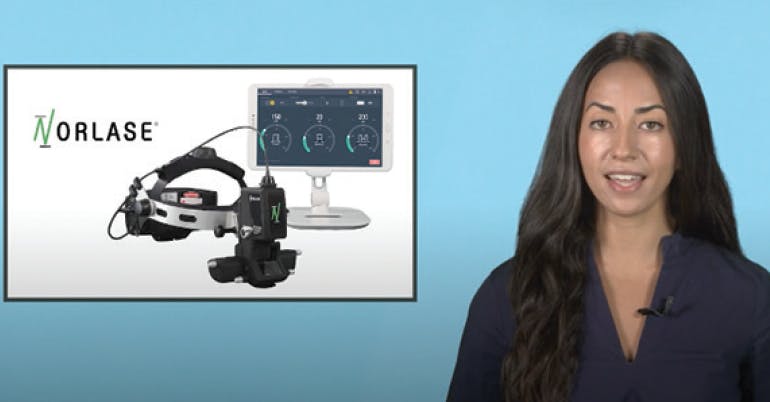
The Lion Laser Indirect Ophthalmoscope Receives FDA Clearance.
A BETTER VIEW
Above and beyond mobility and maintenance, the most important benefit that we have experienced with this new LIO has been its enhanced optics and visualization. The Lion is housed on the Keeler LED indirect ophthalmoscope, and we have found that the view is superior to that of other LIOs with the addition of the Lion’s laser and filters.
Some lasers may make viewing difficult in the far periphery or with media opacities such as cataract or capsular opacities, but the same is not true with the Lion. In addition, the Lion provides enhanced depth of focus, so it allows laser uptake with greater variation in focal length—almost double that of other LIOs.
FINAL TAKEAWAY
The Norlase Lion, the first fully integrated, battery-powered, Bluetooth-enabled, green laser LIO, is poised to disrupt the laser industry. We are excited to be using it in our clinics, and we anticipate continued innovation in this space.


_1784132761.jpg?auto=compress,format&w=75)




