


AT A GLANCE
- Digitally assisted viewing systems offer advantages over optical microscope–based approaches to vitreoretinal surgery.
- The authors evaluated the advantages of heads-up 3D surgery using a digitally assisted vitreoretinal viewing system in a patient with retinal detachment with giant retinal tear.
- The system provided the advantages of reduced phototoxicity and improved visualization of the retinal periphery up to the ora serrata with good magnification.
Giant retinal tears (GRTs) are full-thickness circumferential retinal tears extending more than 3 clock hours or 90° that develop in association with a posterior vitreous detachment.1,2 The incidence of GRTs is about 0.09 per 100,000 of the general population per year.3
GRTs account for approximately 1.5% of rhegmatogenous retinal detachments (RDs), and surgical management of an RD associated with a GRT can be challenging.3
Although GRTs are mostly idiopathic, they are often associated with one or more conditions; these can include ocular trauma, high myopia, aphakia, pseudophakia, genetic mutations involving collagen, and young age.1-4
Today, with the availability of improved vitreoretinal surgical instrumentation and wide-angle viewing systems that allow surgeons to better visualize the operative field, phakic lens-sparing surgery has become common. In addition, the use of chandelier illumination aids in performing scleral depression and clearing of the anterior vitreous without traumatizing the lens.
HEADS-UP SURGERY
In the case presented here and in the accompanying video, we evaluated the advantages of heads-up 3D surgery using the Ngenuity (Alcon) digitally assisted vitreoretinal viewing system in a patient with RD with GRT.
Giant Tear and Retinal Detachment
Digitally assisted viewing systems offer advantages over optical microscope–based approaches to vitreoretinal surgery. Besides the clear advantages of 3D technology over the traditional approach, the Ngenuity also incorporates a 4K monitor, delivers decreased light phototoxicity, and provides digital enhancements and magnification capacity without dimming of illumination. The high-definition screen of the Ngenuity system provides retinal surgeons excellent 3D visualization of the back of the eye with greater depth and detail during surgery than traditional microscopes. These platforms can also be integrated with other commercially available visualization systems.5,6
SURGICAL TECHNIQUE
Here, we explain how heads-up 3D visualization, specifically with the Ngenuity 3D system, can be used in a case with retinal detachment associated with GRTs.
Case Report
A 58-year-old man presented with counting fingers vision and a retinal detachment with GRT involving his macula. He has bilateral high myopia (-10.50 D).
We performed 25-gauge vitrectomy using the Ngenuity heads-up 3D system. While performing vitrectomy in the periphery, we used the system’s chandelier illumination, allowing the surgeon to perform scleral indentation unaided.
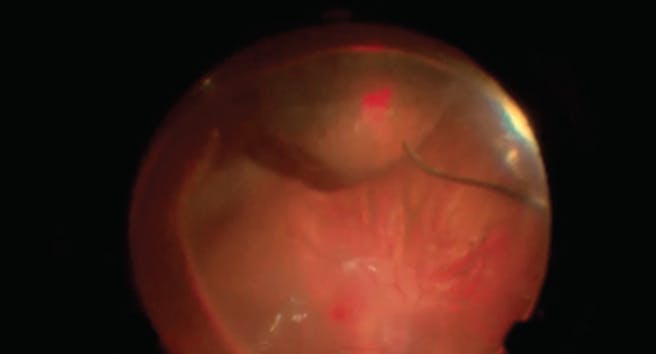
We performed vitrectomy as thoroughly as possible around the giant tear. To check for peripheral vitreous fibers, we injected triamcinolone, which allowed us to identify remaining strands (Figure 1).
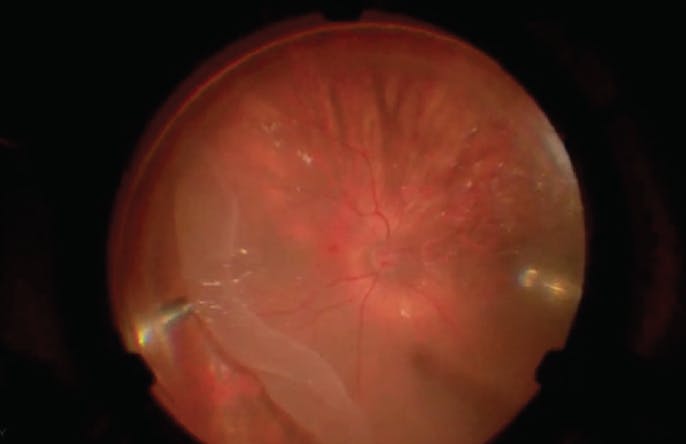
When vitrectomy was successfully completed, we injected perfluorocarbon liquid (PFCL) gently over the posterior pole to flatten the retina (Figure 2). Under the PFCL, we then smoothed down the posterior flap of the tear with the help of a diamond dusted scraper.

Figure 2. PFCL was used to flatten the retina after vitrectomy. This allowed us to smooth the posterior flap of the GRT.
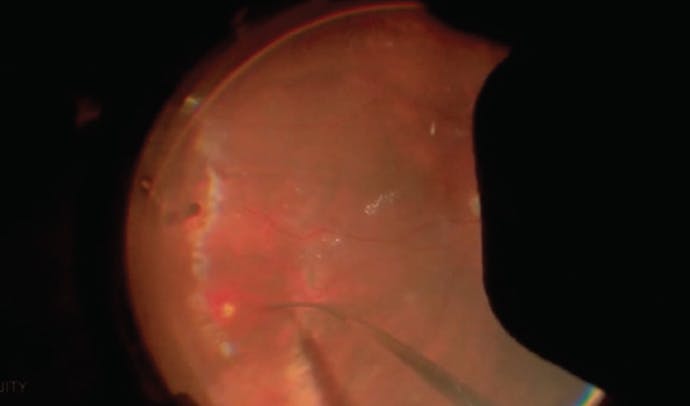
After the retina was flattened, we applied laser around the edges of the tear (Figure 3). In most RD cases, we use sufficient laser to tack down the edges of the tear. However, for GRT cases, we apply laser 360° around the peripheral retina. As we progress around the periphery, we apply additional laser around other small holes.
After checking the edges of the giant tear to ensure that it was reattached and the retina was completely flat in every quadrant, we performed PFCL–silicone oil exchange. The 25-gauge trocars were removed at the end of the case.
At the 6-month follow-up, no neurosensory retinal detachment was observed.
DISCUSSION
The Ngenuity 3D visualization system provides the advantages of digital viewing over analog viewing, including superior ergonomics for the surgeon; enhanced capabilities for surgical observation and teaching; improved depth of field; real-time digital signal processing to enhance visualization, even with low light levels; and the ability to overlay preoperative diagnostic studies and digital templates onto the live surgical field.
Specifically in patients with RD with GRT, the Ngenuity system provides the added advantages of reduced phototoxicity and improved visualization of the retinal periphery up to the ora serrata with good magnification and less asthenopia.
CONCLUSION
In the near future, robotic surgical technologies will become increasingly available, and telesurgery may one day become practicable. The first step of telesurgery is digitally assisted surgery, allowing the surgeon to see via screen-based facilities. The next steps will be robotic intervention using joysticks and quantum internet that connects the surgeon to patients prepared in ORs in another city or country.
Heads-up digitally assisted viewing technology delivers excellent depth perception and better control of screen parameters, resulting in high-quality surgical performance in patients with RD with GRT and other surgical indications. The technology allows high-definition visualization of the retinal periphery with better magnification, the option of filters to enhance visualization of anatomic structures, and lower illumination levels.
Screen-based surgical systems help to significantly improve surgical procedures, teaching, and learning. This technology is the first step on the road to telesurgery, which will continue with the incorporation of robotics in the decades to come.
1. Mathis A, Pagot V, Gazagne C, Malecaze F. Giant retinal tears: surgical techniques and results using perfluorodecalin and silicone oil tamponade. Retina. 1992;12(3 Suppl):S7-10.
2. Kertes PJ, Wafapoor H, Peyman GA, Calixto Jr N, Thompson H. The management of giant retinal tears using perfluoroperhydrophenanthrene: a multicentre case series. Vitreon Collaborative Study Group. Ophthalmology. 1997:104(7):1159-1165.
3. Shunmugam M, Ang GS, Lois N. Giant retinal tears. Surv Ophthalmol. 2014;59:192-216.
4. Mehdizadeh M, Afarid M, Hagigi MS. Risk factors for giant retinal tears. J Ophthalmic Vis Res. 2010;5:246-249.
5. Eckardt C, Paulo EB. Heads-up surgery for vitreoretinal procedures: An experimental and clinical study. Retina. 2016;36:137-147.
6. Dutra-Medeiros M, Nascimento J, Henriques J, et al. Three-dimensional head-mounted display system for ophthalmic surgical procedures. Retina. 2017;37:1411-1414.


_1784132761.jpg?auto=compress,format&w=75)





