


AT A GLANCE
- Details about the composition of an IOFB are key to surgical decision-making.
- Specific instruments designed to remove IOFBs can be useful tools.
- The surgical strategy, including the route of explantation, may differ for each case.
- Topical, intraocular, and/or systemic antibiotics can help to guard against postoperative endophthalmitis.
Surgery for intraocular foreign bodies (IOFBs) requires critical thinking and an intellectually flexible framework. No two IOFB cases are the same, but there are some common principles that retina surgeons can draw on when approaching each case.
Here, we review how the history of each patient with an IOFB can inform surgical decision-making, including instrument choices and surgical strategies. We also discuss several clinical pearls for IOFB removal and whether all IOFBs have to be removed.
IOFB PARTICULARS
Acquiring a thorough history of the patient’s injury is key to success in IOFB cases. The size of the IOFB, its material composition, and the circumstances that led to the injury are all important in deciding whether to proceed with surgery and, if so, how to remove the IOFB.
IOFB removal requires an incision larger than the IOFB itself to provide the extra space needed for instrument manipulation and width during extraction. Although it may be tempting to create an incision that is barely larger than the IOFB to reduce the trauma of surgery, doing so invites the risk of dropping the IOFB during extraction, leading to the possibility of retinal contusion or macular infarction. Also, if the incision is too small, the IOFB can become trapped in the sclera during attempted removal, after which it may be challenging to locate and remove.
All patients with an IOFB, by definition, have a ruptured globe. To guard against endophthalmitis, we administer topical, intraocular, and/or systemic antibiotics to patients as appropriate, depending on the circumstances. Generally, we initiate topical antibiotics and give a single dose of systemic antibiotics at the time of diagnosis. Although eyes in need of IOFB removal usually go to surgery quickly, if we have to wait until the next day for surgery for logistical reasons, we sometimes give intraocular antibiotics the night before surgery. This is particularly true if there is concern for early endophthalmitis. In these instances, antibiotics are typically given intravitreally in clinic; rarely, they are given intracamerally if there is concern for retinal or choroidal detachment or the IOFB is in the anterior chamber rather than the vitreous. We always administer intravitreal antibiotics at the conclusion of surgery. We also immunize against tetanus. Risk factors for developing endophthalmitis include older age, retained IOFB in the vitreous cavity, and IOFBs of plant-based or mixed composition.1
In some instances, the surgeon may elect to observe an IOFB rather than remove it. These may include situations in which inert glass or plastic IOFBs have not caused a retinal tear, retinal detachment, or endophthalmitis or otherwise impaired vision. Metallic IOFBs should generally be removed, as iron and copper may cause siderosis and chalcosis, respectively, if they remain in the globe. On some occasions, however, metallic IOFBs can be observed, particularly if they have been present chronically and become encapsulated. If there is any possibility of endophthalmitis, the IOFB should be removed, regardless of its composition.
INSTRUMENTATION AND SURGICAL APPROACH
Instrument choice and surgical approach are influenced by many variables, including IOFB material and size and the fluidics of the eye. In our experience, glass is difficult to grasp and usually requires forceps with strong purchase. Metallic IOFBs may best be explanted with a magnetic instrument such as an 18-gauge IO Foreign Body Magnet (Bausch + Lomb/Synergetics). The 18-gauge BB Removal Forceps (Bausch + Lomb/Synergetics) are, to the best of our knowledge, the only surgical instrument specifically designed for BB removal.
Reusable foreign body forceps are available, but these occasionally break during sterilization. Small-gauge instruments, such as 25-gauge active aspiration silicone-tipped instruments2 and 23-gauge forceps,3 can be used for small IOFBs or to move a larger IOFB into the anterior chamber for explantation through a corneal incision or wound.
Maintaining stable fluidics during surgery for IOFB removal often presents a challenge. The size of the entry (and perhaps exit) wounds may lead to difficulty maintaining the structural integrity of the globe. Here, being familiar with the settings of your vitrectomy platform is key. We use the Stellaris Elite (Bausch + Lomb), which allows a higher level of infusion flow compared with earlier infusion systems via a feature called FreeFlow. With typical systems, the infusion line is fed through a trocar-cannula. With FreeFlow, the infusion line is coupled to the top of the trocar-cannula (Figure). This allows infusion through the entire internal lumen of the trocar-cannula, resulting in higher flow rates through the same gauge sclerotomy and more stable fluidics. This is especially helpful in cases involving a large wound.
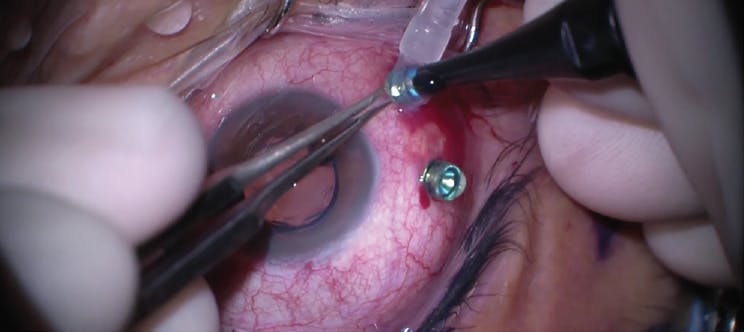
Figure. The FreeFlow infusion line (Bausch + Lomb) allows the entire internal diameter of the trocar-cannula to be used for infusion. The result is higher flow rates with 23-, 25-, and 27-gauge platforms that may improve stability of intraoperative fluidics.
SURGICAL STRATEGY
Retinal surgeons initiating IOFB removal face a decision: to close the traumatic wounds and then remove the IOFB, or vice versa. For eyes with small, centrally located corneal wounds, we generally extract the IOFB first and then suture the entry wound; closing the corneal wounds first can degrade the quality of the view for vitrectomy and IOFB extraction. In eyes with large or peripheral corneal wounds, we suture the wound before extracting the IOFB.
We rarely remove an IOFB via the entry wound. We prefer to explant through a pars plana scleral incision or a clear corneal incision. In many cases, we perform pars plana lensectomy, including removal of the lens capsule, prior to IOFB extraction. We prefer this to lens removal via phacoemulsification, which may impair visualization because of corneal edema. Patients are left aphakic.
Occasionally, when there is no lenticular violation or traumatic cataract, we leave the lens in situ and explant the IOFB via a pars plana scleral incision.
If a retinal tear or detachment is present, it is treated at the time of IOFB removal using standard vitrectomy techniques. We inject intravitreal antibiotics and/or antifungals at the end of every IOFB removal.
Because delayed retinal detachment and proliferative vitreoretinopathy are common after penetrating ocular trauma, we wait several months before considering IOL implantation. IOL placement can be performed by an anterior segment colleague or by the retina surgeon. Aphakic contact lenses are a nonsurgical option.
FINAL THOUGHTS
Meticulous attention to trauma history, surgical equipment selection, and endophthalmitis prophylaxis gives the retina surgeon the best chance to preserve vision in patients with IOFB injuries.
1. Duan F, Yuan Z, Liao J, et al. Incidence and risk factors of intraocular foreign body-related endophthalmitis in Southern China. J Ophthalmol. 2018;2018:8959108.
2. Singh R, Kumar A, Gupta V, Dogra MR. 25-gauge active aspiration silicon tip-assisted removal of glass and other intraocular foreign bodies. Can J Ophthalmol. 2016;51(2):97-101.
3. Huang Y, Yan H, Cai J, Li H. Removal of intraocular foreign body in anterior chamber angle with prism contact lens and 23-gauge foreign body forceps. Int J Ophthalmol. 2017;(5):749-753.


_1784132761.jpg?auto=compress,format&w=75)




