



Each year, the Aspen Retinal Detachment Society (ARDS) hears from a select group of highly distinguished speakers. In several of our past meetings, we have made sure to reserve time on the podium to discuss pediatric retinal care.
ARDS leadership knows that most retina conferences give little attention to pediatric retina care. The reasons are obvious: Pediatric retina is a sub-subspecialty of eye care, and dedicating valuable podium time on an otherwise filled agenda to a discipline that only a small subset of attendees may practice could be unwise.
Still, we know our attendees. ARDS participants’ hunger for learning deeply about a number of subjects is not limited to the topics that pertain most immediately to them and their practices. They’re polymaths. They know that rounding out their retina education gives them a more holistic sense of the space. And hey, you never know when those pediatric retina pearls will come in handy.
Be sure to keep an eye on MedConfs.com for the latest updates about ARDS 2021 and our focus on an in-person meeting.
—Timothy G. Murray, MD, MBA
Presentation by Carl D. Regillo, MD
Summarized by Abdallah Mahrous, MD
At last year’s ARDS meeting, Carl D. Regillo, MD, shared pearls and suggestions for the use of perfluorocarbon liquid (PFCL) in retinal detachment (RD) surgery. This article summarizes portions of his presentation.
Since the FDA approval of purified perfluoro-n-octane liquid (Perfluoron, Alcon) in 1996, PFCL has become an indispensable tool for RD repair. In the setting of primary RD, there are three main ways to drain subretinal fluid:
- directly through a preexisting retinal break;
- through a posterior drainage retinotomy; or
- by using PFCL to drain through the preexisting break.
PFCL has several advantages over the other options in this situation, including minimizing macular distortion or folds. It can also be advantageous in surgery for giant retinal tears and proliferative vitreoretinopathy (PVR).
However, PFCL has limitations, including its cost. It can also create complications, such as retained PFCL bubbles under the retina.1 Although such bubbles are nontoxic and can be observed if outside the macula, a visually significant retained bubble under the fovea should be removed.
PFCL should be used cautiously. If excessive amounts are used with anteriorly displaced subretinal fluid, the fluid can be pushed posteriorly at the time of PFCL–air exchange, potentially causing problems such as macular folds.
PFCL TECHNIQUES
Dr. Regillo reviewed several techniques that can be used to optimize PFCL use.
Valved cannulas help to maintain a closed system in the eye, minimizing variation in fluidics and thus reducing the chance of dispersion and bubbling of PFCL.
Keeping the PFCL in one big bubble minimizes the chance of smaller bubbles breaking off and migrating under the retina or becoming retained elsewhere. Therefore, care should be taken with PFCL use so as to not engage the vitrector as the instrument is entering or exiting the eye, as this can permanently damage the trocar valve.
Another technique is the all-or-none strategy, in which the entire vitreous cavity is filled with PFCL. This decreases the chance for smaller bubbles to migrate subretinally. A full PFCL fill can be facilitated by initially amputating the anterior flap of the retinal tear, which makes it easier for the subretinal fluid to egress and for the retina to settle down while PFCL is filling the eye.
The retinal break can also be extended anteriorly to enlarge it and maximize fluid drainage. This also facilitates laser uptake and minimizes residual subretinal fluid. Very peripheral breaks can be extended out to the ora serrata.
When filling the eye with PFCL, it is recommended that you tilt the eye away from the break. This will cause the retina to flatten as the PFCL fills the eye, squeezing and draining the subretinal fluid through the break.
INJECTING AND EXTRUDING PFCL
It is important to inject PFCL into the eye cautiously and slowly in order to maintain one single, big bubble. It’s also important never to inject over the macula. A high velocity of PFCL injection can force the liquid under the retina. A good technique is to start injecting over the optic nerve, moving nasally as the bubble enlarges and ensuring an eye tilt of 180° away from the break while filling all the way up to the ora.
In removing the PFCL, it’s important to first remove the balanced salt solution anterior to the PFCL. Next, drain over the break until the PFCL is below the level of the break. After draining from the retinal break, the rest of the PFCL should be removed from over the optic nerve to complete the PFCL–air exchange.
To prevent reflux of PFCL from the extrusion cannula, it is recommended to continue aspirating while the cannula is pulled out of the eye. A brief venting of the eye after PFCL–air exchange is also useful to let any peripherally retained PFCL fall back to the posterior pole.
If PFCL is used correctly and subretinal fluid is successfully drained, postoperative facedown positioning is not required. The patient will simply need to position to tamponade the break.
USE IN PVR
Dr. Regillo noted that the same principles of injecting and aspirating PFCL inside the eye apply to PVR detachments. It is especially essential in retinectomies of 180° or greater. In such cases, it is recommended to apply diathermy to any vessels at the retinectomy margins to prevent bleeding.
The retinectomy should be done as anteriorly as possible to prioritize retinal preservation. Any retina anterior to the retinectomy should be removed. PFCL is then used to flatten the retina and apply laser. Then a PFCL–air exchange is done, followed by an air–silicone oil exchange. During PFCL removal, drainage should start at the edge of the retinectomy until the PFCL is below the level of the retinectomy, after which the rest of the drainage can be performed from the disc.
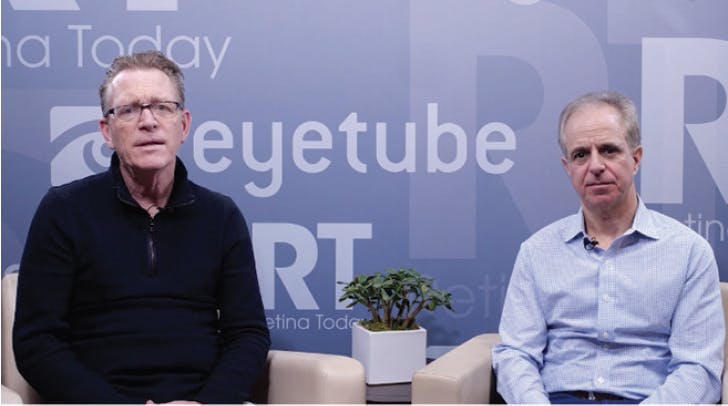
Perfluorocarbon Liquids: Pearls and Pitfalls
Carl Regillo, MD, reviews the pros and cons of using perfluorocarbon liquids for both primary and complicated retinal detachments and explains that—although it can be used to ensure the best possible macular anatomy and visual outcomes—use of perfluorocarbon liquids still carries the risk of retention under the macula.
SUMMARY
The introduction of PFCL was one of the major advances in techniques and technologies for RD repair, whether primary or complicated. PFCL provides excellent displacement of subretinal fluid, eliminates the need for a posterior drainage retinotomy and facedown positioning, and prevents slippage of large retinectomy edges. It also provides good visualization for laser application. To minimize the risk of retained PFCL bubbles, it is important to use valved cannulas to inject PFCL as one bubble, remove the PFCL completely, and vent the eye before completing the air–gas exchange.
1. Figueroa MS, Contreras I. Characteristics of retained subretinal perfluoro-n-octane on optical coherence tomography. Retina. 2012;32(10):2177-2178.


_1784132761.jpg?auto=compress,format&w=75)





