


AT A GLANCE
- A chandelier endoillumination system frees up one of the surgeon’s hands, allowing bimanual surgical procedures.
- Placing the chandelier system at the 12 clock position casts the instrument shadows anteriorly, avoiding any shadowing in the working area.
- A number of surgical indications require both hands for intraocular manipulations, including complex tractional retinal detachments in diabetic eyes, foreign body retrieval and pediatric cases.
In the past few decades, we have seen numerous technological advances for vitrectomy, the most notable being the reduction of surgical instrument sizes. Now, vitreoretinal surgeons are performing transconjunctival microincision vitrectomy with 23- to 27-gauge systems, making possible sutureless surgical procedures that significantly improve patient safety, comfort, and recovery.
However, these smaller gauges require powerful endoillumination systems. The first optical fiber probes introduced by Peyman in 1976 for 20-gauge systems have largely been replaced with wide-angle endoillumination models.1,2 Today, a wide variety of products are available from different manufacturers ranging from single-fiber to dual-fiber chandeliers. Some are inserted into the vitreous cavity through a separate sclerotomy without a cannula, and others are inserted through standard 23- to 27-gauge trocar systems. One of the main advantages of a chandelier endoillumination system is that it frees up one of the surgeon’s hands, allowing bimanual surgical procedures.
RETHINK MANEUVERABILITY
A new flexible chandelier system (Oertli Instruments) is a single-fiber trocar-based self-retaining system available with or without sheathing of the fiber at the distal end; the version without the sheathing is extremely flexible. After a 25- or 27-gauge trocar is placed in the pars plana region, the tip of the endoillumination fiber is attached with a snap-lock connection (Figure 1). Flexible repositioning is possible with other trocars from the Oertli Caliburn system.
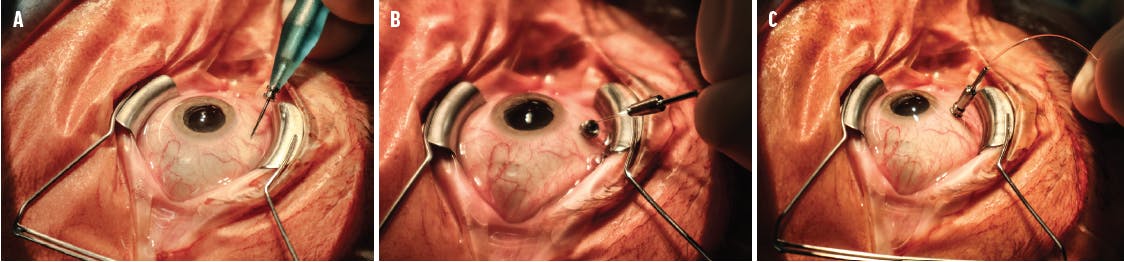
Figure 1. Setup of the 25-gauge single-fiber trocar-based chandelier system connected to the OS4 surgical platform (Oertli Instruments). After the trocar is inserted (A), a snap-lock connection (B) ensures a tight seal between the fiber tip and the trocar (C).
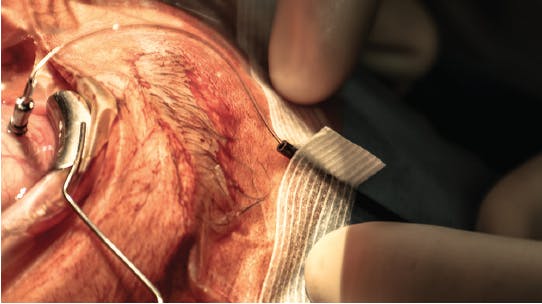
Forming a loop with the flexible part of the unsheathed fiber allows the chandelier to be moved freely during the surgical procedure (Figure 2). The fiber with sheathing must be inflected manually to create the loop necessary for correct positioning. A sterile strip is then used to fix the sheathed part of the fiber. Creating a flap in the strip (Figure 3) allows the chandelier to be lifted and repositioned in all directions with ease.

CLINICAL PERSPECTIVE
The most important aspect of the self-retaining Oertli chandelier illumination system for me is its ability to provide hands-free homogeneous and diffuse widefield illumination, allowing fully bimanual surgical procedures.
My preference for the placement of the chandelier system is at the 12 clock position. This casts the instrument shadows anteriorly so that they do not coincide with my working area. In addition, I can easily modify the tip of the optical fiber from this position without any obstacles. However, there are certain conditions in which a different chandelier location provides better visualization.
There are a number of surgical indications in my clinical routine that require both hands for intraocular manipulations, including the following:
Retinal Detachment
In complex retinal detachment (RD) cases with advanced proliferative vitreoretinopathy presenting with pre- or subretinal membranes, bimanual excision of the fibrotic tissues is often the only maneuver possible to relieve the retina, allow reattachment, and prevent redetachment (Figure 4).3
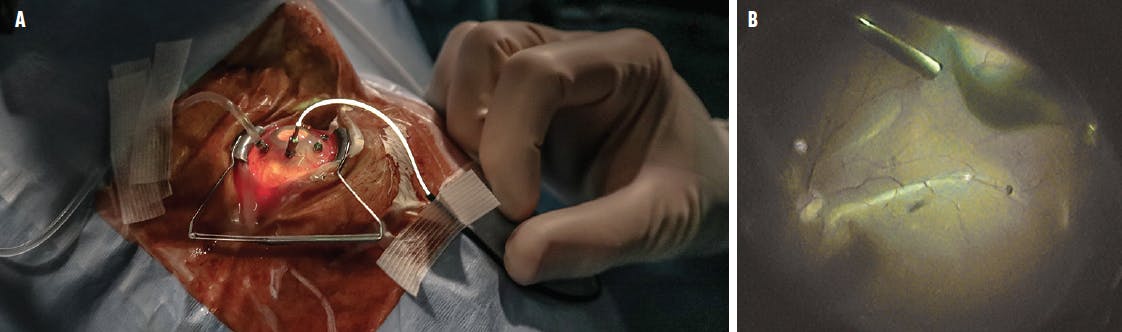
Figure 4. In this eye with a retinal detachment affecting all four quadrants, widefield endoillumination is achieved with the 25-gauge Oertli flexible endoillumination system (A). Quickly repositioning the chandelier tip to the upper temporal trocar provided the best illumination of the nasal retinal quadrant. The surgeon performed indentation with one hand while shaving the vitreous base with the cutter held in the other hand without the need of a skilled assistant (B).
Eyes with tractional RDs due to proliferative diabetic retinopathy are ideal candidates for bimanual procedures. Particularly, the use of 25- and 27-gauge continuous flow cutter probes with a dual blade design at high cutting rates and a cutting port close to the tip of the instrument allows controlled removal of membranes and delamination of the fibrovascular membrane from the underlying retina.
For a secure procedure, I usually have forceps or a spatula in the other hand to grasp and stabilize the retina, which requires hands-free illumination. With this technique, I can better visualize the plane for dissection and thereby limit the risk of creating a break.
The self-holding chandelier allows me to have one hand available for scleral indentation when I perform RD surgery without an assistant. With this setup, I can accomplish controlled, safe shaving of the peripheral vitreous base and complete removal of vitreous from the retinal defects. I can also perform autonomous endolaser treatment of peripheral retinal areas accessible only with indentation (Figure 5). If a retinal defect cannot be sufficiently dried to permit endolaser treatment, I can use a soft-tip cannula in one hand and the endolaser in the other to apply laser burns.
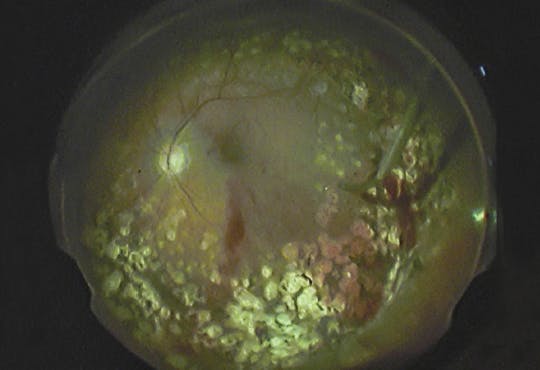
Figure 5. The self-retaining Oertli 27-gauge chandelier system frees one hand for indentation to perform endolaser treatment in peripheral retinal areas after the vitreous cavity is cleared of hemorrhage. In this patient with a branch retinal artery occlusion, recurrent vitreous bleeding occurred in a previously vitrectomized and photocoagulated eye due to active neovascularization.
Chandelier illumination is quite useful when performing a scleral buckling procedure for the treatment of rhegmatogenous RD, as the localization of the retinal breaks and cryoretinopexy can be accomplished through the surgical microscope and a wide-angle viewing system.4 In most of my RD cases I choose primary vitrectomy; thus, my preferred view of the retina is through a noncontact wide-angle viewing system. This allows me to adjust magnification and image focus to detect small defects under indentation that I would potentially miss under indirect ophthalmoscopy.
Because more surgeons are using vitrectomy for RD repair, many are now less experienced with ab externo detachment procedures. This makes chandelier-assisted buckling attractive as a safe alternative. In placing a scleral buckle, I position the chandelier fiber in the pars plana area opposite from the region where the buckle will be sutured onto the sclera. With this positioning, the wide-angle viewing system provides the best visualization, with no shadowing of the retinal defects, an optimal view for successful cryoretinopexy, and the correct location after placement of the buckle.
Diabetic Retinopathy
In diabetic patients, blood leaking from neovascularization can severely impair visualization, and applying diathermy at the location of the leak may not be feasible due to quick blood accumulation. In these instances, a bimanual procedure with a soft-tip cannula in one hand and the endodiathermy probe in the other can help significantly.
In our clinic we see many patients with diabetes who have vitreous hemorrhage and dense cataract. A phacoemulsification-vitrectomy is the preferred treatment choice when intraocular bleeding is not clearing or a concurrent RD is diagnosed on ultrasound. However, phacoemulsification can be challenging in eyes with dense intravitreal hemorrhage because the structure of the lens cannot be visualized sufficiently due to the missing fundus red reflex.5
In my experience, using a chandelier-based intraocular lighting system can significantly reduce complications such as posterior capsular tears, as the retroillumination improves visualization. I typically sit at the 12 clock position and place the chandelier at the temporal side in the pars plana. After completing the lens extraction and IOL implantation, I continue using the chandelier system to address the hemorrhage, but I often reposition it more superiorly for better intraocular views.
Pediatric Cases
In pediatric vitrectomy, achieving posterior vitreous detachment is often challenging, and operating with the vitreous cutter in one hand and forceps in the other facilitates a successful maneuver. Similarly, epiretinal membrane removal in children may be complicated, and a bimanual approach using forceps and scissors can help.
Object Retrieval
Chandelier illumination can be particularly useful when retrieving a dropped nucleus after cataract surgery or an intraocular foreign body located on the retina. With a bimanual approach, one hand brings the object into the mid-vitreous with forceps or a soft-tip cannula, respectively. I prefer not to grasp a foreign body directly when it is located on the retinal surface, particularly in the macular area, as this might induce retinal damage. Instead, from the center of the vitreous cavity, I transfer the object directly to a hook or forceps held in the other hand for secure placement of the lens into the anterior chamber or removal of the foreign body through a sclerotomy.
FINAL THOUGHTS
The use of a trocar-based chandelier system for endoillumination can significantly increase the surgical success rate in a number of vitreoretinal indications by allowing bimanual intraocular manipulation. The ease of use, compatibility with 23- to 27-gauge systems, and the extrawide and homogeneous endoillumination provided by the Oertli chandelier allows me to safely and efficiently perform many challenging cases.
1. Peyman GA. Improved vitrectomy illumination system. Am J Ophthalmol. 1976;81(1):99-100.
2. Peyman GA, Canakis C, Livir-Rallatos C, Easley J. A new wide-angle endoillumination probe for use during vitrectomy. Retina. 2002;22(2):242.
3. Idrees S, Sridhar J, Kuriyan AE. Proliferative vitreoretinopathy: a review. Int Ophthalmol Clin. 2019;59(1):221–240.
4. Cohen E, Rosenblatt A, Bornstein S, Loewenstein A, Barak A, Schwartz S. Wide-angled endoillumination vs traditional scleral buckling surgery for retinal detachment - a comparative study. Clin Ophthalmol. 2019;13:287-293.
5. Nagpal MP, Mahuvakar SA, Chaudhary PP, Mehrotra NS, Jain AK. Chandelier-assisted retroillumination for phacoemulsification in phacovitrectomy. Indian J Ophthalmol. 2018;66(8):1094-1097.


_1784132761.jpg?auto=compress,format&w=75)





