



AT A GLANCE
- Transconjunctival sutureless intrascleral fixation is an efficient, simple, and effective means by which to rescue and reposition a relatively undamaged, dislocated three-piece IOL.
- The surgeon should educate patients on the importance of avoiding eye rubbing after surgery.
- When excessive manipulation of the IOL is necessary, the surgeon should have a low threshold for exchanging the IOL to reduce the risk of postoperative dislocation.
- The author found a statistically significant decrease in the rate of retropupillary block with the use of intraoperative prophylactic peripheral iridotomy.
Today there are numerous approaches to address IOL fixation in eyes without adequate capsular support. Each technique has unique advantages and disadvantages that are worth consideration prior to each surgical case, and there is no consensus on the best method of secondary IOL fixation.1
My preferred technique involves transconjunctival sutureless intrascleral (SIS) fixation of a three-piece IOL using trocar-cannulas (Video). I have now performed more than 500 SIS procedures, and I recently reported the outcomes of the first 488 eyes.2 If a patient presents with a relatively undamaged, dislocated three-piece IOL, I believe the SIS technique is the most efficient, simple, and effective means by which to rescue and reposition the lens.
PREOPERATIVE PLANNING
When evaluating a patient with a dislocated IOL in the office, the surgeon should first perform a thorough assessment of conjunctival mobility with a cotton tip applicator. If there is extensive conjunctival scarring or poor mobility, I recommend performing an exchange for an anterior chamber IOL or placement of an iris-fixated IOL to avoid the possibility of conjunctival erosion and subsequent endophthalmitis with a scleral-fixated IOL.
The surgeon must review the patient’s surgical history and note prior surgical sites involving the sclera (tube shunts, blebs, ruptured globe repair, etc.) to avoid them when creating the scleral tunnels.
Before surgery, I tell all of my patients that it is important that they avoid rubbing their eyes after surgery. I have seen several cases of postoperative IOL dislocation due to aggressive eye rubbing.
RESCUE OR NOT?
In my early experience with the SIS technique, I noted a relatively high early postoperative dislocation rate after repositioning previously dislocated IOLs.2 This was partially due to my aggressive attempts at removing residual capsule and calcified cortex, causing damage to the haptics, the haptic-optic junctions, or both.
When preparing to fixate the IOL, it is important that the optic and haptics be free from vitreous, capsule, and calcified cortex so that the IOL can be easily positioned in the intended location (Figure 1). However, this can be difficult to achieve without over-manipulation of the haptics. When excessive manipulation of the IOL is needed to attempt repositioning, surgeons should have a low threshold for exchanging the IOL to reduce the risk of postoperative dislocation (Figure 2). If an existing IOL appears even remotely warped or damaged, I strongly consider an exchange due to the high risk of dislocation.
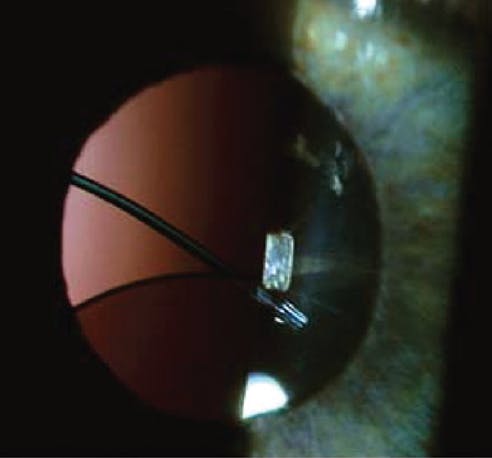
Figure 1. This IOL is relatively free of cortex and capsule and does not appear warped or damaged, making it an ideal three-piece IOL for rescue using the SIS technique.
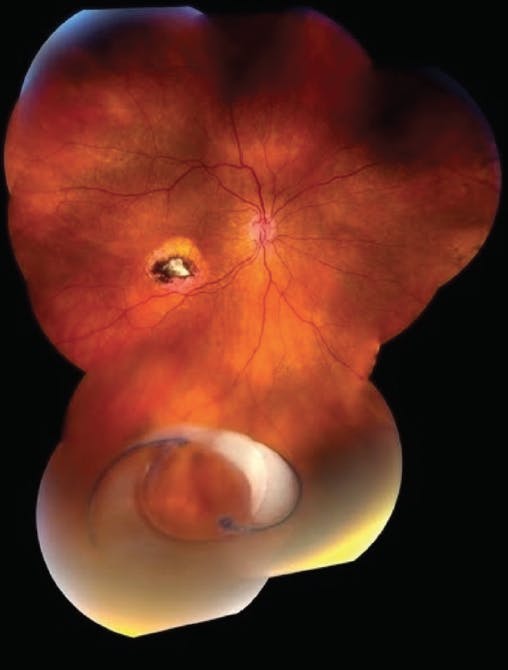
Figure 2. When a three-piece IOL is surrounded by a large amount of calcified cortex and an intact capsule, it may require aggressive manipulation to prepare for repositioning. This can weaken or damage the haptics and/or haptic–optic junction, resulting in high risk of postoperative dislocation. The surgeon should have a low threshold for performing an IOL exchange in these cases.
When it is necessary to free the IOL, certain techniques can help the surgeon to minimize manipulation and avoid damaging or breaking the haptics. The surgeon should use the forceps to grasp the optic rather than the haptics. The surgeon should also avoid using a 23-gauge vitrector, given its propensity to damage the haptics; the larger lumen of the 23-gauge vitrector can more easily cut the haptics when removing cortex and capsule. In my experience, a 25- or 27-gauge vitrector is better for safely and effectively freeing the IOL without inadvertent haptic damage.
Chandelier illumination can facilitate a bimanual technique, so that the surgeon can grasp the IOL optic with forceps while removing cortex and capsule with the vitrector.
Large pieces of calcified cortex can be removed with a fragmatome or moved into the anterior chamber and extracted through a sclerocorneal or limbal incision. These steps avoid extended use of the vitrector around the IOL and augment surgical efficiency by eliminating repeated obstruction of the vitrector by the large calcified cortical fragments.
SURGICAL TECHNIQUE AND TIPS
The surgeon should place three 25- or 27-gauge transconjunctival valved cannulas in the nasal and temporal pars plana, as is typical for pars plana vitrectomy (PPV). No peritomy is performed. A toric marker is used to mark the edge of the limbus at the 12 and 6 clock positions, where the surgeon will later create two scleral tunnels to accommodate the IOL haptics.
Calipers are then used to mark 2 to 3 mm posterior to the limbus at the 6 clock position. The scleral tunnels may be placed anywhere between 2 and 3 mm posterior to the limbus, based on surgeon preference, axial length, and other factors, including the presence of iridodonesis. The surgeon should consider placing the tunnels more posterior to the limbus in longer eyes (> 26.5 mm axial length) or eyes with iridodonesis to avoid postoperative complications, such as retropupillary block (RPB), optic capture, and uveitis-glaucoma-hyphema syndrome.
Tip: It is important to account for pannus when using calipers to mark the tunnels’ distance from the limbus, as improper placement of the scleral tunnels can lead to IOL tilt or intraoperative hemorrhage from the ciliary body incision (Figure 3).
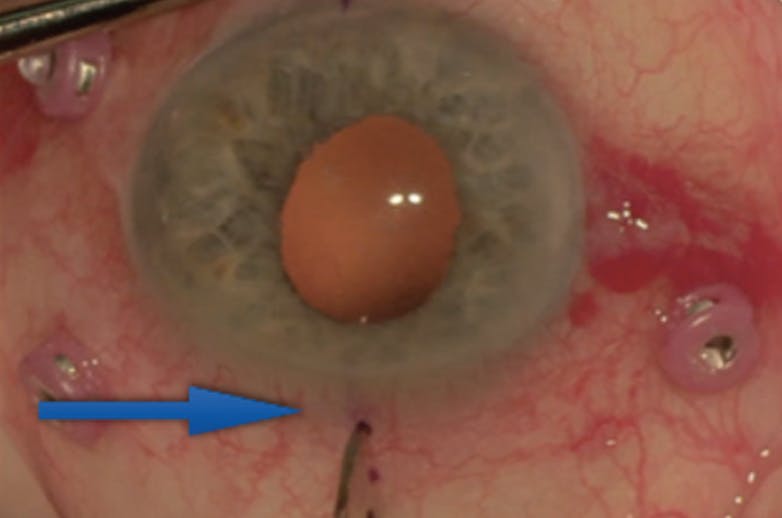
Figure 3. The surgeon should place calipers at the edge of the limbus, below the superior pannus, to ensure proper placement of the scleral tunnel.
An additional 25- or 27-gauge trocar with a valved cannula is used to create a scleral tunnel 2 to 3 mm in length. The trocar is inserted with a 30° to 45° bevel to create a 2- to 3-mm scleral tunnel. When the trocar is removed, the valved cannula remains in place. A similar scleral tunnel is then created 180° from the first in the opposite direction, leaving a second valved cannula in place. The surgeon should take care to insert the superior trocar at the same angle as the inferior trocar to avoid IOL tilt. The scleral tunnels are oriented so that they will allow the haptics to externalize and position the IOL in the correct inverted-S configuration (Figure 4).
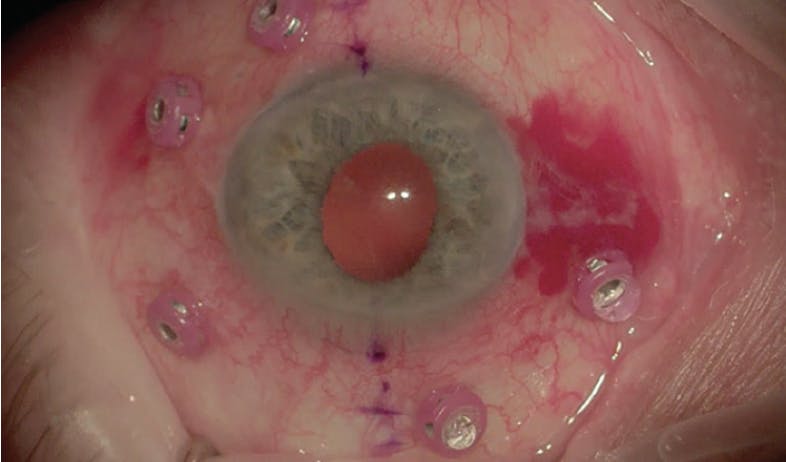
Figure 4. Placement of five 27-gauge trocars prior to vitrectomy. The haptics will be placed through the scleral tunnels at the 12 and 6 clock positions.
Once all the trocars have been placed, the surgeon should perform core and anterior vitrectomy. The vitreous is shaved closely near the scleral tunnels, as excess vitreous around the scleral tunnels can trap a haptic and prevent externalization. The surgeon must remove residual lens cortex and capsule and minimize manipulation of the dislocated IOL. A peripheral iridotomy (PI) is created using the vitrector to prevent RPB.
Tip: In my case series, I found a statistically significant reduction in the rate of RPB when I performed intraoperative prophylactic PI (P = .0297), and I recommend performing a prophylactic PI in every case.2
For surgical ease and to reduce haptic manipulation with the bimanual handshake technique, the surgeon can place the IOL on the retina before externalizing the haptics through the scleral tunnels. The 27-gauge forceps are inserted through the inferior cannula to grasp the distal tip of the inferior haptic. The surgeon then externalizes the haptic through the scleral tunnel after advancing the cannula up the shaft of the forceps. The cannula is removed before externalizing the haptic to minimize stress on the haptic and reduce the risk of intraoperative haptic dislocation.
Tip: I find that the haptic exits the tunnel with minimum resistance when it is externalized at the same angle as the initial tunnel creation. Placing posterior pressure with another pair of forceps just distal to the tunnel also facilitates smooth externalization.
The surgeon then repeats the same procedure for the superior haptic.
Tip: If you have difficulty visualizing the second haptic, I recommend pushing the center of the optic with forceps to displace the IOL and haptic posteriorly. More often than not, this maneuver will provide a better view to allow you to grasp the haptic.
With the haptic tips now externalized, they are cauterized using low-temperature cautery to create a flange. In my case series, there was a statistically significant reduction in the rate of IOL dislocation with flanged versus unflanged haptics (P < .001).2 Thus, I recommend creating flanges for all SIS fixation cases.
Tip: Although most three-piece IOL haptics will form a flange when cauterized, some will not. It has been reported that the haptics of the VA70AD (Hoya) do not form a flange on heating.3 I recommend exchanging all three-piece IOLs that cannot be flanged, as the dislocation rate with unflanged repositioned IOLs in our series was significant (32%).
Tip: To help prevent haptic exposure, I prefer to leave the least amount of haptic under the conjunctiva by tucking the haptics into the scleral tunnel until only the flange remains visible (Figure 5). I then elevate the conjunctiva over any exposed haptic not covered by the scleral tunnel.
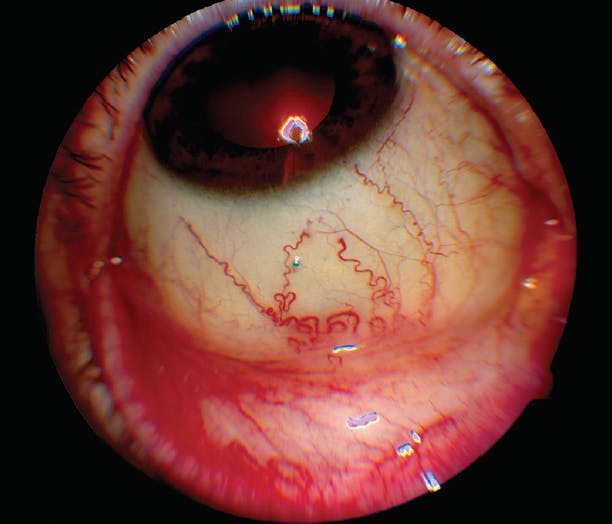
The scleral tunnels created for IOL fixation may leak during the immediate postoperative period, resulting in hypotony. The overall rate of hypotony in my series was 8.8%. However, the vast majority of hypotony cases occurred in eyes with scleral tunnels created with 25-gauge trocars (91%). The rate of hypotony was 13% in the 25-gauge eyes compared with only 2% in 27-gauge eyes (P < .00001).
Tip: The risk of postoperative hypotony can be significantly reduced by using the smallest possible gauge of instrumentation for creating the scleral tunnels.
CONCLUSION
SIS fixation with haptic flanging is a promising technique that maximizes efficiency and simplicity in eyes without adequate capsular support for IOL placement, particularly dislocated three-piece IOLs.
1. Wagoner MD, Cox TA, Ariyasu RG, Jacobs DS, Karp CL. Intraocular lens implantation in the absence of capsular support: a report by the American Academy of Ophthalmology. Ophthalmology. 2003;110(4):840-859.
2. Abbey AM. 25- and 27-gauge sutureless intrascleral fixation of intraocular lenses: clinical outcomes and comparative effectiveness of haptic flanging in a large single-surgeon series of 488 eyes. Presented at: 2020 American Society of Retina Specialists Meeting; July 24-26, 2020.
3. Yamane S, Sato S, Maruyama-Inoue M, Kadonosono K. Flanged intrascleral intraocular lens fixation with double-needle technique. Ophthalmology. 2017;124(8):1136-1142.


_1784132761.jpg?auto=compress,format&w=75)





