


AT A GLANCE
- Errors in coding can include use of wrong codes or modifiers, failure to report wastage, and omitting required information.
- Lack of prior authorization and failure to follow step therapy can also cause denials.
- Reference sheets with specific requirements for each payer and medication can help physicians and coding staff members avoid errors.
Correct coding for intravitreal injections is a complex process. Done right, it will lead to proper reimbursement. Done wrong, it may lead to a denial. There are many variances related to specific insurance policies and specific claim submission requirements that must be observed to result in a clean claim.
When you receive a denial, review these 10 common errors to resolve the problem before resubmission or appeal.
ERROR NO. 1: IMPROPER ICD-10-CM
Confirm that the ICD-10-CM code reported on the CMS-1500 claim form supports medical necessity and chart documentation. For example, if a diagnosis of nonexudative macular degeneration is incorrectly linked to CPT code 67028 and/or the medication, the claim will be denied. A bilateral ICD-10-CM code or a right eye diagnosis linked to a left eye injection code (CPT 67028-LT) can also cause rejections.
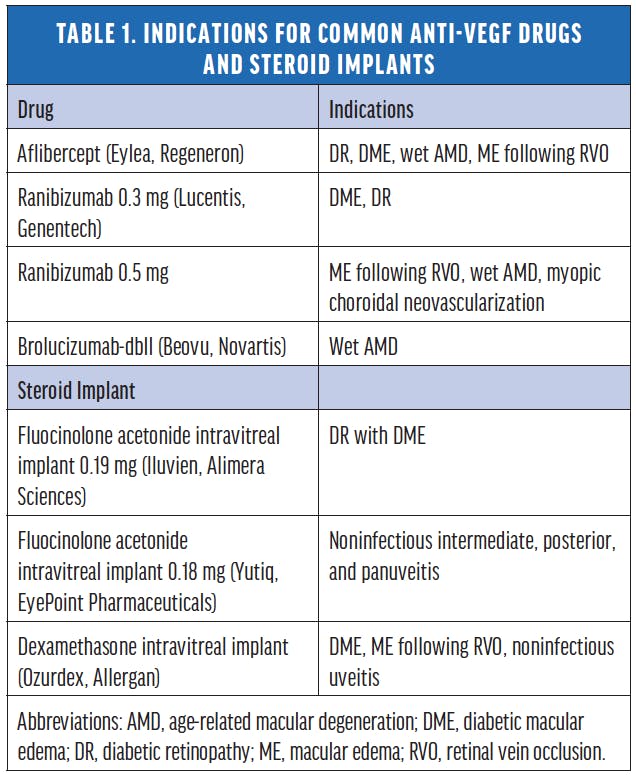
Additionally, check that the ICD-10-CM code is indicated for the specific drug or included as an expanded payable diagnosis per the unique insurance payer policy in question. Due to off-label use of bevacizumab (Avastin, Genentech), payable diagnoses are per payer policy and based on current medical literature. Table 1 lists the indications for common anti-VEGF drugs and steroidal intravitreal implants.
ERROR NO. 2: NDC REPORTED INCORRECTLY
The National Drug Code (NDC) for the injected drug entered on the insurance claim form should follow these guidelines:
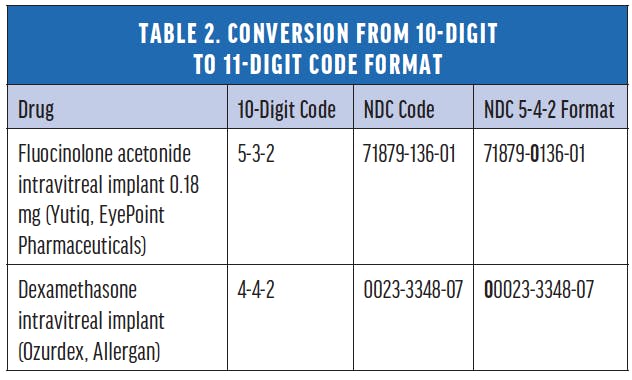
- NDC code converted to 5-4-2 format. Typically, NDC codes are listed on the vial in a 10-digit format. To be recognized by payers, however, it must be formatted in the 11-digit 5-4-2 sequence. This requires placing a zero in a specific position. Table 2 illustrates this conversion.
- On the CMS-1500 form, report the converted NDC code, in item 24a or EDI loop 2410, preceded by the qualifier N4.
ERROR NO. 3: ADDITIONAL INFORMATION REQUIRED
Per payer policies, report additional claim information in item 19 of the CMS-1500 form or the electronic equivalent. For example, in billing for bevacizumab injections, most carriers require the coder to provide the name of the medication and dosage as additional information.
ERROR NO. 4: WRONG HCPCS CODE
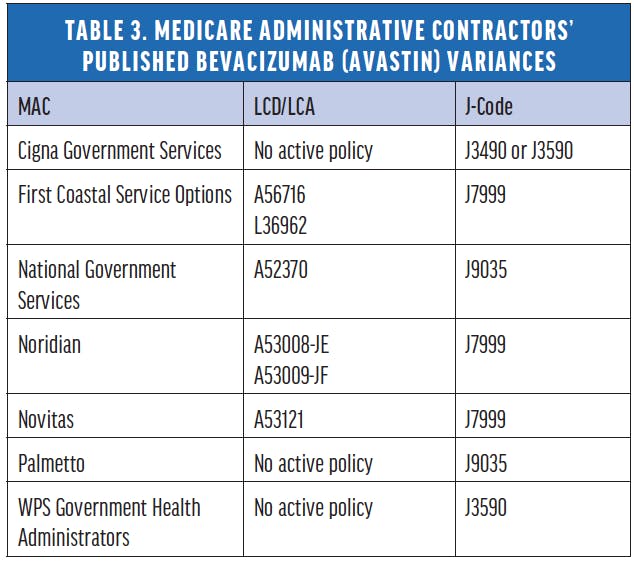
Healthcare Common Procedure Coding System (HCPCS) codes are used to report medications on insurance claim forms. For bevacizumab, HCPCS J9035 may be recognized for ophthalmic use, but many insurance payers require a miscellaneous HCPCS code, J7999, J3490, or J3590. Several Medicare Administrative Contractors (MACs) have local coverage determinations (LCDs), local coverage articles (LCAs), or published bulletins specifying the HCPCS code required for ophthalmic use of bevacizumab, and these can be reviewed at aao.org/lcds. Table 3 outlines these variances. Although a MAC may require a specific HCPCS for bevacizumab billing, other payers may require a different code. Confirm the policies for bevacizumab for each insurance carrier.
ERROR NO. 5: UNITS ERROR
The units reported on the insurance claim should accurately reflect the medication dosage used and match the chart documentation for the intravitreal injection. For instance, the HCPCS code J0178 for aflibercept (Eylea, Regeneron) is defined as injection, aflibercept, 1 mg. Based on the descriptor, 1 unit equals 1 mg. If 2 mg (the labeled dosage) is injected, you should report 2 units. Incorrect billing for 1 unit may lead to a claim denial or may trigger a chart review.
For an intravitreal injection of ranibizumab (Lucentis, Genentech) for diabetic macular edema (DME), the indicated dosage is 0.3 mg, and the HCPCS code J2778 descriptor is injection, ranibizumab, 0.1 mg. The correct coding in this case would be 3 units. If you incorrectly report 5 units (dosage of 0.5 mg) for this case with a diagnosis link of DME, the claim may be denied or recouped in an audit. The chart documentation would not match the claim submission, and the diagnosis linked is not indicated for that dosage.
ERROR NO. 6: INJECTION SOONER THAN 28 DAYS
Most MAC LCDs or articles related to intravitreal injections state that frequency should not be less than 28 days per eye. Based on these Medicare policy guidelines, many other payers also include these frequency edits in their policies.
ERROR NO. 7: WASTAGE NOT REPORTED
Since January 2017, Medicare has required the use of modifier -JW to indicate measurable drug wastage of 1 unit or greater. Wastage is an issue for several ophthalmic drugs. For example, triamcinolone acetonide injectable suspension 40 mg/mL (Triesence, Alcon) is provided in a single-use vial of 40 mg, with an HCPCS descriptor of injection, triamcinolone acetonide, preservative free, 1 mg. If 1 mg of this formulation was injected and the remaining 39 mg discarded, this is reported on two lines of the CMS-1500:
- J3300, 1 unit
- J3300-JW, 39 units
As another example, in coding for photodynamic therapy (PDT) with verteporfin for injection (Visudyne, Bausch + Lomb), using the HCPCS code J3396 (injection, verteporfin, 0.1 mg), report a total of 150 units for full reimbursement on two separate lines. Failure to report the wastage separately will result in a claim denial or audit. In fact, PDT laser (CPT 67221) with erteporfin is currently the focus of Medicare Recovery Audit contractors, targeted toward identified failures to report drug wastage.
ERROR NO. 8: MODIFIER MISHAP
The misuse of modifiers is a frequent reason for claim denials. Coding for intravitreal injection with CPT code 67028 requires use of the eye modifier(s) -RT, -LT, or -50 (bilateral), as appropriate. If the injection is performed during a global period, a surgical modifier should be appended, preceding the eye modifier:
- -58 modifier: staged or related procedure or service by the same physician during the postoperative period.
- -78 modifier: unplanned return to the OR/procedure room by the same physician following initial procedure for a related procedure during the postoperative period.
- -79 modifier: unrelated procedure or service by the same physician during the postoperative period.
The definition of same physician includes all physicians in the same group practice under the same tax identification number (EIN).
ERROR NO. 9: LACK OF PRIOR AUTHORIZATION
Failure to obtain a necessary prior authorization for an intravitreal injection will cause a rejected claim. Requests for prior authorizations made retroactively after a claim denial are often rejected.
Best practice is to develop internal resources that define, per payer and medication, when a prior authorization is required. This resource then provides a quick reference to confirm if a prior authorization is necessary prior to providing the treatment.
ERROR NO. 10: STEP THERAPY NOT FOLLOWED
An insurance payer may require the use of a preferred drug for intravitreal injections, typically a lower-cost medication such as bevacizumab, before initiating treatment with a higher-cost drug such as aflibercept. If the step therapy policy was not followed, this can lead to a costly claim denial that may not have appeal rights.
Research and identify insurance carriers with step therapy policies related to anti-VEGF treatment, and provide internal resources and practice management system flags for staff and physicians to avoid this error and its potential impact on reimbursement.
TAKE A PROACTIVE APPROACH
As claim denials are resolved and reasons identified, communicate these problems and their solutions to all physicians and staff in the practice to avoid perpetuating the same rejections. Proactively review claims before submission for potential errors, and consider any insurance payer policy nuances. Taking these crucial steps and doing a final scrub of each claim will reduce denials and increase efficiencies.
To learn more about coding intravitreal injections and to identify new resources, visit aao.org/retinapm.


_1784132761.jpg?auto=compress,format&w=75)





