


Surgical advances in the management of severe proliferative diabetic retinopathy (PDR)-related tractional retinal detachments (TRDs) have led to improved anatomic and functional outcomes. Small-gauge vitrectomy in combination with traditional en-bloc dissection and bimanual surgical technique continue to be the most utilized techniques in cases with severe PDR and extensive TRD formation.1 The increased use of ophthalmic viscosurgical devices (OVDs) in posterior segment surgery along with the introduction of a viscodissection instrument by Fortun and Hubbard have expanded the vitreoretinal surgeon’s armamentarium against epiretinal fibrovascular proliferation in PDR.2-4
Case Report
A 52-year-old woman with a history of uncontrolled type 2 insulin-dependent diabetes mellitus presented to the emergency department with progressive loss of vision in the right eye. Several months prior to presentation, she experienced a TRD in the left eye. The patient underwent combined phacoemulsification with IOL implantation, small-gauge pars plana vitrectomy with membrane peeling, endolaser, and intraocular gas tamponade of the left eye at another institution without significant improvement of vision. The patient’s BCVA was 20/250 in the right eye and 20/800 in the left eye.
Anterior segment examination of the right eye was notable for a mild-to-moderate nuclear sclerotic cataract. A dilated fundus examination of the right eye revealed a TRD with extensive broad posterior fibrovascular proliferation, scattered areas of preretinal hemorrhage, and evidence of peripheral panretinal photocoagulation (Figure 1). Examination of the left eye revealed a posterior chamber IOL, mild vitreous hemorrhage, and an attached atrophic-appearing retina. OCT imaging revealed a thickened posterior hyaloid with epiretinal membrane (ERM) formation causing a tractional detachment, as well as intraretinal and subretinal fluid. A decision was made to proceed with vitrectomy with membrane peeling, laser, and intraocular tamponade to be determined at the time of surgery.

Figure 1. Initial presentation of the right eye demonstrating extensive fibrovascular proliferation and TRD.
Small-gauge vitrectomy was performed under monitored anesthesia care with a peribulbar block of 50:50 2% lidocaine and 0.5% bupivacaine. A standard vitrectomy setup was employed with the insertion of three self-retaining 25-gauge cannulas placed with a beveled incision and conjunctival displacement. The vitrectomy was performed using the Stellaris Elite Vision Enhancement System (Bausch + Lomb) under a wide-field noncontact microscope system (Resight, Carl Zeiss Meditec). A thick sheet of fibrovascular tissue causing a TRD throughout the posterior pole and periphery was visualized. A combination of the vitrector and viscodissection (performed with a 25-gauge Hubbard Visco Dissector [Bausch + Lomb]) was used to delaminate and segment the preretinal tissue until it was completely removed.
A key to performing viscodissection is to preserve the continuity of the posterior hyaloid. The preservation of the posterior hyaloid and en-bloc dissection allows for natural countertraction that aids the OVD in creating dissection planes between the retinal tissue and the ERM.
An initial small opening was created in the posterior hyaloid using the vitrector. The Hubbard Visco Dissector is an extendable nitinol cannula that can be angled to 90° relative to the shaft of the instrument and thus placed parallel to the retinal surface between the retina and the preretinal membranes (Figure 2). The tip of the cannula was advanced through the opening in the posterior hyaloid, and the OVD was slowly injected using the footpedal. As the OVD was advancing, gentle blunt dissection with the cannula was used to assist in delaminating the hyaloid and the fibrovascular membranes. The cannula was advanced in the areas being separated by the OVD. Extreme care is necessary to ensure that the cannula remains parallel to the retinal surface to avoid creating iatrogenic retinal breaks from inadvertent retinal traction.
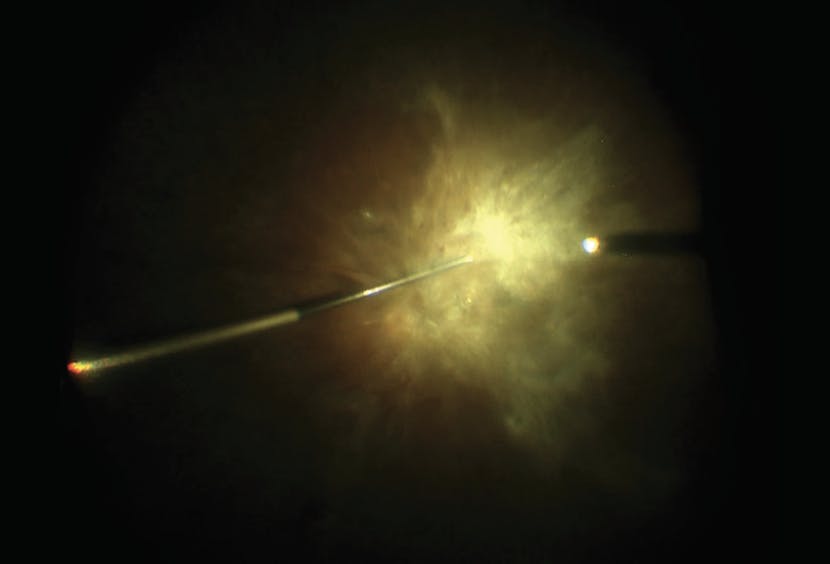
Figure 2. Viscodissection cannula extending through the posterior hyaloid, oriented parallel to the retinal surface. Controlled injection of OVD along with gentle blunt dissection was used to delaminate hyaloid and ERMs from the retinal surface.
Once sufficient separation between the ERM and the retina was achieved using the viscodissection cannula, the vitrector was used to continue segmenting and removing the ERM (Figure 3). The end-grasping forceps were used to manually remove a thick sheet of membrane from the optic nerve head (Figure 4). The remainder of the vitrectomy was carried out, ensuring that the hyaloid was out as close to the vitreous base as possible.


Figure 4. Removal of adherent fibrovascular membranes from the optic disc using endgrasping forceps.
Several retinal breaks were noted inferiorly and all traction surrounding these breaks was removed. A complete fluid-air exchange was carried out, and the retina flattened. Laser retinopexy was applied to the retinal breaks in panretinal fashion for 360° (Figure 5). Given the patient’s monocular status and the presence of several retinal breaks, a decision was made to exchange air for 1000-centistoke silicone oil (Silikon 1000, Alcon) through the 25-gauge cannula for longer-term tamponade.

Figure 5. The vitrectomy was completed and carried out to the vitreous base. A fluid-air exchange was performed and panretinal endolaser photocoagulation was applied.
One week after surgery, the retina was flat and attached under oil (Figure 6). One year after surgery, the retina remains attached after uneventful silicone oil removal, and the patient’s BCVA is 20/100.

Figure 6. Wide-field color photograph 1 week following surgery demonstrating that the retina is flat and attached under oil following removal of the extensive fibrovascular proliferation.

Discussion
This case highlights the use of numerous tools to address extensive fibrovascular proliferation causing a severe diabetic TRD. Since its initial description by Stenkula and Tornquist in 1983, viscodissection has been used sparingly for removal of ERMs.5 Grigorian et al presented a case series of eyes with TRDs that found viscodissection is comparable to more traditional approaches with intraocular scissors and pick dissection.6 The design of the viscodissection cannula described by Fortun and Hubbard allows for efficient viscodissection. Its curved design and ability to be extended or retracted, along with footpedal control for delivery of the OVD allow for precise intraocular movements. Access to these broad membranes is often limited because of their close association with the posterior hyaloid. The dissection planes created by the viscodissection cannula enable safer segmentation and membrane removal using the vitreous cutter.
Conclusion
Combined viscodissection and delamination remains a valuable tool in the vitreoretinal surgeon’s armamentarium against extensive epiretinal fibrovascular proliferation in severe PDR. Successful anatomic and functional outcomes can be achieved when viscodissection is used in conjunction with other more traditional surgical techniques and small-gauge vitrectomy.
1. Altan T, Acar N, Kapran Z, Unver YB, Ozdogan S. Transconjunctival 25-gauge sutureless vitrectomy and silicone oil injection in diabetic tractional retinal detachment. Retina. 2008;28(9):1201-1206.
2. Stenkula S, Ivert L, Gislason I, et al. The use of sodium-hyaluronate (Healon) in the treatment of retinal detachment. Ophthalmic Surg. 1981;12(6):435-437.
3. Stenkula S, Ivert L, Berglin L, Crafoord S. Healon Yellow as a surgical tool in maneuvering intraocular tissues. Ophthalmic Surg. 1992;23(10):708-710.
4. Fortun JA, Hubbard GB 3rd. New viscodissection instrument for use with microincisional vitrectomy in the treatment of diabetic tractional retinal detachments. Arch Ophthalmol. 2011;129(3):352-355.
5. Stenkula S, Tornquist R. Use of Healon in vitrectomy and difficult retinal detachments. In: Miller D, Stegman R, eds. Healon (Sodium Hyaluronate): A Guide to Its Use in Ophthalmic Surgery. New York, NY: Wiley; 1983:207-221.
6. Grigorian RA, Castellarin A, Bhagat N, et al. Use of viscodissection and silicone oil in vitrectomy for severe diabetic retinopathy. Semin Ophthalmol. 2003;18(3):121-126.
