


CASE
A 57-year-old man was referred to the retina clinic by his primary care provider for a routine diabetic eye examination. He had no visual complaints and no history of retinal pathology. He had attended annual diabetic eye examinations for the past 12 years.
His medical history was notable for type 1 diabetes with no insulin requirement and hyperlipidemia. He had undergone a pancreatic transplant in 2015 due to uncontrolled diabetes and islet cell dysfunction. Since his transplant, his hemoglobin A1C had normalized, and he was instructed to stop taking oral diabetic medication. His ocular history was significant for cataract surgery in each eye in 2017.
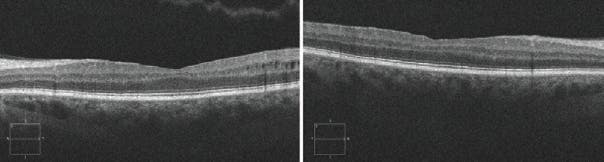
Examination revealed UCVA of 20/25 OD and 20/15 OS, normal IOPs, and well-centered IOLs. Dilated fundus examination revealed asteroid hyalosis in the right eye, clear vitreous in the left eye, and healthy nerves with a cup-to-disc ratio of 0.3 in each eye. Both eyes had prominent arteriovenous nicking changes, diffuse dot-blot hemorrhages in all peripheral quadrants, mild venous engorgement, and neovascularization along the superior and inferior temporal arcades. Rare macular dot-blot hemorrhages were appreciated (Figure 1). Fluorescein angiography revealed delayed arteriovenous filling time, peripheral nonperfusion, several areas of neovascularization leakage, and leaking microaneurysms in the macula (Figure 2). OCT revealed trace macular edema (Figure 3).
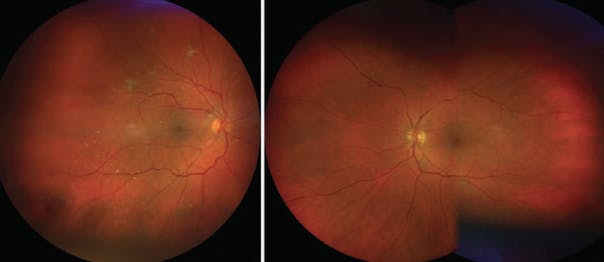
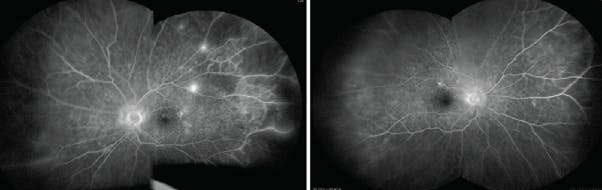
Figure 2. Fluorescein angiography revealed several findings, including delayed arteriovenous filling time, peripheral nonperfusion, neovascularization leakage, and leaking microaneurysms in the macula.
At this time, working diagnoses of ocular ischemic syndrome (OIS), venous stasis retinopathy, and delayed-onset proliferative diabetic retinopathy were considered. Bloodwork and a carotid ultrasound were ordered, and the patient was scheduled to return for panretinal photocoagulation.
Before his return for laser treatment, the patient presented to the emergency department due to fatigue and dizziness and was found to have leukocytosis with a white blood cell count of 80,000/mm3, which was predominately neutrophilia. A peripheral smear in the emergency department showed rare blast forms with a predominance of mature neutrophils suggestive of a myeloproliferative disorder. He was scheduled to see hematology/oncology the next day.
At the oncology clinic, the patient’s leukocytosis had increased, with a white blood cell count of 114,000/mm3 with elevated cells of various progression within the myeloid lineage. No blasts were noted on a peripheral smear.
At that time, the patient was given a presumptive diagnosis of chronic myelogenous leukemia (CML), peripheral blood was drawn for a Philadelphia chromosome (BCR-ABL PCR) test, and the patient was started on hydroxyurea to lessen the chance of leukostasis. Bone marrow biopsy revealed left-shifted myeloid hyperplasia with no increase in blast cells or evidence of abnormal lymphoid or plasma cell populations. Philadelphia chromosome translocation was seen in all cells, consistent with CML. The patient was started on dasatinib (Sprycel, Bristol Myers Squibb), and improvement of his BCR-ABL percentage, clinical symptoms, and blood counts followed. The patient completed panretinal photocoagulation and is being followed to see if the retinal findings resolve.
DISCUSSION
OIS is a rare condition stemming from prolonged ocular hypoperfusion. Mean age at onset is 65 years, it is twice as common in men as women, and there is bilateral involvement in up to 22% of cases.1,2 The incidence is estimated to be 7.5 per million, although this number may be artificially low as OIS is frequently misdiagnosed. There is a high 5-year mortality rate associated with OIS, especially due to cardiovascular disease.2
The term venous stasis retinopathy describes the posterior segment findings of OIS, such as retinal artery narrowing and retinal vein dilation.3 Retinal hemorrhages, usually in the external layers in the midperiphery, small in number and rarely confluent, are characteristic and seen in 80% of affected eyes.1 Microaneurysms are frequently seen in both the macula and the midperiphery.
Among the first manifestations of OIS are diffuse macular capillary telangiectasias that, combined with microaneurysms, lead to macular edema. Neovascular glaucoma may lead to quick progression of optic disc damage, though this may also be due to ischemia of the optic disc and reduction of retrobulbar blood flow.1 Ischemia of the retina may also lead to increased production of VEGF. Neovascularization may occur, more often at the optic disc than the retina, which may lead to vitreous hemorrhages. Other signs of OIS include cotton-wool spots, chorioretinal atrophy, choroidal neovascular membrane, and anterior or posterior ischemic optic neuropathy.1
In 90% of patients, OIS will present with vision loss, usually related to chronic or acute retinal ischemia or damage to the optic nerve from secondary glaucoma.1 Vision loss is often gradual, with 67% of patients experiencing loss over weeks to months. Although many patients will present with relatively good vision—43% with a VA of 20/20 to 20/50—after 1 year of follow-up, 58% of all eyes will have VA ≤ counting fingers.4
Anterior segment signs are not uncommon in OIS. Roughly 66% of patients will experience neovascularization of the iris and iridocorneal angle; however, only 50% will have elevated IOP or neovascular glaucoma.1
Fluorescein angiography in OIS will demonstrate a prolonged arm-to-choroid and arm-to-retina circulation time, with the affected eyes in 60% of patients taking a minute or longer to fill. The most sensitive sign is prolonged retinal arteriovenous time, present in 95% of cases. This, however, is nonspecific. Staining of major retinal vessels and their branches in late phase angiography is seen in 85% of eyes, possibly due to endothelial cell damage secondary to chronic ischemia.1
The differential diagnosis of OIS includes occlusion of either the internal or common carotid artery, carotid aneurysm, giant cell arteritis, fibrovascular dysplasia, inflammatory conditions, diabetic retinopathy, and central retinal vein occlusion (CRVO).2,5,6 OIS, unlike CRVO, does not present with dilated and tortuous retinal veins. OIS may be differentiated from diabetic retinopathy by an absence of hard exudates and fewer retinal hemorrhages. Neither CRVO nor diabetic retinopathy show retinal arterial stasis or choroidal filling defects.1 Additionally, the differential diagnosis for OIS should include hyperviscosity syndromes and autoimmune uveitis, which may be seen in hematologic and oncologic disorders.
Uncommonly, the retina can be infiltrated by neoplastic cells and affected by anemias and hyperviscosity syndromes associated with leukemia. Leukemic retinopathy (present in 36% to 50% of newly diagnosed acute myeloid leukemia patients) may present with intraretinal hemorrhages (24%), white-centered retinal hemorrhages (11%), and cotton-wool spots (16%).7
Extreme leukocytosis, as was seen in our patient, can lead to peripheral nonperfusion and neovascularization. In a review of chronic leukemias, prolonged leukocytosis was associated with vascular stagnation, peripheral capillary dropout, microaneurysm formation, and, rarely, proliferative retinopathy.8 That review included no patients with proliferative retinopathy, which the authors noted was likely due to maintenance of leukocyte counts under 50,000/mm3. There are, however, two notable studies of CML leading to proliferative retinopathy with a striking resemblance to sickle cell retinopathy.9,10
Treatment of ocular manifestations of leukemia builds on systemic modalities such as chemotherapy and biologic therapies.11 Because systemic therapies may not be adequate due to poor penetration to ocular structures, local therapeutic approaches including intravitreal injections of dexamethasone, anti-VEGF agents, or methotrexate have been investigated.11 Intravitreal methotrexate is thought to be effective as an adjunctive treatment in the absence of systemic active disease in the blood or bone marrow, based on a small investigation.11
Treatment of OIS is often complex and multifactorial. Although visual changes associated with OIS are often irreversible, it is important to treat the associated excessive VEGF production. Ablation of the peripheral retina via panretinal photocoagulation is indicated in patients with neovascularization in the anterior or posterior segment; however, this is effective in only 36% of patients because choroidal ischemia alone is enough to prompt production of VEGF.1
Additionally, elevated IOP should be treated with topical IOP-lowering therapy and may require a glaucoma specialist to comanage, especially for patients who develop neovascular glaucoma.
CONCLUSION
For all patients with OIS, a multidisciplinary approach is necessary to find the underlying etiology, especially given the high mortality rates associated with this condition. Although the most common cause is carotid occlusion, hematologic malignancies must remain in the differential diagnosis. It is unlikely that vision losses associated with OIS can be completely reversed, so preventing progression is the main target of therapy.
1. Terelak-Borys B, Skonieczna K, Grabska-Liberek I. Ocular ischemic syndrome - a systematic review. Med Sci Monit. 2012;18(8):RA138-RA144.
2. Mendrinos E, Machinis TG, Pournaras CJ. Ocular ischemic syndrome. Surv Ophthalmol. 2010;55(1):2-34.
3. Duker JS, Magargal LE, Stubbs GW. Quadrantic venous-stasis retinopathy secondary to an embolic branch retinal artery obstruction. Ophthalmology. 1990;97(2):167-170.
4. Sivalingam A, Brown GC, Magargal LE. The ocular ischemic syndrome. III. Visual prognosis and the effect of treatment. Int Ophthalmol. 1991;15(1):15-20.
5. Brown GC, Magargal LE. The ocular ischemic syndrome. Clinical, fluorescein angiographic and carotid angiographic features. Int Ophthalmol. 1988;11(4):239-251.
6. Mizener JB, Podhajsky P, Hayreh SS. Ocular ischemic syndrome. Ophthalmology. 1997;104(5):859-864.
7. Talcott KE, Garg RJ, Garg SJ. Ophthalmic manifestations of leukemia. Curr Opin Ophthalmol. 2016;27(6):545-551.
8. Jampol LM, Goldberg MF, Busse B. Peripheral retinal microaneurysms in chronic leukemia. Am J Ophthalmol. 1975;80(2):242-248.
9. Morse PH, McCready JL. Peripheral retinal neovascularization in chronic myelocytic leukemia. Am J Ophthalmol. 1971;72(5):975-978.
10. Frank RN, Ryan SJ Jr. Peripheral retinal neovascularization with chronic myelogenous leukemia. Arch Ophthalmol. 1972;87(5):585-589.
11. Vishnevskia-Dai V, Sella King S, Lekach R, Fabian ID, Zloto O. Ocular manifestations of leukemia and results of treatment with intravitreal methotrexate. Sci Rep. 2020;10(1):1994.


_1784132761.jpg?auto=compress,format&w=75)





